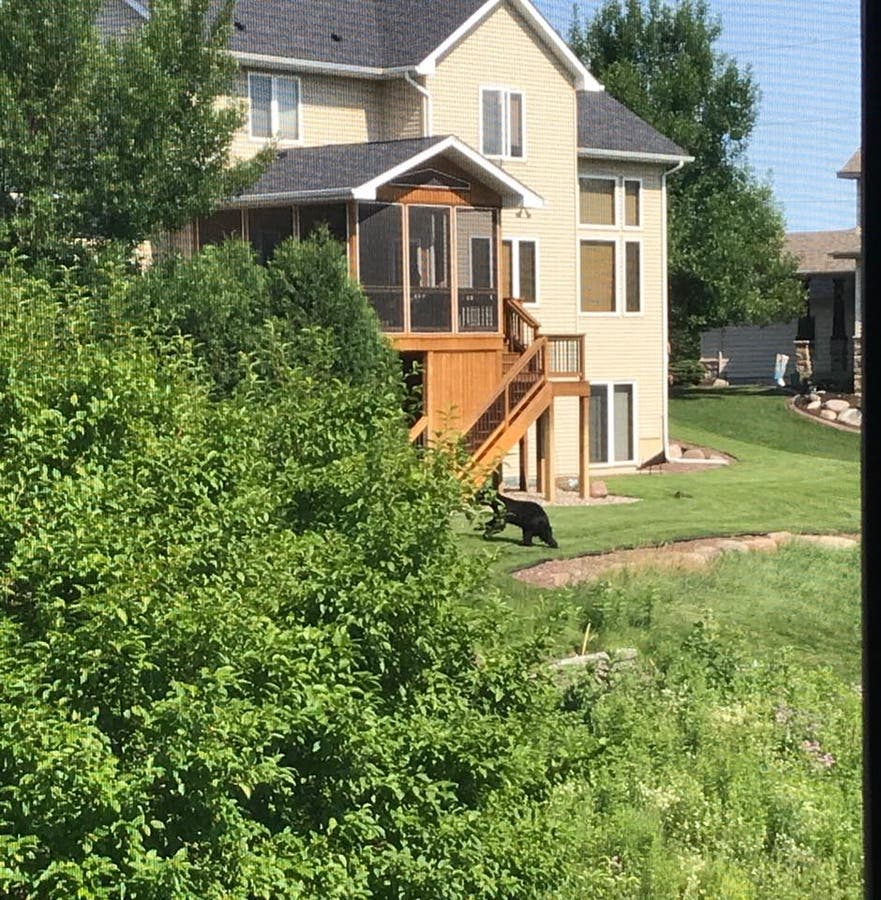

Chaska Police Department said it has received reports of a bear sighting in the area of Cascade Drive and Guardian Angels Cemetery in Chaska. The MN DNR is aware and is responding to the area. Keep your distance from the bear if you see it.
Meanwhile, the Star Tribune reports that Minnesota’s new “bear watch” tool is surprisingly active.
In a story headlined: ”New DNR tool shows black bears lumbering beyond their usual Minnesota range,” the newspaper reports researchers say they've been surprised by the number of bear sightings in the Twin Cities and further south.
Find out what's happening in Eden Prairiefor free with the latest updates from Patch.
Many more sightings have been pinned to the online map (https://www.dnr.state.mn.us/hunting/bear/bear-sightings.html) around the Twin Cities since the tool went live in May, including more than 40 in Anoka County.
“We didn’t expect to see this many sightings in the Twin Cities area or south of there,” said Dave Garshelis, a research biologist with the Minnesota Department of Natural Resources. He cautioned against reading too much into the data, however.
Find out what's happening in Eden Prairiefor free with the latest updates from Patch.
“This is the first chance for people to actually report stuff in a formal way, and so obviously we’re seeing what appears to be a lot of sightings compared to — nothing. We don’t have a baseline,” Garshelis said. “It’s not really clear that this is represents any kind of an increase. When you look at the map you think, ‘Oh, wow, it seems like a lot of bear sightings. It must be that there’s bears moving in.’ But we don’t really know that.”
Minnesota has an estimated 12,000 to 15,000 bears. While some posit that the bears in southern Minnesota are juvenile males pushed out of their territory in the north by an expanding population, Garshelis suspects that a number of the bears sighted near the Twin Cities and farther south wandered into the state from Wisconsin. He says Wisconsin’s bear population has been growing for years, and the state has a “very restrictive” harvest by hunters — the bears’ only natural enemy.
Wisconsin has an estimated 29,000 bears, up from just over 9,000 in the late 1980s, which has pushed more bears farther south. Scott Walter, large-carnivore specialist with the Wisconsin Department of Natural Resources, said for the past couple of decades bears have been moving from their typical range in the north to the southern part of the state, a trend that has accelerated in the past five to 10 years. He said when male bears reach about 18 months of age, they get pushed out to find their own territory.
Minnesota is not alone. News reports in the Charlotte (N.C.) Observer, Pensacola (Fla.) News Journal and the Buffalo (N.Y.) News have reported increased bear sightings attributable to growing bear populations. Bear experts advise learning to live with the animals.