Health & Fitness
NatureLit Blog: THE SALAMANDER ROOM Brings Ecology Home
On the NatureLit blog, Christine Petersen reviews nature-themed children's literature.
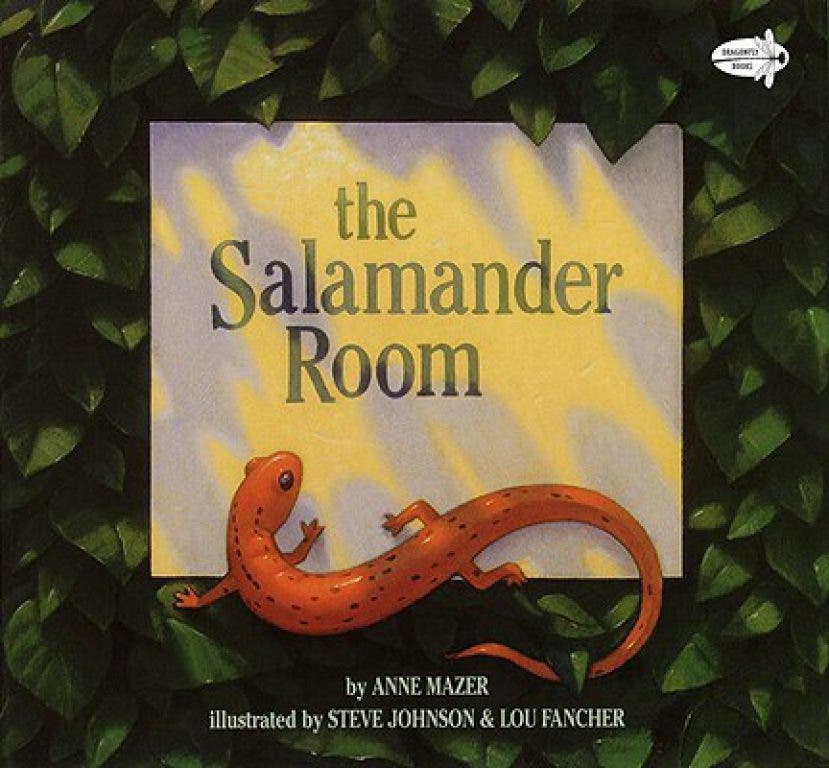
To learn which books a child loves most, you could inquire. But the evidence can often be seen in the books themselves. Through devoted rereading, the corners of a child's most beloved books become soft and frayed; cracks form along their fragile spines, and pages must be taped to repair tears incurred from enthusiastic turning. The Salamander Room (Dragonfly Books, 1991), written by Anne Mazer and illustrated by Steve Johnson, was among the first books my son singled out for this kind of tough love.
***
Find out what's happening in Hopkinsfor free with the latest updates from Patch.
The Salamander Room begins when Brian, a boy of about five, finds a fiery orange salamander on the forest floor. Smitten, he brings the animal home. Most of the story is told through dialogue. Brian’s mother—who, admirably, shows no sign of squeamishness at this new arrival—poses guiding questions that encourage the boy to consider what a salamander needs to be at home. The boy’s prosaic answers reveal the power of a child’s imagination.
Author Anne Mazer captures the expansive enthusiasm of a small child, yet keeps his ideas grounded in ecology. As a result, this charming story is also an effective educational tool. Through Brian, we learn about the salamander's needs for survival (food, water, shelter, appropriate temperature, etc.), its place on a food web within a temperate forest habitat, and even hear about the components required for photosynthesis. These messages come through without being weighed down by scientific terminology that would confuse and distract young readers. Also integral to the story is an ethical question that will spark the thinking of older kids: Should wild animals be kept as pets?
Steve Johnson, a native Minnesotan who studied at St. Paul's School of Associated Arts, provides illustrations that almost seem to come alive on the page. If that description sounds trite, consider this progression of events. The first two-page spread depicts Brian as he discovers the salamander under a pile of autumn-dry leaves. Here, the art is tidily framed by a white border. When the boy returns home and begins answering his mother’s questions, the illustrations become less contained. At first the changes are small—just a few leaves hanging over the edge of a frame here, a salamander's tail dangling there. Within a few pages, however, a multitude of creatures are creeping and fluttering around the text. Eventually an entire forest—complete with mature trees and a lily pad-studded pond—spills across the pages. The transition is so complete that Brian's dialogue must float atop foliage, tree trunks, and a luminous sky.
Mazer offers no grand moral to wrap up the package. Brian and the salamander simply fall asleep, side-by-side in a starlit forest. We understand, without being told so, that this is the salamander's "room.” It’s equally clear that Brian can imagine loving the forest like his own home.
While adults may recognize elements of magical realism in The Salamander Room, young children might reply that reality is magical. Until they are taught otherwise, children often don’t lay boundaries between humanity and the natural or metaphysical worlds. They value stories that show this perspective, and will return to them again and again. With that in mind, expect your copy of The Salamander Room to become ragged with use. Not to worry. As we learned from the Velveteen Rabbit, this only proves that it is Real.
***
Find out what's happening in Hopkinsfor free with the latest updates from Patch.
Young readers may be inspired, as I was, to find the many animals Steve Johnson has hidden in the pages of The Salamander Room. In addition to three salamander species (possibly the mud salamander, spotted salamander, and red-lined salamander), this "habitat" includes a multitide of insects, spiders, and songbirds. Children who live east of the Rocky Mountains will recognize some of these creatures from their own backyards and local parks. Less familiar species can be identified using a magnifying glass and a field guide.
I’ve included a partial list below. Can you locate these animals? What can you add to the list?
- Northern cardinal
- American goldfinch
- Eastern bluebird
- tree swallow
- black-capped chickadee
- painted bunting
- vermillion flycatcher
- monarch butterfly
- Eastern swallowtail butterfly
- woolly bear caterpillar
- red skimmer dragonfly