Community Corner
(OPINION) Budget Deal: Structural deficits, fun with shifts and borrowing and the tradeoffs for Hopkins Public Schools
Hopkins Public Schools' director of business services discusses the deal to end the shutdown.

(Editor's note: John Toop is director of business services at . He drafted this op-ed after that Gov. Mark Dayton and Republican legislators had agreed to a deal that would end the shutdown. Since then, the sides the final details as expected.)
The government shutdown is apparently over and now we get to see the real ramifications of what our elected officials will be passing in the next few days. What kind of bill will end up finally being passed? Will there be any structural education policy or collective bargaining reforms that remain in the bill? Since Governor Dayton stated he wanted no policy reforms as part of his compromise agreement, it appears likely there will none, or very limited reforms, in the K-12 bill. Regardless, the final budget deal ended up as a not so good deal for K-12 by further delaying, or “shifting” in legislative parlance, payments to school districts. Was there a tradeoff? Probably, in the sense that we received a shift instead of an outright cut in funding, as some other states have done. So that’s the good news out of this budget deal for K-12. However, this additional “shift” will have a potential continuing impact on the legislature’s future capacity to increase education funding. Unless we can get the Minnesota economy humming again, we are in for a repeat performance of a sizable budget deficit as soon as the next biennium. But I digress from the issue at hand, which is what this budget deal means as far as tradeoffs for Hopkins Public Schools.
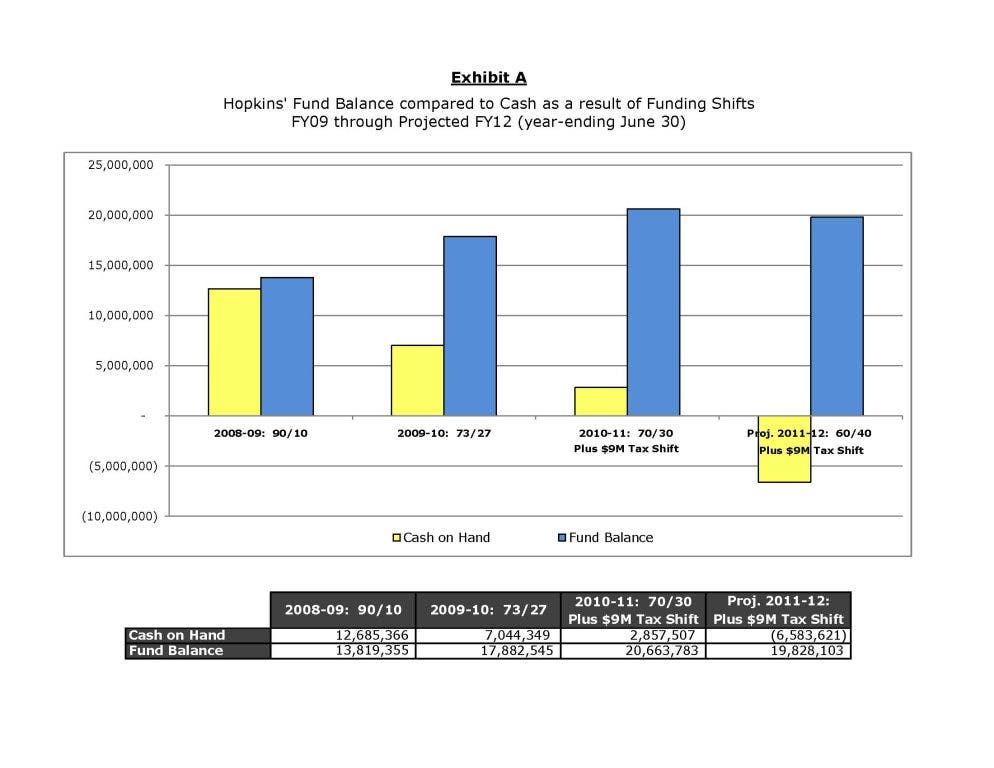
From a global perspective, the “shifting” of payments to future years helps the State balance their books currently, while Hopkins Public Schools gets to record on our books a larger receivable (IOU) than we usually would. In the past, the State paid us 90% of what they estimated they would owe us during the year and withheld 10%, which was paid in the following year when final figures were known. In the past three years we have went from this “normal” 90/10 pay schedule of state aid to 73/27, 70/30, and now for this upcoming biennium, 60/40. Exhibit A shows our actual and projected operating fund balance vs. our actual and projected cash on hand for FY09 through projected FY12.
Find out what's happening in Hopkinsfor free with the latest updates from Patch.
(Click on the graph to the right to view Exhibit A. —Ed.)
Without funding shifts there is usually a high correlation between fund balance and cash on hand. With funding shifts this correlation begins to erode quite quickly. Because the State is on a cash basis of accounting, this 30% decrease has “saved” the state $2.1 billion and allowed the budget to be balanced, (but not really, because they say they are good for it later, which is the only way we can truly record it as a receivable).
Find out what's happening in Hopkinsfor free with the latest updates from Patch.
When people talk about structural deficits this is exactly what they are talking about. The good news to know is that whenever the State has done this to school districts in the past, they have always paid the money back. The bad news is that sometimes it has taken a very long time. One last, oh by the way, bad news thing: The State has also done this with local property tax levies, shifting 48.6% of our “shiftable” school property tax levies, or $600 million, into the current year, so that they could reduce state aid by the same amount they require us to recognize early. Impact to Hopkins cash is $8.7 million.
So let’s add this up and look at the impact for Hopkins. $2.1 billion in deferred state aid plus another $600 million in early levy recognition equals $2.7 billion that will need to be paid back to schools at some point in the future. What kind of impact will this have or has it had on Hopkins so far? Well, the good news is that so far, none, other than some lost interest earnings, which at this point because of the low interest rates is minimal. The bad news is this upcoming “shift” to 60/40 will likely put us in a borrowing position of $6 million. There’s other good news though, because the State is increasing the per student formula allowance by $50 per student for each year of the upcoming biennium, with the intention we can use this money to offset any borrowing costs. That is less than a 1% increase per year, but for Hopkins I can pretty safely say that it will more than offset the costs of borrowing that we will have at current rates for borrowing.
Well then, is there any really, really bad news about this shifting, because it sure sounds like we are being made whole and then some right? I would say the answer to that for Hopkins is yes, but the answer for other school districts may not be. Here’s why: Hopkins’ fund balance (reserves or savings account) is very strong, which has enabled us to withstand the previous “shifting” without having to do any cash flow borrowing. Other school districts may not have as strong a reserve as Hopkins, which means they will have to borrow more than they are already borrowing, which could exceed their total cost of borrowing to more than $50 per student. An example: In my previous experience at a 1,000 student district, if they have to borrow more than $5 million at 1% interest for a year it will exceed the increase of $50 per student for the year and they will be a net loser in the borrowing game for that year. Also, what happens if interest rates go up, pushing the costs of borrowing up even further?
Hopkins receives about $58 million in state aid this coming year and 30% of that is $17.4 million, plus the property tax shift for Hopkins is about $8.7 million, for a total borrowed by the State from Hopkins Public Schools of $26.1 million. It’s only this last $6 million of the $26.1 million that we will need to borrow in FY12, but if our reserves start decline we will likely need to borrow more later. This in and of itself is not bad news, if you can couple it with little or no salary and benefit increases for all staff, which comprises about 80% of our General Fund budget. I am hopeful that our bargaining groups will have an appreciation of the extraordinary times we are in, and negotiate accordingly, so that we can keep the impact to student class size increases minimal.
The last issue to communicate is probably the most important. The true statewide impact associated with borrowing against the future remains to be seen, but it will impact subsequent biennia. Let’s say the $2.7 billion is repaid over 10 years at $270 million per year, or $540 million per biennium. I have seen numbers that show the $50 per student increase each year of this biennium is scheduled to cost the State $128 million. The payback amount per biennia is 4 times that amount, which means that paying it back in this fashion could be looked at as a minimal equivalent of about a $200 per student increase each biennium for the next five biennial budgets. That’s a hole that will be tough to dig out of, not to mention the fact, again, because the State is on the cash basis of accounting, the payback will be counted as an increase of $540 million to education funding each biennium. The true impact of this “shifting” will be played out in the future and will likely impact Hopkins Public Schools and every school district in the State, with minimal, if any, future additional funding available for K-12. The best thing that can happen for K-12, in my opinion, is that we get our State economy growing strong as quickly as possible, so the “shift” can be paid back as soon as possible.