Community Corner
How Do Designers Shape The Simulators They Create?
Patch talks with two designers about how their choices influence the way their games portray the real world.


With the release of SimCity coming tomorrow, Patch wanted to find out why designers of simulation-style games make the choices they do—and how those choices impact players’ perceptions of the real world.
Patch interviewed two designers via e-mail: Scottish game designer Chris Sawyer and England-based designer Cliff Harris, founder of Positech Games. Check out what they have to say and then share your thoughts in the comments below.
Related Content: Click here to find out what SimCity has to say about Southwest LRT. Click here to see how gamers think simulations like SimCity influence their opinions on public policy (or don’t).
Find out what's happening in Hopkinsfor free with the latest updates from Patch.
Find out what's happening in Hopkinsfor free with the latest updates from Patch.
***
Patch: What were the major assumptions you had to make when building your model (for Locomotion)?
Sawyer: The whole game design was based on the assumption that people will pay for items to be transported from somewhere that produces it to somewhere where it's needed. Expanding this further - the model presumes that the further you transport something the more you get paid, and the quicker you transport something the more you get paid. The model is simple though - it doesn't take into account any preference for where cargo or people want to go - As long as they are delivered to somewhere that accepts them then you get paid.
Patch: How much is your own worldview reflected in the game's design choices?
Sawyer: I have a personal bias towards railways so that might well be reflected in the game design!
Patch: Could you provide an example of a choice you had to make and why you made the decision you did?
Sawyer: When designing a simulation/strategy game it's always difficult to choose the right balance between realism and fun. For example setting the scale of the game world in the game - If we'd set the scale correctly then you'd have to wait several hours for a train to transport items a reasonable distance, which wouldn't be much fun would it? The landscape scale (and the time scale) is designed so that hopefully the game progresses fast enough to be fun while not being too unrealistic.
Patch: Was there a particular theme or message that he wanted players to take away from the game? How did his model contribute toward the communication of that theme or message?
Sawyer: I've not really thought about that. I really only set out to create a fun game to play, a positive game where you are rewarded for good construction and management skills.
Patch: Does Locomotion privilege one form of transportation over another? If so, why?
Sawyer: Yes it does but it's all pros and cons rather than favouring one form of transport as always being better than another. That's actually one of the fundamentals of the game design, that the player has to choose and design the appropriate type of transport for the given conditions at the time - whether that be road based services for smaller quantities of cargo or when the budget is small, or trains where large amounts need transporting over medium distances, or aircraft over long distances and where speed is important, or even ships where quantity and cost is important rather than speed. There shouldn't be any worthless transport types in the game - They all have their uses.
Patch: What conclusions are players likely to draw about real-world transportation systems after playing Locomotion?
Sawyer: Not sure really - Perhaps they will understand better how the different types of transport all have their uses and that no method of transport is always better than another. And perhaps they'll appreciate how complicated a large transport system is to build and run!
Patch: Compared to other media (books, film, paintings, etc.), are games more or less likely to filter the real world through a specific worldview?
Sawyer: My view is that games should primarily be fun, and that realism usually needs to be adapted or reduced to make a game fun. With the types of games I've done I've reduced the realism to a level where hopefully all you're left with are the fun elements of reality, and ignoring some of the less fun things. That often means scaling the game world and the passing of time differently, or simplifying parts of the world, and even limiting the level of detail. After all many things in the real world probably aren't much fun (like the stress of running a complex transport network...) so the challenge to the game designer is to adapt the design so that it hopefully is fun to play. Making a game more and more realistic isn't necessarily going to make a game more fun to play.
Cliff Harris
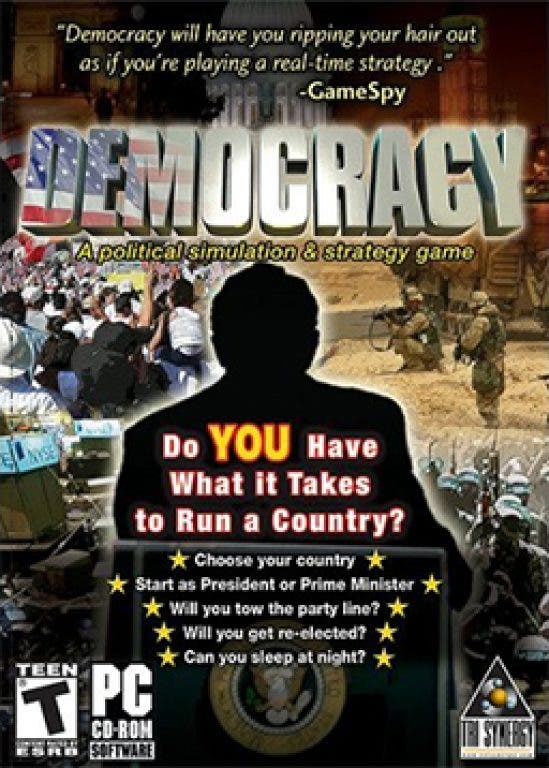
Select games: The Democracy series, Gratuitous Tank Battles
***
Patch: What were the major assumptions you had to make when building your model?
Harris: I had to make a lot of simplifying assumptions. I assumed people acted as rational agents, that they made decisions based upon policy and facts rather than political personalities or their own upbringing, or the media. I assumed that there was only a single opposition party and that a simple majority voting system was in place rather than an electoral college.
Patch: How much is your own worldview reflected in your design choices?
Harris: Hopefully none. I tried very hard to make all of the issues and equations reflect nothing but objective facts. Although I obviously hold political views, they have changed substantially over the years which made this easier, as I could happily empathise with both sides of most debates.
Patch: Can you provide an example of a choice you had to make and why you made the decision you did?
Harris: I left out interest rates from the economic model, which is a huge glaring thing to do, and I made a deliberate decision to do this because if it was included, you then need to include a whole bunch of other variables and effects, and the simulation would have bloated as a result.
Patch: Was there a particular theme or message that you wanted players to take away from your game? How did your model contribute toward the communication of that theme or message?
Harris: I wanted people to appreciate the interconnectedness of policies, and the complexities and ramifications involved in policy change. People don't think two or three moves ahead when it comes to politics, they want lower taxes, or higher government spending on X, but they don't think through the very long term effects that even the slightest policy change can have. I also wanted people to look at politics as a debate over issues and ideas, rather than slogans and personalities. Too much politics is content-free these days.
Patch: Compared to other media (literature, film, paintings, etc.), are games more or less likely to filter the real world through a specific worldview?
Harris: I wouldn't necessarily have said so. The range of people making games
is pretty broad in terms of political views. I guess it tends to be fairly 'western' and younger than some other media. This is why there is a lot of racism in games, especially first-person shooters. There is a lot of testosterone swishing about in game design, and that definitely has an effect. I'd like to see a major triple-A game designed by someone who is older than fifty, and maybe female and non-white. I think only when literally all groups of people across the world are making games will be actually realize how narrow a slice of potential gaming we are currently experiencing.
Get more local news delivered straight to your inbox. Sign up for free Patch newsletters and alerts.