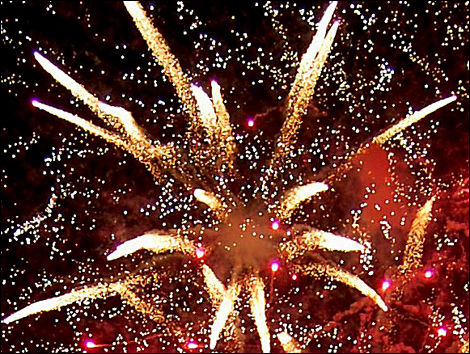
It’s that time of year. Pack the cooler with cold beverages, watermelon and lots of snacks. Throw in some blankets, a couple of chairs and lots of bug spray. And don’t forget sparklers, glow-in-the-dark sticks and Frisbees.
Because it’s time to head to the all-American tradition – to one of more than 14,000 fireworks displays that light up the U.S. skies each 4th of July.
Did you know that a 10 minute fireworks show this year can involve setting off almost a half-ton of explosives? How are these fireworks developed? How do they choreograph them to work with music? And, in today’s increasing environmental awareness, how eco-friendly are they?These pyrotechnics of the sky have come a long way from exploding bamboo when a Chinese monk named Li Tian inserted gunpowder into a bamboo stick, threw it in the fire, and watched it blow up. The Chinese believed the loud bang was powerful enough to scare off evil spirits and began using firecrackers into many religious events.
Find out what's happening in Lakevillefor free with the latest updates from Patch.
Fast forward 1000 years or so.
Modern firework consists of a shell of plastic or heavy paper surrounding compartments separated by cardboard. A compartment at the base of the shell contains gunpowder to propel the firework into the sky from a mortar. A larger compartment contains chunks of a mixture of chemicals (typically metal salts) that produce light and color when heated, which are known as stars. Typically these stars are mixed with gunpowder inside the compartment, which explodes to ignite the stars and scatter them across the sky. Seems fairly straight forward.
Find out what's happening in Lakevillefor free with the latest updates from Patch.
Now add in the requirement to manage the ‘dance’ of these displays with popping and sizzling during the right musical moments. This now becomes the expertise of pyrotechnicians.
You don’t think people are still running around with long torches to light fuses just at the right time, do you? Nope.
According to Popular Mechanics, it can take two hours of planning to execute a single minute of firework choreography with musical accompaniment. These pyrotechnicians can program the whole show from a computer that will tell them what type of firework will explode at what altitude, how long it hang in the air, and what other fireworks should be fired beneath the ‘big frame’ to fill the visual horizon.
What about designing them to be greener and more environmentally friendly? Yes, says a team of scientists at the US Army’s Pyrotechnics Technology and Prototyping Division.
According to the US Army, the worst offending chemical component of fireworks is the oxidizer that sets off the explosion, with the most common types being nitrates, chlorates and perchlorates. Each of these individually are considered environmental pollutants with potential adverse effects on people and wildlife.
Researchers have developed new pyrotechnic formulas that replace perchlorate with materials that burn cleaner and produce less smoke and color-producing chemicals. The challenge is cost. These eco-friendly pyrotechnics are expensive, and it will take time for them to be cost-competitive.
Everyone loves a good fireworks display. It’s about as American as it gets – right up there with baseball and apple pie. Now let’s make them more eco-friendly.
As Independence Day rounds the corner for the 237th time, here’s a look at the biggest pyrotechnic celebrations across the United States.
No matter where you are located, there’s always something special about watching these beautiful displays on a summer evening – oohing, aahing and clapping when each new explosion brings about a colorful shower of twinkling lights. Enjoy. But remember, be safe.