

One great advantage of traveling to Peru is the lack of jetlag, as the country is in the same time zone as Minnesota during our summer. We had a good night's sleep (a bit chilly, but thick wool blankets warded off the cold), ate breakfast and then met our tour guide in the hotel lobby for a private 1/2-day tour of Cusco and the surrounding Inca ruins. Our guide, Mario, was joined by his son (school was out because the national holiday) and a driver as we started out on another sunny, beautiful day.
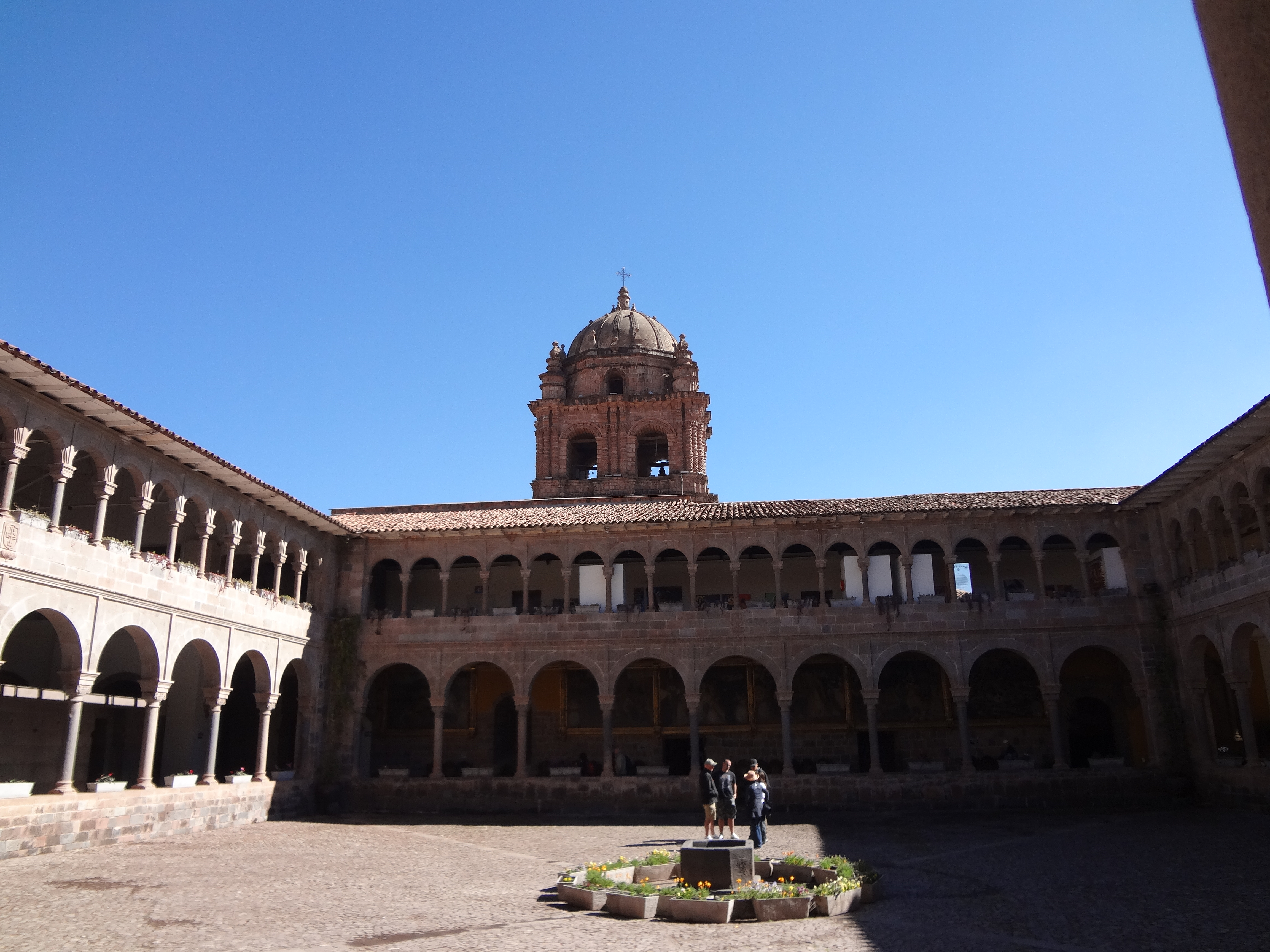
Our first stop was the Qurikancha and the Convent of Santo Domingo. The Qurikancha was an Incan sanctuary dedicated to Inti, their Sun God. When the Spanish invaded the area in the early 1530's, they destroyed most of the site, leaving only part of the fine Incan stonework as a foundation for the construction of the Convent of Santo Domingo. While the convent has suffered damage over the centuries from earthquakes, the Incan stonework has survived in good condition.
We then drove up the valley to a hill on the north end of the city to the famous archaeological site, Sacsaywaman. This large site was used as a fortress and a place for ceremonies. The stonework is incredible, as the Incans fit together large boulders weighing many tons - all without mortar, but with gaps so narrow that one can't fit a piece of paper between the boulders. Scientists today still aren't sure how the Incans accomplished it. The Spanish later used the site as a source of building materials for Cusco. We also stopped at several other, smaller sites in the area that acted as outposts that warned the city of any invasions coming up the Sacred Valley. A stop at the Christo Blanco (White Christ) statue, standing on a hill overlooking the Cusco Valley, offered some terrific views of the city.
Our tour with Mario finished at the Cusco Cathedral, located on the Plaza de Armas in the center of Cusco. Built on the foundation of another Incan temple, this classic building was built between the mid-1500's and mid-1600's. Photos aren't allowed inside, but there are some beautiful examples of paintings and intricate cedar wood carvings. A locally-painted version of the "Last Supper" includes cuy (guinea pig - a popular local cuisine) on the table. Mary is an important figure in this cathedral and is the subject of many paintings and small churches within the site.
After saying farewell to Mario and his son, we ate a late lunch at a restaurant off the plaza and then spent a couple of hours at the Museo Inka (Inca Museum). Photos aren't allowed inside, but there were some very interesting displays of the various peoples and civilizations over the centuries, most of which preceded the Incans. One very interesting display featured several mummies cradled into a fetal position.
We returned to the hotel in the late afternoon and then met the trekking group at 5pm for a briefing. Our G Adventures guide, David, was friendly and gave a very informative overview of the next five days. We had a very interesting (and we were to find out over the coming days, very fun) group of 13 trekkers, all speaking some version of English and ranging in age from 21 to 42: three recently-graduated university students from the UK, four people from Ireland (including newlyweds on their honeymoon), two brothers from Australia, a couple from Canada, and us - the 'old' married couple from the U.S. We then got our porter bag, and after dinner at the hotel, packed up our gear for the trek. While the porters carried about 13 pounds for each person in a bag (sleeping bag, mat and extra clothes), my wife and I each carried about 15 pounds each in a daypack (rain gear, toiletries, extra jacket, first aid kit, headlamp, etc.). Since we had trained in Minnesota for ~6 months by taking long walks each weekend with heavy sandbags in our daypacks, the weight was not a problem.
We went to bed early, eager to finally get started the next day by loading up on the bus at 7:30am and spending the day driving down the Sacred Valley to the town of Ollantaytambo, seeing the picturesque views and ruins along the way.
Next up: We travel down the Sacred Valley and see a local village and several Incan ruins, ending at the town of Ollantaytambo, more than ready to get started on the 4-day hike on the Inca Trail.