Politics & Government
Civic Order Gets Made One Sign On The Door At A Time [OPINION]
A short essay on authority and legitimacy.

April 6, 2026
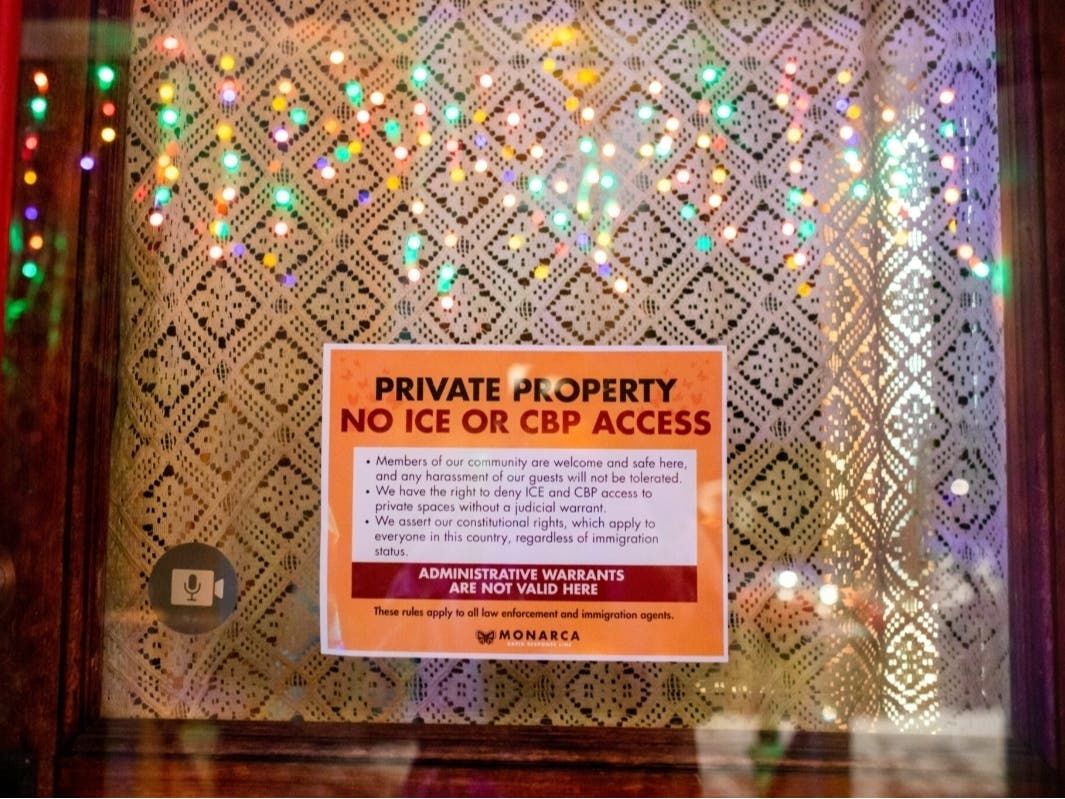
The sign on the door of a restaurant in Northeast Minneapolis is easy to misread. It states that federal agents may not enter without a judicial warrant, and inside, additional signs mark the boundary between public and private space.
Find out what's happening in Minneapolisfor free with the latest updates from Patch.
In another moment, such gestures might be dismissed as political theater. What struck me instead was how ordinary they felt. They were not confrontational or defiant, but procedural. Less protest than housekeeping. What I encountered was not resistance in the spectacular sense, but a quiet reminder of how civic order actually works.
Nothing about the signage felt hostile. It was declarative, yes, but calm. The restaurant was announcing its boundaries before anything else, before menus, before greetings, before the rituals of hospitality could unfold. As someone entering from the outside, I became momentarily aware of myself in a way I had not expected to be when going out to dinner. Not intimidated exactly, but newly conscious of the fact that space, like authority, has rules.
Find out what's happening in Minneapolisfor free with the latest updates from Patch.
The sign on the door felt less like a challenge to authority than a reminder of it. Power, to be legitimate, must still knock, must still explain itself, and must still act through lawful process.
– Richard Hurst
When the young man at the entrance greeted me, and I mentioned that it was my first visit, he replied that the restaurant had been in the neighborhood for many years. The comment seemed almost instinctive, as if the history of the place were part of the greeting itself — a way of situating both the guest and the establishment before anything else happened.
Only later did it occur to me that the management of my presence may, in some sense, have been conditioned on the possibility that I was exactly the kind of person the sign anticipated. I am a white man of a certain age, with a certain haircut, carrying myself in a certain way. Until recently, I worked in a patrol capacity in this city. In a strange sense, the restaurant’s assumptions may not have been entirely wrong. I was not a federal agent, but I was not far removed from the world the sign imagined.
And yet, even in that realization, I did not experience the signage as accusatory. I was not singled out for confrontation or moral judgment. I was being routed through a set of rules that applied regardless of who I was or what authority I might represent. The sign did not accuse. It instructed. It did not escalate. It clarified.
That distinction matters. James Madison worried less about virtuous leaders than about durable systems of restraint. Constitutional order, in his view, did not depend on trust or good intentions alone. It depended on structure, process and the careful drawing of lines. Authority had to exist, but it also had to be bounded. Power had to be acknowledged, but filtered through law and custom before it was allowed to act. What threatened a constitutional system was not authority itself, but authority uncontained and unaccountable.
The restaurant’s signage functioned as a kind of micro-constitutional order. It did not reject the rule of law. It insisted upon it. Federal authority was not denied outright. It was conditioned. A warrant was the price of entry. Public and private spaces were clearly marked, not to provoke conflict, but to prevent it. This was not defiance so much as procedural clarity.
People elsewhere might see a sign like that and read it as partisan provocation or ideological hostility. I did not experience it that way. What I saw was something broader and, frankly, more reassuring. An assertion of democratic habit rather than political rage. Not resistance as spectacle, but resistance as routine. Not a slogan, but an understanding of how authority is supposed to work.
Civic life does not reside only in courts, elections, or formal institutions. It lives in people who know where the lines are, who articulate them calmly, and who expect process to matter. In that sense, the sign on the door felt less like a challenge to authority than a reminder of it. Power, to be legitimate, must still knock, must still explain itself, and must still act through lawful process.
What made the encounter resonate personally was my own position in relation to those boundaries. I am someone from Minneapolis who has been away for several months, returning not quite as a local and not quite as a stranger to the city. I was, in effect, someone whose life straddles both sides of the authority line the restaurant was carefully drawing. The momentary awkwardness I felt on entry was not an accusation. It was a mirror.
The lesson here is not that communities should distrust one another, nor that authority should be treated as inherently suspect. It is that democratic life depends on shared understandings of limits. When those limits are articulated calmly and clearly, on a sign, at a doorway, or in a constitution, they make coexistence possible. They allow strangers to become guests, and power to remain lawful.
Minneapolis, for all its recent upheaval, has not forgotten how to do this kind of civic work. Sometimes it happens in courtrooms or council chambers.
Sometimes it happens on a simple sign posted on a door.
The Minnesota Reformer is an independent, nonprofit news organization dedicated to keeping Minnesotans informed and unearthing stories other outlets can’t or won’t tell..