Schools
Calling All Budding Northfield Inventors, Your Camp is Here
Students entering first through sixth grade have a chance to participate in the week-long Camp Invention at Sibley Elementary.

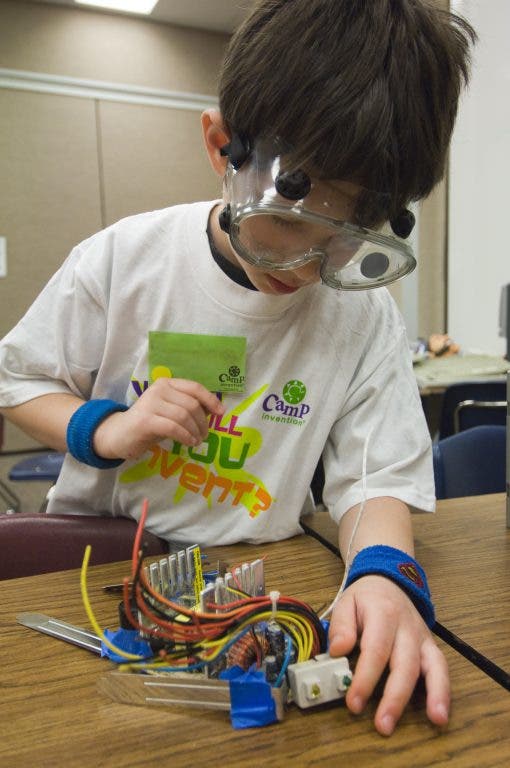


Ready, set, learn.
More than 50 Northfield students are primed to tackle Camp Invention next week when it opens on Monday at under the guidance of third-grade teacher Tony Seidl.
The camp, rooted in science, technology, engineering and math (STEM) education, gives students, who are entering first through sixth grade, an opportunity for a hands-on educational experience that Seidl says his students enjoy when he introduces it in his everyday classroom.
Find out what's happening in Northfieldfor free with the latest updates from Patch.
Students will get the opportunity to work together in the week-long camp to build a clubhouse, decipher mysterious codes and tear apart broken appliances and revamp them into multi-step inventions akin to a Rube Goldberg-type machine, which performs a task.
“I love the idea,” Seidl, in his first year as director, said of the camp.
Find out what's happening in Northfieldfor free with the latest updates from Patch.
And apparently so do children.
Started in 1990 as an outreach program of the National Inventors Hall of Fame Museum, Susan Clarke, regional coordinator for Camp Invention in Minnesota, said the nonprofit has grown to 48 states. Last year, 66,000 kids participated in various summer programs.
“It’s learning with a twist,” Clarke said. “Everything is open-ended. There are no right or wrong answers.”
Camp Invention touts four different programs, which rotate annually through participating schools so kids have a chance to try different activities each year.
This year Northfield is equipped with the SPARK program, which offers five different daily lessons. They are:
• W!LD: Wondrous Innovations and Living Designs module, which give the children an opportunity to learn about inventive animals and their characteristics, like mimicry or snails that create iron-plated armor.
• The Curious Cypher Club, which challenges students to solve a daily coded message to earn materials to build a clubhouse, aimed at building teamwork.
• Bounce! An Atomic Journey, which teaches children about chemistry and physical science where students conduct experiments and create a bouncy ball to take home.
• Game On: Power Play, which challenges children to use nontraditional equipment to play classic games.
• I Can Invent: Edison’s Workshop, which challenges students to tear apart a broken appliance and re-imagine it into a multi-step machine that solves a challenge.
The I Can Invent workshop is the signature unit of Camp Invention and anchors all four programs.
“(The children) would be perfectly happy to do that all week long,” Clarke laughed. “They love investigating how things work.”
At the end of the week, family, friends and community members are invited to Sibley to see what each student made.
“It’s fantastic for the kids to just show off what they have been doing,” Seidl, who will be joined by other teachers and volunteers to lead the camp, said. “It’s a great experience for the parents, too.”
WANT TO SIGN YOUR KID UP?
HOW: You can register by visiting the Camp Invention website or calling 800-968-4332. Walk-ins are welcome on the first day of camp, which starts at 8:30 a.m. Monday at Sibley Elementary.
COST: $210—scholarships are available
WHAT A DAY LOOKS LIKE:
A day at the Camp Invention program is packed with hands-on activities, brainstorming, experimentation, and unbelievable action! Although daily activities are widely diverse and vary based on the program being hosted, as well as the number of participants, here is a quick glimpse of what a typical day of fun at the Camp Invention program looks like...
9 a.m.—Children are signed in by their parents and join their counselor and age-appropriate group at the Base Camp area. During this gathering period each morning, they might build a newspaper tower or learn the Camp Invention cheer.
9:15 a.m.—Children move to their first module, during which they might be crash-landed astronauts on an alien planet! After assessing their strange new surroundings, children might be challenged to design shelters and spacesuits that are able to withstand the planet’s harsh conditions and acid rain.
10:20 a.m.—Children enjoy a morning snack.
10:30 a.m.—Children move to their second module, during which they might find themselves in safety goggles and using real tools to take apart and investigate small appliances.
11:40 a.m.—Half of the children gather in the common area for lunch, while the other half indulges in high-energy games and activities in the gymnasium or outdoors.
12:10 p.m.—Children who ate lunch earlier now work off that energy by switching with the other group, who now gather in the common area for lunch.
1:05 p.m.—Children move to their next module of the day, during which they might explore Newton’s first law of motion by conducting an experiment based on a magician’s tablecloth trick or participating in a relay race that demonstrates the concept of inertia.
2:10 p.m.—Children move to their final module of the day, during which they might clean up a simulated landfill that is leaking toxic chemicals into groundwater.
3:15 p.m.—Children gather in the Base Camp area with their counselor, where they might create a marshmallow sculpture or create soda pop fountains until their parents arrive.
3:30 p.m.—The fun comes to an end, and children are signed out by their parents.
Source: Camp Invention
Get more local news delivered straight to your inbox. Sign up for free Patch newsletters and alerts.