Schools
Going Green at Prairie Creek
How much can you learn from garbage? Math, science and where food comes from, elementary students find.
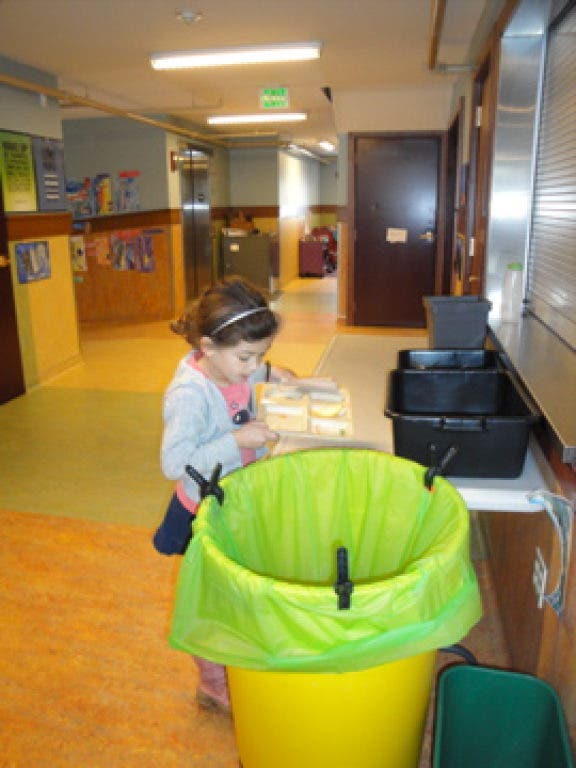


Whack! A first-grader bangs her tray against the side of a trash barrel after eating lunch at Prairie Creek Community School.
Out falls the typical remains of a school lunch—crusts from a PB&J sandwich, a couple of orange peels, a napkin and a stray piece of lettuce. But unlike many school lunch trash barrels, the contents of this one will never see a landfill.
Instead, it will be hauled to a commercial composting facility—the kind that can compost meat and dairy as well as vegetable matter—where what was lunch today will be rich garden compost in a few weeks.
Find out what's happening in Northfieldfor free with the latest updates from Patch.
This fall, received an $11,000 grant from the Minnesota Pollution Control Agency to institute a compost program to reduce the school’s waste from its hot lunch program. Prairie Creek is the smallest of eight institutions statewide to receive the composting grants. (Northfield Public Schools received $29,000 for a similar composting program at , and is also experimenting with composting.)
Only a few months into existence, the Prairie Creek program has dramatically reduced how much trash the school generates while increasing its recyclables. Moreover, the program may save the school money.
Find out what's happening in Northfieldfor free with the latest updates from Patch.
“We originally thought this might cost a little bit more,” said Josie Rawson, a Prairie Creek parent volunteer who coordinates the “Go Green” composting program.
Because garbage tipping fees are lower for recycling and compostibles than trash, the school is now “breaking a little below even” and expects to save money in the long run. More importantly, it has been able to go from a 6-yard dumpster for trash to a 2-yard dumpster, while doubling the number of recycling bins it fills.
Trash in the Classroom
The composting program has also been a boon to learning for the 60 second- and third-graders at the school, who have been charged with teaching other students about the value of composting and its role in the food cycle.
“This fall, we basically lived, breathed and ate compost,” said teacher Molly McGovern Wills.
For three weeks in the fall, the students measured how much trash the school generated before it started composting. The dumpster diving led to lessons on weighing and measuring, how volume is calculated, as well as how much paper was ending up in the trash.
“In their learning, they realized that a whole bunch of stuff that could be recycled was going into the landfill,” said Rawson, whose daughter is a second-grader at the school.
Students also visited the Mulch Store composting facility at Empire—north of Rosemount—to find out how compost was made and they toured Open Hands Community Supported Agriculture farm and the Gardens of Eagan to see how farmers use compost to help plants grow.
“We focused a lot on what is in a compost pile,” said McGovern Will, “and what makes things decompose. We talked about bacteria and fungi and how hot it gets in a compost pile.”
The students later wrote skits and made posters to help teach other students about what could go into the new composting buckets around school, what could be recycled and what needed to go in the trash.
In October, they hosted an “Empty Bowl Dinner,” selling clay bowls they created in art class and soup they made from vegetables they harvested at Gardens of Eagan as a fundraiser for the food shelf at the . The benefit raised more than $1,000.
While the program is now established, the learning continues.
On Earth Day—April 30—the students will host a demonstration and information table at the Riverwalk in downtown Northfield to spread the word about composting.
Reducing Waste, Schoolwide
The composting program is the centerpiece of several efforts at Prairie Creek to reduce waste, said Rawson.
In fall 2009, the school switched food service providers to the in Northfield. Lunches are delivered and served at the school using reusable containers. The school switched to Hastings Creamery and Dairy for its milk because the cartons are available in compostible packaging. It also installed a dishwasher, and parent volunteers help serve lunch each day and then wash the sturdy plastic trays and bowls and metal flatware used at lunch.
Working with its cleaning provider, ServiceMaster by Ayotte, and Waste Management, its garbage hauler, the school added uniform recycling and trash bins to each classroom.
“Surveys show that when the recycling and trash are next to each other and the bins are the same size, the amount of recycling increases,” said Rawson.
The Next Step
Now that students are aware of waste and compost, they are spreading the word to their families. They also will be learning about how compost works in gardens this spring.
While still in the planning stages, the next step will likely be establishing a school garden, said Rawson.
“This spring, we’re hoping to plant a salsa garden,” she said.