

Fulfilling Our Pledge to Protect the Arctic National Wildlife Refuge. President Eisenhower began the bipartisan legacy of protecting this area for future generations over a half century ago when he set aside 8.9 million acres as the Arctic National Wildlife Range in 1960. At that time, Alaska was made a state and given the right to select 103,000,000 acres for use as an economic and tax base. Eleven years later the Alaska Native Claims Settlement Act froze development on federal lands, including the Arctic National Wildlife Range, pending final selection of parks, monuments, and refuges.
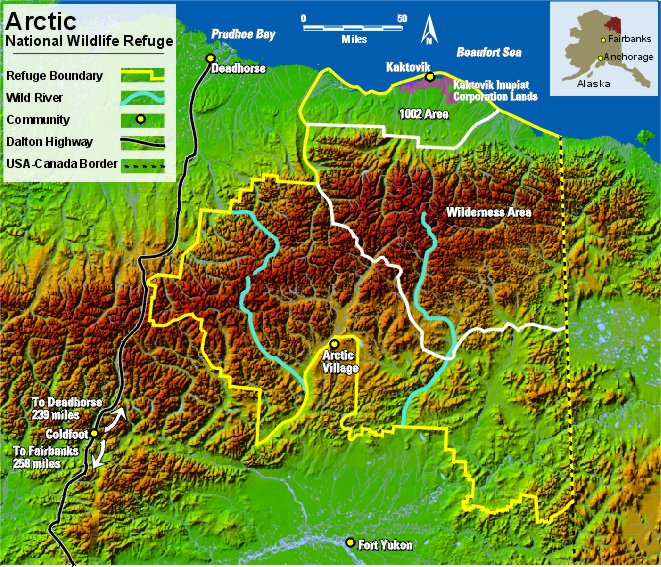
On December 2, 1980, the Alaska National Interest Lands Conservation Act was enacted. It created 104,000,000 acres of national parks, wildlife refuges and wilderness areas from federal land holdings. In order to get it passed, section 10-02 of the Arctic National Wildlife Refuge, that part of the refuge on the northern shore of the Refuge was carved out, to be evaluated from surface geological studies and seismic exploration surveys.
As a result of those studies, it was determined that there was likely oil to be recovered from this area. It should be noted that to the west of Section 10-02 is Prudhoe Bay oil fields and pipeline. Further west of this area is the National Petroleum Reserve of Alaska (NPR-A), an area considerably larger than the Arctic National Wildlife Refuge.
There have been opposing efforts over the years since 1980 to either close development or open section 10-02 to oil development. The arguments for are simple, there is oil there and it should be recovered. The arguments against are more complex. This area is the birthing area of 1.9 million Porcupine caribou, hundreds of bird species and many mammals, ranging from Musk Oxen to Polar Bears.
The arctic tundra of section 10-02 is very fragile and it is likely that oil development would compromise this wildlife. In contrast to the area west of section 10-02, there is considerable land between the sea and the Brooks Range, allowing for migration of the animals and birds, or as is the case in the "western" reserve (NPR-A), it was possible for all sides of the issue to work together to identify areas that should be protected and those that would be suitable for oil development. Section 10-02 is not wide enough to permit multiple uses.
The Gwich'in Indians located their communities along the migration routes of the caribou to their birthing area in Section 10-02. They depend on the caribou for food, clothing and their livelihoods. Oil development would disrupt the migration and likely compromise their sustainability. The Gwich'in Indians, the Inupiat Eskimos and other native people have opposed oil development in section 10-02. Section 10-02 represents less than 5% of the northern coast of Alaska and its development would have little to no impact on the price of oil in the United States.
Over 100 Indian Tribes and numerous environmental justice organizations support the Gwich'in people and so does the government of Canada which has created two national parks to the immediate east of Section 10-02, along the Yukon border with Alaska. In fact there is a signed treaty between the United States and Canada calling for protection of the Porcupine Caribou herd and its birthing area in Section 10-02.
It would take an act of Congress to open up the area for oil development. So far this hasn't happened. However, there have been efforts to do so in Congress. In March, 1989 a bill permitting oil drilling in section 10-02 was "sailing through" the Senate when the Exxon Valdez oil spill delayed and ultimately derailed the process. The Bush administration pressed Congress to reverse the ban on offshore drilling. In 2006 there was an oil spill off the northern shore and 2013, Shell Oil stopped it's offshore drilling.
Today, with the recent discovery of huge oil deposits in North Dakota has taken the pressure off of the Northern coast of Alaska. This may be the best time to pass legislation to provide Section 10-02 permanent protection, by designating it "wilderness status." At the same time there is new pressure coming from Alaskan oil interests, to drill and expand the pipeline into Section 10-02, even though there is considerable undeveloped areas in the agreed on areas of the western reserve. For this reason, the Alaska Wilderness League in coalition with many other organizations is working to pass HR 139 to protect Section 10-02. There are over 100 authors in the House, including Representative McCollum,
Please learn about this issue and urge your congressional representative to support it. I am available to come to your group to speak on this issue and to show video of the area and Gwich'in people. You can contact me at 651-674-2587,