Crime & Safety
10 Years Later: Fire Chief Discusses the Impacts of 9/11 on the Fire Service
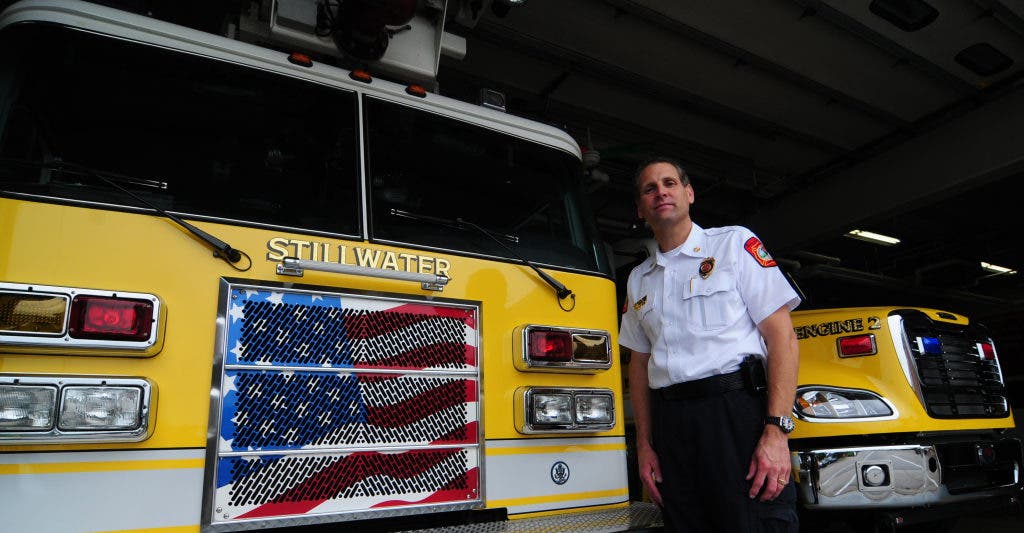
Stillwater Fire Chief Stu Glaser discusses the changes and impacts the Sept. 11, 2001 terrorist attacks have had on the fire service over the past 10 years.


Ten years ago the world changed forever.
The terrorist attacks on Sept. 11 impacted millions of lives—and it also changed how first responders go about their business.
“One of the biggest things 9/11 did for emergency responders nationwide is the whole concept that we are now targets as well,” Stillwater Fire Chief Stu Glaser said.
Find out what's happening in Stillwaterfor free with the latest updates from Patch.
In his 25-year career in the fire industry, Glaser said up until that tragic day 10 years ago, when firefighters responded to a call there wasn’t the thought that something else might be happening.
“We never thought that an incident might be fake to get us there to hurt us,” the fire chief said. “Up until that day in the United States that just wasn’t how it was. Now, all of a sudden, you get the call and you’re always thinking about those attacks in the back of your mind. You’re a bit more cautious when pulling up to a scene. You’re more aware and always looking for something doesn’t look right.”
Find out what's happening in Stillwaterfor free with the latest updates from Patch.
Since the terrorist attacks, situational awareness has been brought to light in a number of ways—including the way firefighters train, communicate with other agencies and approach an emergency call.
“Since 9/11 we really have to think that it could be someone with a real bomb,” Glaser said. “It could be someone trying to get you.”
Historically, firefighters hadn’t trained that way, he said. But now it’s a reality.
When firefighters get called to an explosion, fire—or whatever the situation may be—firefighters have to wonder if that’s what is really going on, the chief said.
“The biggest takeaway from that day is if something doesn’t look right, doesn’t feel right, doesn’t smell right, you better stop and take a look,” Glaser said. “The realization that terrorism is after all of us and they don’t care who they get. In our society, until 9/11, it had never been like that before.”
Remembering 9/11
Glaser said he remembers Sept. 11, 2001 like it was yesterday. He signed on as the Stillwater Fire Department’s assistant fire chief five months earlier. Glaser was getting ready to go to work—as he watched the attacks play out live on national television.
There was a city Safety Committee meeting that morning, Glaser remembers. During that meeting the assistant city administrator at the time told city officials the Pentagon was being evacuated—and all of these things people weren’t hearing in the news yet.
“It was a weird feeling obviously, but I remember that day like it was yesterday,” Glaser said. “It’s often compared to how people in the 1940s remembered Pearl Harbor. For our generation, it was immediately clear that it was a life-changing event.”
Watching the Twin Towers fall was the biggest shock of all, Glaser said. There were more people in one of those buildings than there are in the city of Stillwater, which is amazing to think about, he said.
The idea that the New York City Fire Department, with more than 40,000 firefighters, needed mutual aid was incomprehensible, Glaser said.
“That’s not to minimize their training,” he said. “It speaks to the magnitude of the attack. They needed help and that was a huge eye-opener.”
The Impacts of 9/11 on the Fire Service
The terrorist attacks acted as the impetus that pushed the way first responders communicate (800 MhZ radios) over the peak and into place—and strengthened the relationships—and information sharing—between public safety agencies.
There is information that continues to be police-sensitive, but now it is understood that firefighters and police should both know what’s inside a building to enhance their ability to jointly respond to a situation.
“That’s a huge piece that has grown over the last 10 years,” Glaser said.
The implementation of the National Incident Management System that works with multiple agencies in multiple jurisdictions makes for a much better response to a major event, Glaser said.
“Now there is a place for seemingly unrelated agencies—like Public Works and Public Health departments—to fit in so they understand the structure and the ways we work together,” the chief said. “That’s a huge piece that has occurred since 9/11.
Funding following the terrorist attacks was another impact on public safety.
There are a multitude of grants from the Department of Homeland Security that have been made available to public safety departments for protective gear, training and funding to adequately staff first response teams—and all of that stemmed from 9/11.
“From a tragedy and a disaster, we have moved forward to realize we had weaknesses in certain areas of our emergency response systems,” Glaser said. “After 9/11 we started looking at how were are going to fix that.”
Get more local news delivered straight to your inbox. Sign up for free Patch newsletters and alerts.