Health & Fitness
How To Take Better Pictures at Indoor Sporting Events
Local photographer Maris Ehlers of Maris Ehlers Photography gives a list of tips and tricks for ways to take better photographs of kids at indoor sporting events.
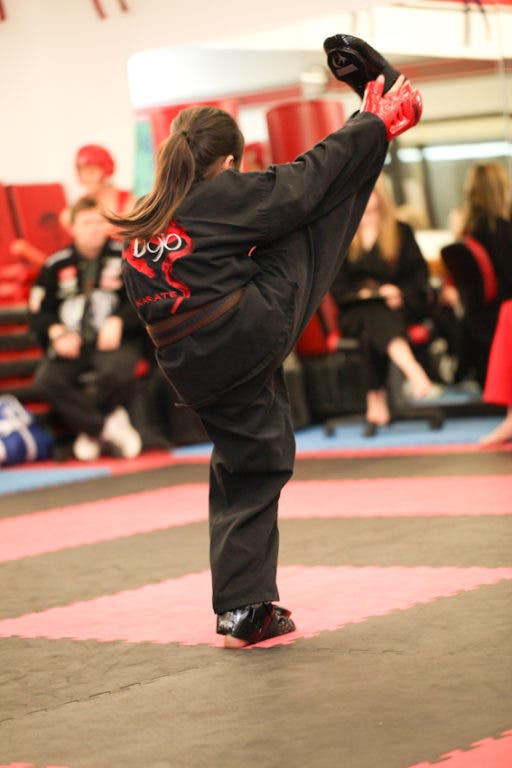


Recently our son received his red belt in karate. It’s his 7th belt, and a big deal to our family. It represents a lot of hard work and commitment (commitment that has, by the way, waned more than a bit here and there on both of our parts), and graduation night is a night to celebrate this achievement. For him, karate has been a wonderful experience that has taught him focus, respect, self-discipline and yes… skill! What better way to celebrate this achievement than with pictures of the big event (accompanied, of course, with a few tips on how to take better pictures at indoor sporting events).
When our son first started in karate, I can remember thinking “This will never work.” He wanted to run around, jump on the sparring equipment and generally just have a good time. His instructors would have to remind him at least 30 times per class “Sit like a black belt.” His response (I could see it in his eyes) was along the lines of “Why would I want to sit like a black belt when I can do crazy ninja moves instead? Wanna see one?”
We've come a long way, and it's so fun to see the documented progress in our images from one belt ceremony to the next, and so if you take pictures at indoor sporting events (or just indoor events), this list is for you.
Find out what's happening in St. Michaelfor free with the latest updates from Patch.
How to Take Better Pictures at Indoor Sporting Events
The most important prep work you can do for any shooting, regardless of the location, is to adjust your camera settings. I almost always set mine in this order:
Find out what's happening in St. Michaelfor free with the latest updates from Patch.
- White Balance – Most cameras today have pretty good white balance settings, so most of the time you can leave it on auto. I do recommend, however, especially when shooting inside, to try to choose the white balance setting on your camera that most closely matches the indoor light source (fluorescent, tungsten, etc). After you’ve made your selection, do a few test shots. If you are going to be using flash, make sure your test shots also use flash. Take a look. If the color looks good, I’d leave it there. If it looks off, try another setting. Don’t get too hung up if you are in fluorescent lighting but get better results on the tungsten setting. Each setting is simply a different set of values, and a lot of things can corrupt a light source. Focus more on getting a white balance that is accurate and natural looking vs worrying about what the label says.
- ISO – Cameras today not only have a wide ISO range, but you can get better and better pictures at higher iso levels. In the good ‘ole days, a high ISO (or film speed) meant grainy pictures. Today, a high iso can vastly improve your exposure indoors without adding a lot of grain to your images.
- Shutter Speed - Remember that you need a higher shutter speed to effectively “stop” action. If you look at your camera and you are at a shutter speed below 1/125, you aren’t likely going to be stopping anything.
Next, here are some guidelines if you are going to be shooting a lot during an indoor sporting event:
- Ask Permission – In spaces that are cramped, be sure to ask the coaches, instructors or leaders if you can move around during the event to take pictures. You’ll find that most of the time they will allow it, and they may have some ideas for you on good places to stand or sit for a good view.
- Be Selective – Admittedly, it can be somewhat annoying at an event when a parent or by-stander is shooting with flash as if they are the paparazzi with a looming deadline. Keep in mind that when you are behind the camera, you don’t necessarily see the flash firing in your eyes, but other people do. Including the participants. Hint: If your child is hiding from you during the event, you are probably taking too many pictures and distracting him or her from their mission. Maybe back off a bit.
- Zoom In – Zoom lenses are great for athletic events, and I will sacrifice perfect clarity and / or exposure for a great shot with some action in it. Using zoom can help you get closer to the participant without having to physically be closer (and therefore reducing the paparazzi effect), and I really enjoy isolating an athlete when they are in the middle of it all.
- Be in the moment - If you have to choose between taking an amazing shot and being in the moment, choose the later, especially if it is an important event. I try to take my shot just before his belt is completely tied, for example so that I don’t miss the huge smile on his face when it’s done. Also, when he looks over to see if I saw his moment, I want him to see my eyes and smile, not the end of my lens.
Below is a fun shot list for an indoor athletic event that you might like to focus on the next time you are shooting in the gymnasium on a Saturday morning:
- Get the whole team or group during warm up
- An empty locker room (with equipment strewn about here and there).
- A player in a one-on-one consult with the coach or instructor before or during the event.
- Interaction between the kids before, during and after.
- Catch someone in the middle of a move, be it a karate kick, shooting a basket, some great defense or just enjoying the game.
- Try turning away from the action and capture the reaction to the shot or the kick. Focus on the player who just kicked the winning goal, the players on both teams or even the spectators. You’ll be amazed at what you get.
Try to tell a story of the event while you are there, and remember to grab some detail shots. They are often overlooked and highly underrated!