Politics & Government
Twin Cities Metro Is Booming: These 8 Suburbs Are Growing Fastest
Vacancy rates in the Twin Cities metro are at their lowest since the early 2000s, and they are some of the lowest in the country.


WOODBURY, MN — The Twin Cities metro population is booming, according to a new report from the Metropolitan Council. "People want to come to the Twin Cities region, whether to work or live, because of everything we have to offer," said Council Chair Alene Tchourumoff in a statement.
The region’s total growth breaks down roughly into thirds.
"Urban center" communities, which include Minneapolis and Saint Paul and the region’s oldest suburbs, have accounted for one-third of the region’s population growth since 2010.
Find out what's happening in Woodburyfor free with the latest updates from Patch.
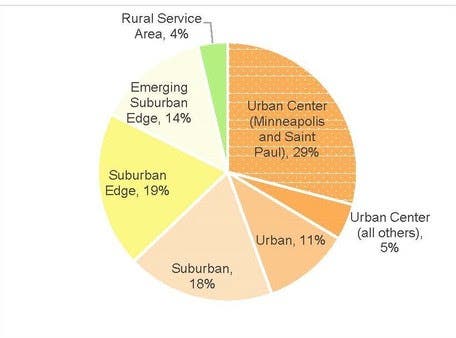
"Suburban communities" (cities that experienced their peak development before 2000, e.g., Brooklyn Park, Maplewood) accounted for another third of the region’s growth.
"Suburban edge" and "emerging suburban edge communities" (which tend to have more developable land, e.g., Chanhassen, Woodbury) have accounted for the remaining one-third, with modest growth in more rural and agricultural communities.
Find out what's happening in Woodburyfor free with the latest updates from Patch.
Different kinds of development have contributed to this growth.
Urban center and urban communities are growing primarily because of new multifamily developments like apartments and condominiums, while suburban communities are growing primarily because of new single-family homes (both detached homes and townhomes).
Suburban communities’ growth reflects both single-family and multifamily housing.
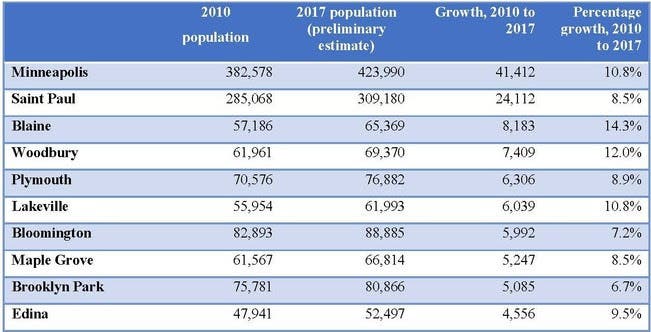
The communities that have added the most people since 2010 are:
Communities with existing or planned transitways have captured the most growth
Nearly 40 percent of the region’s growth has occurred in communities containing existing transitways (the Blue Line, Green Line, Red Line, and A Line in the METRO system along with the Northstar commuter rail line).
Another 18 percent has occurred in communities with planned transitways (the extensions of the Blue Line, Green Line, and Red Line; the Gold Line; the Orange Line and its extension; and the C Line and D Line).
Tight housing market
According to the preliminary estimates, the region added 83,100 households between 2010 and 2017, but just 63,670 housing units. The remaining 19,430 households occupied existing housing, drawing down vacancy rates.
Vacancy rates dropped as the economy improved after 2010 and reached an estimated 4 percent in 2017, down from 5.8 percent in the 2010 Census.
According to Census data, vacancy rates in the Twin Cities metro are at their lowest since the early 2000s, and they are some of the lowest in the country.
Image via Minnesota Department of Transportation
Get more local news delivered straight to your inbox. Sign up for free Patch newsletters and alerts.