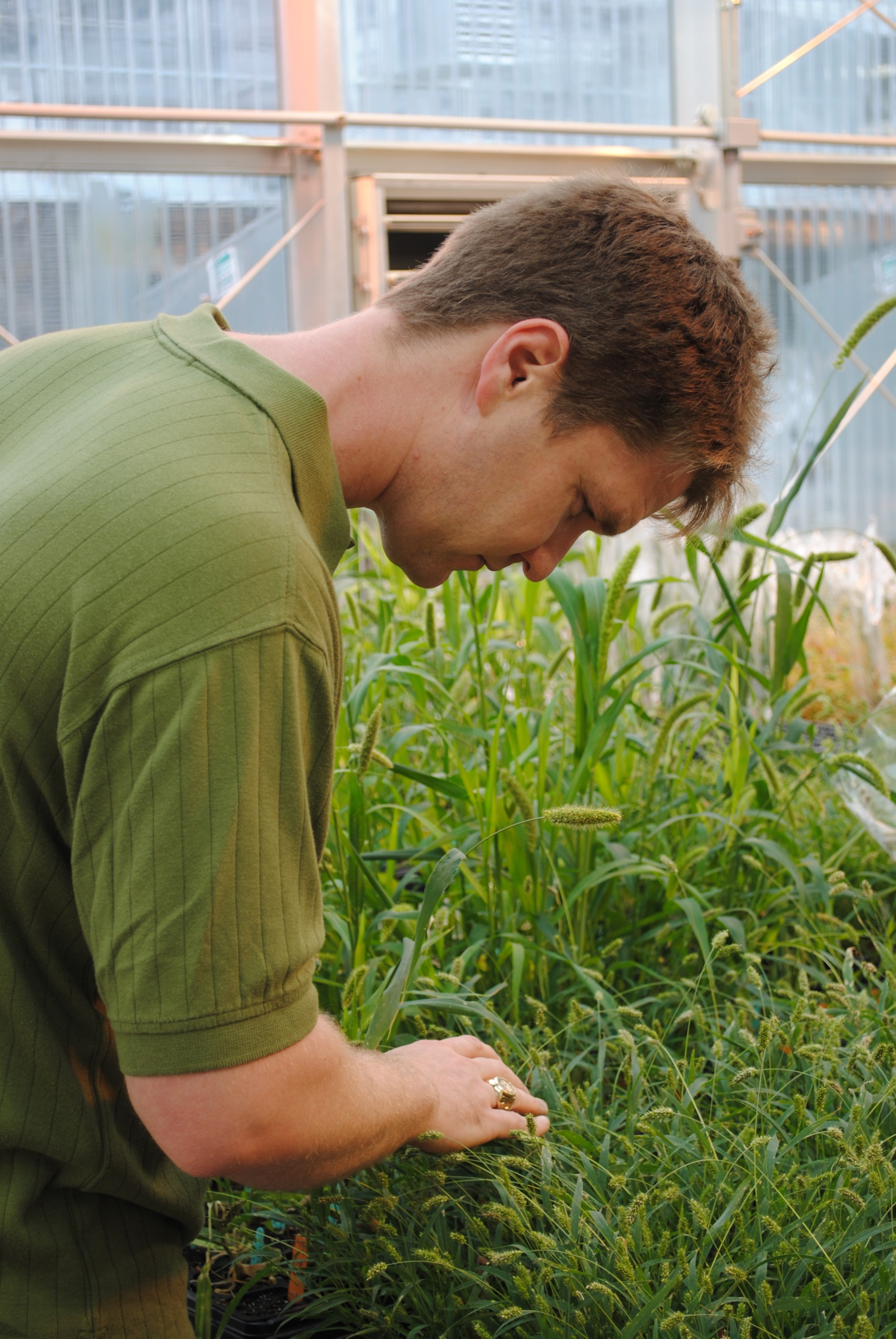
Roots & Shoots’ August Guest blogger: Timothy Anderson grew up in the St. Louis area before attending Colorado State University to obtain his bachelor’s in biochemistry and his Ph.D. in biochemistry and molecular biology at UCLA. Tim is now a postdoctoral associate in Dr. Tom Brutnell’s lab, Enterprise Rent-A-Car Institute for Renewable Fuels at the Danforth Center.
As the world’s population continues to increase to more than seven billion people and growing, heavy demands have been placed on the food supply, due to the diversion of farmland for economic development, increasing demand for crops as food and feed, and the use of important food crops in the production of renewable energy.
As a result, there is great concern whether there will be enough food available to feed the global population, especially in light of evidence suggesting current crop production may have peaked and cannot sustain the nine billion people predicted to inhabit the earth by the year 2050.
Find out what's happening in Creve Coeurfor free with the latest updates from Patch.
Since many of the important food crops consumed by humans, including rice and wheat, utilize C3 photosynthesis for carbon dioxide assimilation, their productivity is severely diminished under hot and dry conditions.
As a mechanism to adapt to these environmental conditions, some plants have evolved C4photosynthesis, by which specialized cell types and biochemistry have developed and are dedicated towards the concentration of carbon dioxide around Rubisco, the primary enzyme involved in carbon fixation during photosynthesis, which enables them to gain greater water and nutrient use efficiency. Therefore, it would be beneficial to engineer C4-like properties into C3 crops, such as rice, to improve yields.
Find out what's happening in Creve Coeurfor free with the latest updates from Patch.
In C3 photosynthesis all biochemical reactions occur in a single cell while plants using C4 photosynthesis utilize two cell types to capture and concentrate carbon dioxide around Rubisco in the bundle sheath chloroplasts. The use of two cell types to perform photosynthesis greatly decreases photorespiration in C4 plants, enabling them to be more productive than their C3 counterparts.
As a post-doc in Dr. Tom Brutnell’s lab, my work is focused on engineering an alternative C4 photosynthetic pathway into the model plant Setaria viridis. While Setaria already possesses the ability to perform C4 photosynthesis, reconstituting an alternative C4pathway in an organism that already contains the appropriate anatomy could shed important light on the genes and regulatory elements essential for this pathway to work efficiently.
Setaria is a perfect model to study and manipulate C4 photosynthesis because its genome has been recently sequenced and the methods for transformation have been established, making it the optimal plant for use in genetic engineering and synthetic biology.
READ THE FULL POST HERE.