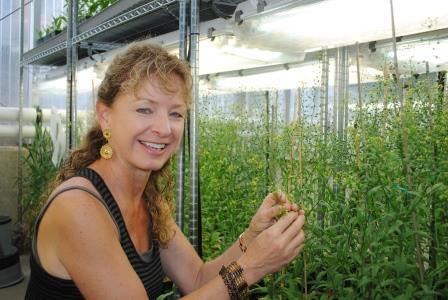
Dr. Toni Kutchan joined the Danforth Center in 2006 and is the Oliver M. Langenberg Distinguished Investigator and serves as Vice President for Research. Dr. Kutchan’s lab is dedicated to investigating how plants produce medicinal compounds at the enzyme and gene level, which could lead to new sources of medications for use against conditions such as dementia and cancer.
Q: Briefly, how do you describe your research?
A: Using modern technology, plants are studied to learn how they create chemicals that, in-turn, make frequently used medicines. Once the “how” is understood, the genes that are involved in the production of those chemicals are isolated and used to either improve the plants as sources of medicine or used to develop synthetic biology platforms— i.e. are moved into other organisms to produce the medicines.
Q: How has medicinal plant science evolved in the past 10 years?
A: Traditionally, plants have been an important source of serious medicines such as anticancer compounds, pain killers, and antihypertensives; they continue to be a source of new medicines for human and veterinary medicine. Plants are also now being used as synthetic biology platforms for production of various chemicals and vaccines.
Find out what's happening in Creve Coeurfor free with the latest updates from Patch.
Q: Is there anything new or exciting in your area of expertise?
A: A most exciting method currently being developed is one with which to bioinformatically interrogate large sequencing datasets to understand more quickly how plants make any one given chemical. That’s the cool part of being able to work here at the Danforth Center; we are currently expanding strongly in those directions.
Q: Do you think those technologies will help understand different species of plants more quickly since only a small percentage of plants have been researched?
A: Absolutely; next generation sequencing and bioinformatics allow us to use very little plant material, and with that material these new technologies generate so much novel information. Just as other technologies, sequencing and bioinformatics become less expensive with time, and that allows us to investigate largely unstudied, non-model systems and analyze them thoroughly, quickly and relatively inexpensively.