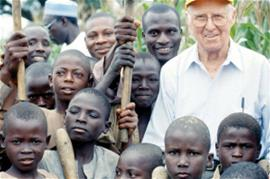

While giving thanks this holiday season, stop a minute to remember those, such as Dr. Borlaug, that dedicated their life’s work to feeding the world.
November is known for its cool weather, delicious food, and time spent giving thanks for life’s cherished moments. Across the world, many people are thankful for a man that, through his wheat-breeding research, saved more lives than anyone else in the history of mankind. Dr. Norman E. Borlaug is known as the father of the Green Revolution, winner of the Nobel Peace Prize in 1970, Distinguished Professor at Texas A&M University and is the namesake of The Norman Borlaug Institute for International Agriculture.
Known for his humanitarianism, Dr. Borlaug combined his scientific knowledge with his drive to help people, making his life mission to develop improved grain varieties to feed the hungry people of the world. Still today his legacy serves as an inspiration to young, passionate innovators who want to make a difference in the world.
Dr. Borlaug’s Legacy
Find out what's happening in Creve Coeurfor free with the latest updates from Patch.
Shortly after earning his doctorate in 1942, Dr. Borlaug found himself working for the Mexican Agricultural Program developing what would be the revolutionary shuttle-breeding process. This innovative process allowed for two generations of wheat to be grown each year, instead of the traditional one generation, cutting breeding time in half. While in Mexico, Dr. Borlaug and his colleagues also perfected a dwarf wheat variety that could produce large amounts of grain, resist diseases, and resist lodging – the bending and breaking of the stalk that often occurs in high-yielding grains. It was through these innovations in research that Dr. Borlaug aided in feeding millions worldwide.
Julie Borlaug, the granddaughter of Dr. Borlaug and the associate director of external relations at the Borlaug Institute, said, “Most people don’t realize that my grandfather’s breakthrough in shuttle-breeding occurred when he was in his 30’s. This research was radical and out-of-the-box, and many people questioned him.” It’s for these reasons that Julie encourages students to adopt her grandfather’s mindset. “You’re never too young to make a breakthrough. It just takes believing in yourself, ignoring the critics, and pushing forward. ”
Find out what's happening in Creve Coeurfor free with the latest updates from Patch.
In 1964, Dr. Borlaug was appointed director of the Wheat Research and Production Program at the then newly established International Maize and Wheat Improvement Center (CIMMYT) near Mexico City. This position allowed him to expand his teaching mission, as he shared his knowledge with thousands of young scientists. “My grandfather focused on talking to, training, and investing in the young scientists, researchers and farmers,” Julie Borlaug said. “His guiding philosophy was ‘take it to the farmer’ and he truly believed everything started by going to the field.”
Dr. Borlaug came to Texas A&M University in 1984 as Distinguished Professor of International Agriculture. At A&M, Dr. Borlaug continued to teach and inspire the next generation of leaders in research.
Read this article in its entirety here.