Politics & Government
Lawmakers Wrap Up Legislative Session
Creve Coeur-area lawmakers took aim at redistricting, domestic violence laws, the 'Turner fix' and the state's budget.
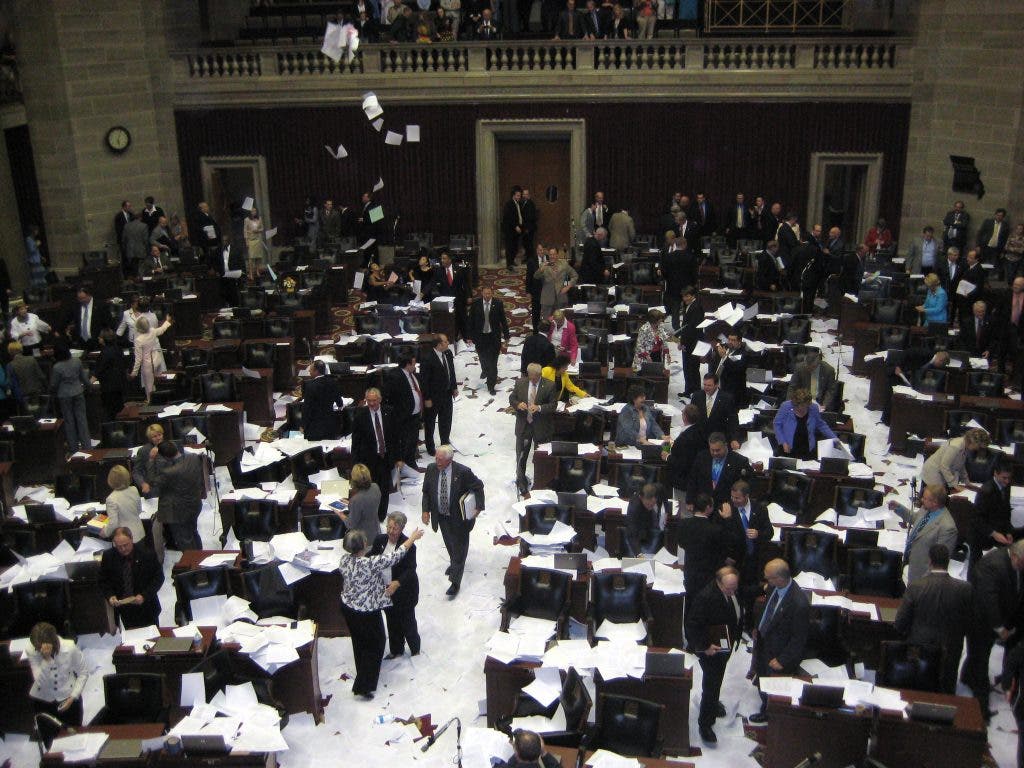
Republican lawmakers who represent portions of Creve Coeur played a major role in shaping this year’s session of the Missouri General Assembly.
The legislature ended its roughly five-month session on Friday, most notably adjourning without deals on sweeping changes to tax credit programs, local control of the St. Louis Police Department or a measure aimed at getting the process started in building a nuclear power plant in Callaway County.
The legislature did have a list of successful ventures, from ending the “franchise tax” on corporate assets to extending a prescription drug program to seniors. House Speaker Steve Tilley, R-Perryville, said at a post-session press conference that the Republican caucus accomplished some notable goals.
Find out what's happening in Creve Coeurfor free with the latest updates from Patch.
“About five months ago, we came before you all with the Show Me Solutions initiative,” Tilley said. “First and foremost, it was a pledge that we heard the citizens of this state and we were going to balance our state budget, we were going to live within our means and we were going to hold the line on taxes.”
“And let me tell you, first and foremost, mission accomplished,” Tilley added.
Find out what's happening in Creve Coeurfor free with the latest updates from Patch.
House Minority Leader Mike Talboy, D-Kansas City, said in a statement that Republicans chose to pursue the wrong types of priorities over the last few months.
“To House Democrats, job creation means providing opportunities for Missourians to support their families at a fair wage,” Talboy said in the statement. “Attacking Missouri workers will not bring economic prosperity.”
DIEHL SEES EXPANDED ROLE
Perhaps one of the most active members of the local delegation was Rep. John Diehl, R-Town and Country. The second-term lawmaker saw an increased role during this session, chairing the powerful House Rules Committee that can stall legislation before it arrives on the floor.
More notably, Diehl was in charge of a House committee tasked with reconfiguring Missouri’s congressional districts. Drawing map was especially challenging because Missouri lost a congressional district based off the latest U.S. Census numbers.
After a number of fits and starts, the legislature approved a map near the tail end of the session. Lawmakers eventually overrode Gov. Jay Nixon’s veto, a move that propelled the map into law.
Among other things, the redistcting plan It also placed Creve Coeur in U.S. Rep. Todd Akin's district.
Some lawmakers have suggested that legal action should be taken against the map, especially because of the make-up of the reconfigured 5th Congressional District. But Diehl told reporters earlier this year he expected the proposal to hold up in court.
“All things considered, I think it’s a compact and contiguous map,” Diehl said. “As we’ve gone through this process, we’ve always said you could look at one particular spot on the map and you can try to find fault with any particular district or spot on the map. But when you go to change that, it creates problems all throughout the map.”
LAMPING STEERS BILLS TO PASSAGE
Another lawmaker who engaged in an active session was Sen. John Lamping, a Ladue Republican whose district encompasses most of Creve Coeur.
Lamping successfully handled legislation aimed at altering laws related to domestic violence and adoption records. He also was heavily involved in revising laws related to human trafficking.
In an interview, Lamping said the domestic violence bill – which passed through both chambers of the General Assembly – aims to sync up terms and definitions currently in statute.
Lamping also said the bill’s language seeks validate that stalking is encompassed under domestic violence.
“The biggest change of the application now going forward is that there are now protections for teens where there never were protections, meaning court orders of protections that they can request,” Lamping said. “So up until now, a 16-year-old dating a 15-year-old with the 15-year-old subject to domestic violence, there was nothing the parents or the guardians could do in terms of getting a court order of protection.”
“So that’s the biggest change that takes place,” Lamping added. “It really brings into the 21st century the realities of domestic violence in that it does occur for people who aren’t adult age. It was just long overdue.”
In the next two or three years, Lamping said there could be further changes to domestic violence law.
“Anything as comprehensive as this should really every 10 or 15 years… stop, sync it all up and make sure everything’s in line,” Lamping said.
The legislation changing language regarding adoption records and human trafficking also passed through both chambers and are also on Gov. Jay Nixon’s desk.
"Up until now, we barely defined human trafficking in law," Lamping said. "And now, we've redefined it, we've expanded the penalties, we've given the victims of human trafficking the right to use the fact that they're being trafficked as a defense. It really brings human trafficking into the legal code where we didn't have it before."
CUNNINGHAM SEEKS ‘TURNER FIX’
Sen. Jane Cunningham, R-Chesterfield, was involved in the scramble to establish a so-called “Turner fix,” which seeks to change state law in the light of a court decision
Cunningham said in an interview that her role was to try and “honor the rights of the children in the unaccredited districts to make sure that no child lost their rights under statute and under the Supreme Court decision.” She also said she wanted "to respect and accept the positions of the county districts so they would not have to accept children they feel like they can’t or won’t right now.”
"So balancing those two desires, I came up with a fix that allowed the students in the city and in Riverview Gardens to have a scholarship to go to any independent school that they wanted to go to that was accredited, as well as allowing the county districts to open charters in the city of St. Louis to provide some supply and to allow county district to decide how many seats under their class size policy that they have for students to attend,” Cunningham said.
Cunningham said the goal of that legislation was to “make sure we had the supply to not turn any child away.” She said the bill prompted agreements from a number of nearby school superintendents.
But Cunningham’s bill didn’t end up passing. Another bill from Sen. Jim Lembke, R-Lemay, which would have exempted St. Louis City schools from paying tuition and transportation costs to adjoining school districts, also failed this year.
Because the legislature didn’t act, Cunningham said her best reading of the Turner v. Clayton decision is that county districts will have to accept the students.
“It’s not too late to do it, we could still do it next year,” Cunningham said. “Let’s just say that the judge does go ahead and implement the statute and the Missouri Supreme Court decision and come September the county districts are scrambling and trying to accommodate those children… They’ll be back here hoping we’ll be giving them a Turner fix. And if the education community that lobbies the halls here will come around and accept a reasonable fix, we could get it done next session.”
SCHUPP EXPRESSES DISAPPOINTMENT
Rep. Jill Schupp, D-Creve Coeur, said lawmakers initially came into the session hoping to work together on economic development, job expansion and make the state "more environmentally sound."
But Schupp said the legislature didn’t seem to get around to doing any of those things.
“On the contrary, I think that we have done things that are purported to provide jobs that don’t and that won’t,” Schupp said. “And we’ve done things that hurt… the middle class, the average Missourians and really the lower-class people. We’ve sort of taken away kind of the safety net programs that exist.”
Schupp said lawmakers did “a little bit better” in funding higher education than earlier in session. She added she is “grateful the body recognized that we have to do in terms of educating our students.”
“In terms of K-12 funding, which I also think is critical to the development of our future workforce and our future leaders, our dollars have remained flat in the last year,” Schupp said. “Flat is not equal. Flat is a really a decrease. But in this type of environment and economy, we could have done worse.”
Additionally, Schupp said the legislature had opportunities to look at “streams of revenue” to assist with the budget. That includes collecting sales tax from Internet sales and increasing the state’s tobacco tax.
“I think this was the year that we needed to really either raise it to the amount constitutionally allowed here or to go out and put it before the public and get an increase,” Schupp said. “I’ve been getting back surveys and in my district, I think one of the highest survey responses I got was ‘would you be willing to raise the cigarette tax by 65 cents above [the current 17 cent rate]. And I got an 85 percent response from about 1,000 people.”
“When we make some of these choices here, I think in some ways they’re false choices,” Schupp added. “Because we could have done things that would have helped support programs that were important to our seniors, to our young kids, to our working class people. And that would be my disappointment in view of this session.”