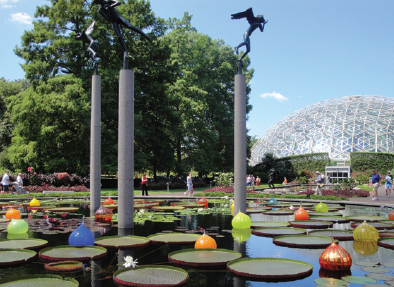


Forest Park in St. Louis has been designated one of the Ten Great Public Spaces for 2013 by a national nonprofit educational group. The group’s Great Places in America program highlights the role that planning and planners play in adding value to communities. Jeff Soule with the APA says Forest Park’s public-private restoration and usage – 13 million visitors a year – is impressive.
“One of the things we look for is the quality of the design, which is terrific,” Soule says. “We look for the diversity of uses and then we look for, you know, who’s using it? Is it getting a broad cross-section of people? So, Forest Park certainly meets all of those ideas really, really well.”
Forest Park isn’t the only ‘great’ feature of St. Louis. As described by Partners for Livable Communities, “St. Louis is a city and region that is well-connected. As the major metropolitan area nearest to both the geographic and population centers of the United States, St. Louis is connected to a rich history, a thriving culture, a diverse economy and a promising future.”
Find out what's happening in Creve Coeurfor free with the latest updates from Patch.
The Greater St. Louis area represents a 16-county region, which encompasses portions of both Missouri and Illinois. Nearly 2.8 million people call St. Louis home, making it the nation’s 19th largest metropolitan area. From a nationally acclaimed zoo, art museum and symphony orchestra, the region boasts some of the nation’s top cultural attractions, even better, most of them have free admission!
Home to 19 Fortune 1,000 companies and several firms listed by Forbes magazine in its U.S. list of ‘Largest Private Companies,’ the region offers a diverse economy, a talented workforce, top-ranked educational institutions, and a pro-growth business culture.
Find out what's happening in Creve Coeurfor free with the latest updates from Patch.
• Workforce. Missouri boasts an educated workforce, having 138 post-secondary educational institutions, more than most other midwestern states. Missouri also offers several highly successful workforce training programs.
• Cost of living. St. Louis is considerably more affordable than comparable metropolitan regions. In fact, it has the lowest cost of living among the nation’s 20 largest metropolitan areas, according to the Council for Community and Economic Research.
• Business affordability. Ranks the 7th most cost competitive location to do business, according to a study by KPMG LLP. The study looked at labor, taxes, real estate and utility costs.
• Higher education. With more than 30 universities and colleges, St. Louis is a top-choice for students pursuing degrees in a variety of fields. Over 119,000 students are currently enrolled in area four-year institutions, which produce more than 25,000 new graduates adding to the area’s skilled workforce each year.
• Health care leadership. St. Louis is consistently ranked as one of the nation’s leading health care centers, including the renowned Washington University and Saint Louis University Schools of Medicine, 53 hospitals, as well as a dental school, college of optometry, two schools of pharmacy, and numerous nursing and allied health programs.
Terrific Quality of Life
The proximity of BRDG Park to major life science entities is enhanced by the exceptional advantages of living in one of the most affordable cities in the nation. St. Louis provides an outstanding cultural life, shopping, entertainment, professional sports and athletic facilities. Important quality of life features include:
• Neighborhoods. An extensive selection of affordable quality housing in a wide-range of neighborhoods, ranging from a bustling urban setting to some of the most beautiful suburbs found anywhere in the U.S.
• Outstanding Schools. Top-ranked public and privateschools.
• Cultural attractions. St. Louis boasts the second best zoo in America (and it’s free!), the nation’s oldest botanical garden, number one ranked art fair and an internationally admired symphony orchestra. It is home to distinguished theater and opera companies, a vibrant art community and many excellent museums.
• Sports. St. Louis has three national sports teams, including the St. Louis Cardinals – winner of the 2011 World Series, St. Louis Rams football and the St. Louis Blues hockey team.
Big City Advantages All Within Reach
• Livable. Centrally located near the population and geographic centers of the U.S., St. Louis has easy access to virtually anywhere. Convenient access to four interstate highways means short commute times. Just 15 minutes from BRDG Park is the major metropolitan airport with ample flights and parking.
• Climate. St. Louis enjoys the advantages of four full seasons, with few extremes. Average monthly temperatures range from 32°F in January to 81°F in July.
• All-American City. The St. Louis region was named a 2008 All-America City by the National Civic League, the oldest and most prestigious civic recognition in the nation.
Outstanding Recreation Amenities
• Greenways, Parks and Trails. For bicyclists, joggers, hikers, and rollerbladers, there are more than 120 miles of paved bikeways. Highlights include the 225- mile Katy Trail and trails along the Mississippi River.
• Forest Park. Forest Park is the largest urban park in the U.S. At 1,300 acres, it is approximately 500 acres larger than Central Park in New York. The park is home to the region’s major cultural institutions – the Zoo, Art Museum, History Museum, Science Center, and The Muny outdoor theatre. It serves as a sports center for golf, tennis, baseball, bicycling, ice skating and more.
• Nature Areas. In addition to being in close proximity to the Ozark area’s streams for canoeing, fishing and recreation, St. Louis is within easy driving distance of the most outstanding regional and state parks in the Midwest.
Read the full article here.