Schools
Hazelwood West Middle School Students Learn the Art of Afro-Brazilian Martial Arts
On the last day of Black History Month, Hazelwood Patch brings you a local group that teaches Hazelwood West Middle School students the art of Capoeira.
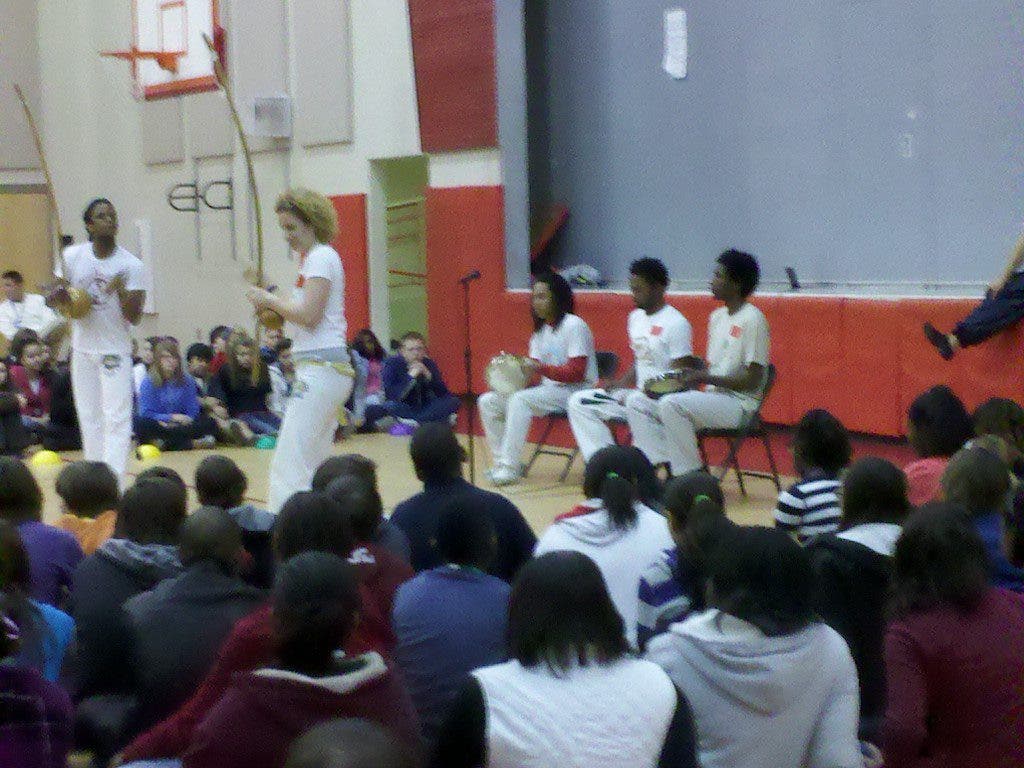


seventh-grade students were in for an exotic and enriching historical treat Wednesday when the Cordão de Ouro Capoeira troupe came to perform as part of the school’s Black History Month celebrations.
Capoeira is an Afro-Brazilian art form that combines music and dance with acrobats and martial arts. Tebogo Shultz, the group’s leader, said that he originally learned about Capoeira through a video game he played in college. When he discovered that it was more than a game, he said he decided to learn more about it. In 1998, Shultz went to study abroad in Brazil, where he learned Capoeira from some of the masters.
“Every culture in the world has a martial art,” he said. “We tend to forget that Africa is a diverse place with a diverse culture, and that there are still martial arts there today.”
Find out what's happening in Hazelwoodfor free with the latest updates from Patch.
The performance started with the players introducing the students to their instruments, which included drums, tambourines and an African string instrument. Shultz gave students a history lesson about Capoeira. The group then played a bit of music and began to demonstrate some of the more intricate Capoeira moves, individually at first and then in pairs. Students were enthralled by the performances, clapping and cheering throughout.
After the initial demonstrations, the players invited several students to try Capoeira. Once the players had given them a quick tutorial, most of the volunteers were surprisingly adept Capoeiras and participated enthusiastically.
Find out what's happening in Hazelwoodfor free with the latest updates from Patch.
“This is my first time doing it,” said seventh-grade student Jacob Pickett, one of the student volunteers. “It was a lot of fun…it’s great.”
Another seventh-grade student who took a shot at Capoeira, Lee Russell, seemed to be a natural during his performance with one of the players.
“I think it’s easier to know how to do it if you’re already a dancer,” Lee said. “It was a lot of fun and I may try doing it again sometime.”
Stacey McMackin, HWMS’s library media specialist and the event’s organizer, said this is just one of the many ways the school has celebrated Black History Month.
“Today’s performance is a multicultural thing that I thought the students would enjoy as part of our month-long Black History celebration,” she said. “I thought the seventh graders might really be engaged in something having to do with martial arts, too.”
She said that since many students don’t get the chance to see live arts outside of the school, it’s especially important and a personal goal of hers, to bring these performances in.
The purpose of Black History Month is to celebrate the many accomplishments of black Americans throughout history. Throughout the years, this month of celebration has served to unify Americans through learning new history, and for Shultz, Capoeira “transcends sport” by not being about competition, but rather a unifying art form that brings people together.
“Capoeira is the art of making friends,” he said.
Today, Shultz teaches Capoeira at Pinx Academy of Danc in St. Louis. He said that originally, slaves developed this form of martial arts.
“The slave trade jammed together so many different African cultures in Brazil and they brought all of their martial arts traditions with them,” he said. “Capoeira is actually a hybrid of many martial arts brought together in this situation.”
Much like slaves in the United States were not allowed to play drums or sing their traditional songs, Shultz said that it was illegal for African slaves to practice Capoeira in Brazil.
“They would play Capoeira in secret and disguise it as a religious practice,” he said. “Capoeira is just one little slice of the Afro-Brazilian cultural tie, kind of the physical side of it.”
Much like the traditional African oral tradition, Shultz said that some of the older Capoeiras, who are in their nineties today, told him that when they first started doing Capoeira, they were deemed Africans, but now they’re called Brazilians. Shultz said he was told that feel that practicing Capoeira helps them stay tied to their rich cultural history.
Throughout the several hundred years of Brazilian slavery, Shultz said Capoeira was underground and illegal, and that even when slavery was abolished in Brazil, the stigma wasn’t erased. As a result, Capoeira is still considered an art of the lower class as a result, Shultz said.
“It wasn’t until the 1920’s or 30’s that this man, Master Bimba, took Capoeira out of the underground and formalized it into an academy,” he said. “Now we train like any other martial arts school does, but Capoeira still has that stigma to it in Brazil and even other parts of the world.”