Health & Fitness
BBB's Shred Day April 20, Plus 10 Tips To Reduce Identity Theft
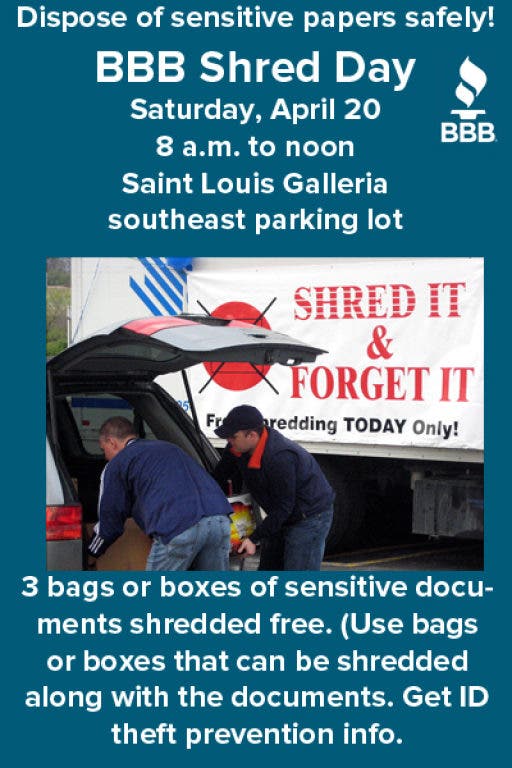
The BBB is sponsoring free document shredding from 8 a.m. to noon Saturday, April 20, at Saint Louis Galleria.
Identity theft has been in the news lately, and many consumers may feel helpless to protect themselves, especially when a retailer experiences a security breach.
The Better Business Bureau reminds consumers that there are things they can do to reduce the threat of ID theft. And it doesn’t have to mean giving up on the use of credit or debit cards.
Some of the most pervasive forms of identity theft involve financial information obtained from consumers’ homes, their own insecure computers or careless use of credit or debit cards in public places.
Find out what's happening in Kirkwoodfor free with the latest updates from Patch.
It’s a mistake to leave bank statements, credit card statements or other sensitive documents laying around in plain sight in your home or at work. Visitors to your home, including friends and family or those who work for you, may be tempted to take such papers and use them to commit fraud.
Documents should be kept in a secure place, preferably under lock and key. And older documents should be destroyed safely.
Find out what's happening in Kirkwoodfor free with the latest updates from Patch.
The BBB is sponsoring a ‘shred day’ on Sat., April 20, from 8 a.m. to noon at the southeast parking lot of Saint Louis Galleria, near the intersection of Brentwood Boulevard and Interstate 64. Consumers can bring up to three bags or boxes of documents to be shredded free. Shred-it, a Securit company, is donating the shredding and will have several trucks on hand.
In addition to shredding outdated or unneeded documents, the BBB has 10 steps you can take to protect your identity:
- Shred statements and applications you get in the mail that you don’t want to keep. These include credit card applications, insurance forms, financial statements, health forms, billing statements from utilities and phone service.
- Cut up expired credit and debit cards. Make sure you cut through the numbers.
- Protect your Social Security number, all account numbers and passwords. Don’t carry these numbers in your wallet. Give out personal identifiers only when absolutely necessary. Beware of unsolicited e-mails and phone calls if someone asks for the numbers.
- Secure personal documents at home. If you have roommates, employ outside help or have contractors in your home, make sure personal documents are in a safe place and not lying out in plain sight.
- Minimize personal information printed on checks. You don’t need to include your Social Security number, driver’s license or phone number.
- Monitor bank and credit card transactions for unauthorized transactions. Crooks may start with small transactions to see if you notice.
- Pay attention to billing cycles. If bills don’t arrive on time, follow up with your creditors.
- Don’t create obvious passwords. Avoid using your birth date, child’s name or birth date, mother’s maiden name or the last four digits of your Social Security number.
- If you conduct business online, use your own computer. A public computer is less secure.
- 10. Never use email to communicate sensitive personal information. Don’t respond to emails asking to verify your personal information and identifiers. Neither your bank, credit card company, online payment system nor the IRS will call or email asking you for confidential information. They already have it.
For more BBB news, go to the BBB website or follow the BBB on Facebook, Twitter or YouTube.