Health & Fitness
Bartold's Grove in Maplewood was the place to spend those hot summer nights
Much of what happened at Bartold's Grove must have stayed at Bartold's Grove. For nearly 100 years, the Grove was a pressure relief valve for the over-stressed city dwellers.
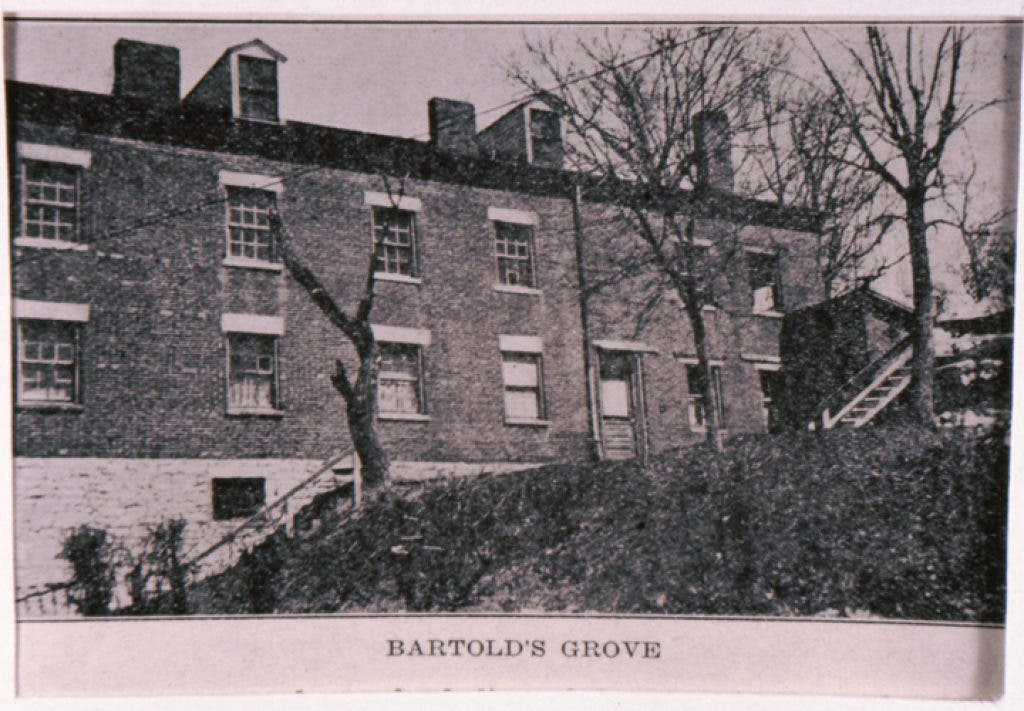


Around 1840, Henry Bartold and his brother Frederick opened a stone roadhouse at the current site of the Sunnen Corporation. Originally known as the Eight Mile House, it was the first stop for travelers heading west from downtown St. Louis. Eventually it came to be known as Bartold’s Grove.
The Grove served many purposes during its long life. It offered lodging, provided a picnic spot for well-to-do St. Louisans, and it was a place for nighttime merrymakers. The Globe-Democrat wrote, “Anything to eat or drink might be obtained.” One regular customer explained that dancers would arrive at seven when the only evening Missouri Pacific train dropped off passengers. Then, “as there was not a train into St. Louis until the following morning at seven o’clock, this meant we danced all night.” Until Prohibition closed the Grove in the mid-1920s, each Fourth of July over 300 Scots would gather in kilts and with bagpipes to celebrate American independence.
The Grove attracted many celebrities. General Grant was a frequent guest during the Civil War and probably after. Mark Twain sat side-by-side with Sam Hildebrand, an infamous outlaw. When the Grove was finally shuttered, the Globe-Democrat called it a tragedy, “to those who knew it when’ it lingers in memory along with big-wheeled bicycles, hoop skirts and penny arcades.
Find out what's happening in Maplewood-Brentwoodfor free with the latest updates from Patch.
According to one local history buff, the Grove was later known as the Cool Cave Tavern, which causes this writer to speculate that the building backed up to a cave. Larry Giles can recall exploring the derelict building when he was a child and living in Maplewood. The building survived until the late 1950s or early 60s.
Much thanks to Joyce Cheney for the text and research in this article. This information was excerpted from, “Maplewood, the First 100 Years.” Still the #1 best seller at Scheidt Hardware and also available at the Maplewood City Hall, the Maplewood Public Library, the Maplewood Chamber of Commerce and I think but I haven’t checked recently, Amazon.com.
Find out what's happening in Maplewood-Brentwoodfor free with the latest updates from Patch.