Neighbor News
Missouri Public Transit Association Reveals Study Findings
Despite the Direct and Indirect Economic Impact Exceeding $3.67 Billion in Missouri, , State Funding for Transit Remains at a Record Low
The Missouri Public Transit Association today released the findings of a six-month study designed to quantify the economic impact of public transit services in the state of Missouri. Highlights include the fact that the direct and indirect impact of public transit in Missouri this year exceeds $3.67 billion, yet a distinct lack of state funding for transit in Missouri remains – including dollars allocated for Springfield.
The first-of-its-kind study, commissioned in partnership with Citizens for Modern Transit and AARP in St. Louis, was led by Robert M. Lewis, FAICP, CEcD, an independent consultant and assistant professor of Urban Planning & Development at Saint Louis University. He revealed the following findings from the 2019 Economic Impact of Public Transit Services in the State of Missouri study:
· There is a total of 34 transit providers in the Missouri. They collectively spend $675 million each year on operations, capital improvements and labor compensation for the 4,500 individuals who are employed at an average salary of $64,200.
Find out what's happening in Springfieldfor free with the latest updates from Patch.
· Missouri public transit providers provide an annual average of 60.1 million rides, which is equivalent to 9.8 rides per year, per Missouri resident. In conjunction with these trips, transit riders are spending $600 million on goods and services. This translates into a direct economic impact of $1.28 billion each year in Missouri.
· The direct spending triggers another $2.4 billion in statewide economic activity, including $1.03 billion in added household earnings for Missourians. These indirect, or multiplier effects, further support another 24,680 jobs in the state that pay an average of $30,200 per year. Because of all the economic activity and job creation triggered by transit operations and riders, the State of Missouri collects an estimated $48.8 million in taxes per year.
Find out what's happening in Springfieldfor free with the latest updates from Patch.
· The direct and indirect economic output supported by public transit’s annual operations in 2019 exceeds $3.67 billion in Missouri. This includes $2.65 billion in the St. Louis Metro Area, $786.4 million in the Kansas City Metro Area and $251.9 million throughout the rest of the state.
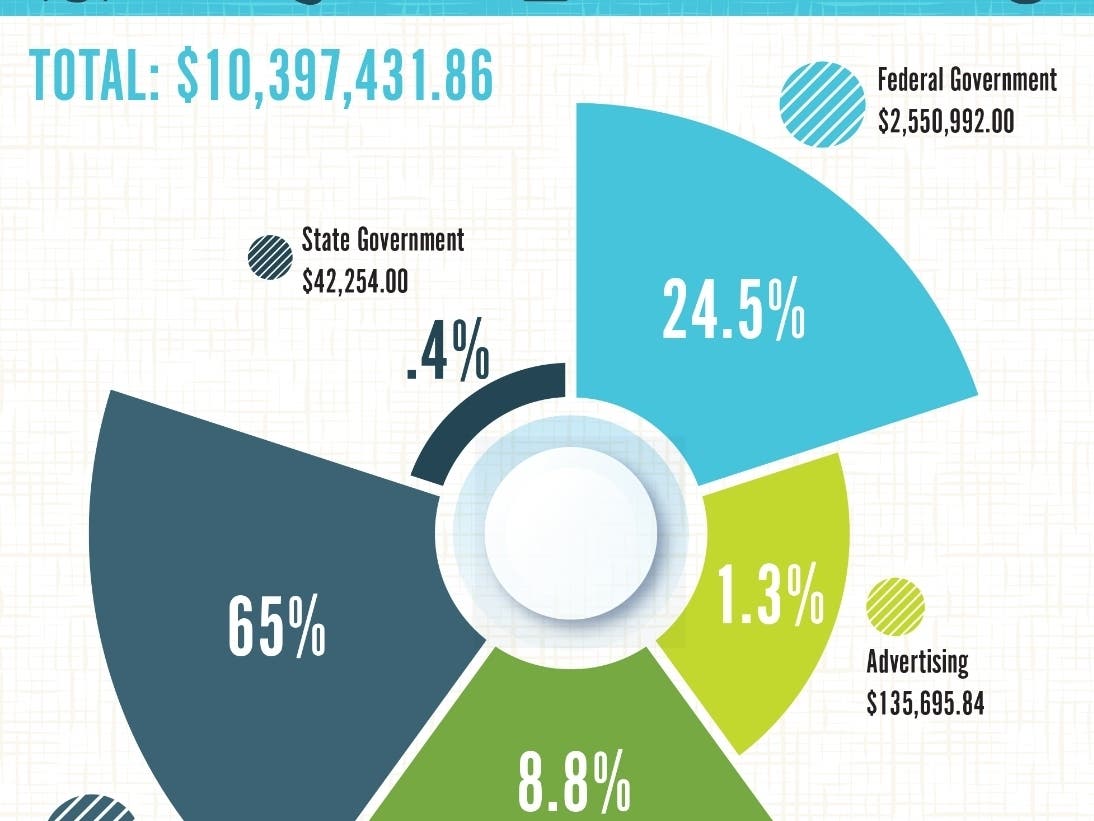
The study also confirmed that Missouri transit providers serve every county in the state. The highest density of transit utilization is found in the urban areas of St. Louis and Kansas City, but there is access to public transportation in all rural areas and small towns. It also highlighted a distinct lack of support from the state when it comes to transit funding – pointing to The Bus services through CU Transit Services in Springfield as a local example. The Bus and OATS Transit combine to have a $66.8 million economic impact on Greene County and supports 474 jobs. Yet, it received .4 percent or $42,254 from the state of Missouri for its FY2017 budget of $10.4 million. The remainder came from federal funding and local sources.
“This pinch is not limited to Springfield – it is being felt across the state as Missouri currently allocates $1.75 million per year for public transit, a total that must be divided among all 34 transit providers,” commented Lewis during his presentation. “This amounts to 34 cents per Missouri resident, which is similar to Kentucky, but less than a third of Arkansas and one quarter of Oklahoma, and is almost insignificant when compared to Illinois. Of nine bordering states, Missouri has the 8th largest GDP and the slowest growing GDP since the Great Recession.”
“The hole that exists in each transit providers’ budget is funding from the state of Missouri – it is missing from the equation,” added Kimberly Cella, executive director of the Missouri Public Transit Association. “That is why we did this study. State funding is at a record low. Missouri ranks 47th in the country for state funding for transit. Some of our transit providers are getting as little as $5,000 from the state. We’ve got to be bold. The state has to do better. Whether you ride transit or not, Missouri’s investment in transit is key to the economic viability of this state.”
Director of Transit for City Utilities of Springfield, Matt Crawford, who also serves as treasurer of the Missouri Public Transit Association echoed Cella’s comments. “Our attitude toward investment in transit is going to be reflected in economic growth, or lack thereof, in Missouri in the near future and for generations. Investing in transit means investing in people, jobs, education, medical services, and all areas of our communities,” said Crawford. To learn more about the Missouri Public Transit Association and this study, visit www.mopublictransit.org. Individuals can also like the organization on Facebook or follow them on Twitter at @MOPublicTransit.