Community Corner
When Mammoths and Mastodons Walked the Earth: Missouri History Museum Takes Visitors Back In Time
'Mammoths and Mastodons: Titans of the Ice Age' exhibition includes genuine remnants of these magnificent mammals, realistic replicas and plenty of interactive displays.




In the entranceway to the Missouri History Museum, not too far from where a small herd of Asian elephants roam their enclosure at the St. Louis Zoo, an elephant-like creature sporting huge, curved tusks looms over visitors.
This creature, a lifelike replica of a Columbian mammoth, stands 14-feet at the shoulder and looks like it could’ve won a tug-of-war with a couple of African elephants. It is part of the museum’s “Mammoths and Mastodons: Titans of the Ice Age” exhibit, which continues through April 15. These magnificent mammals, which inhabited North and Central America during the Pleistocene and Holocene eras, are definitely an appropriate exhibit for a history museum because they shared space with and were hunted by early residents of what became Missouri.
“Really, human history is completely involved in this,” said David Lobbig, the museum’s curator of environmental life. “It’s part of our history, though it’s not written with words. It’s written with art and artifacts like tools that show that we were in close communion with these animals.”
Find out what's happening in St. Petersfor free with the latest updates from Patch.
Just inside the entrance to the exhibit, which is on loan from The Field Museum of Chicago, two displays put that history into perspective. One wall has a family tree for the proboscideans, which includes mastodons, mammoths and elephants. It shows how they all started in the same “trunk” of the tree before branching off to different genetic destinations.
History
Proboscideans get their name from the proboscis, or trunk, that many of them possess. They first appeared 55 million years ago in Africa, according to the exhibit. Over many generations, they evolved into over 150 different species that ranged across the globe. A display of small statues in front of the family tree wall shows proboscidean members including the mastodon, mammoth and elephant and how they relate to each other in size and appearance.
Find out what's happening in St. Petersfor free with the latest updates from Patch.
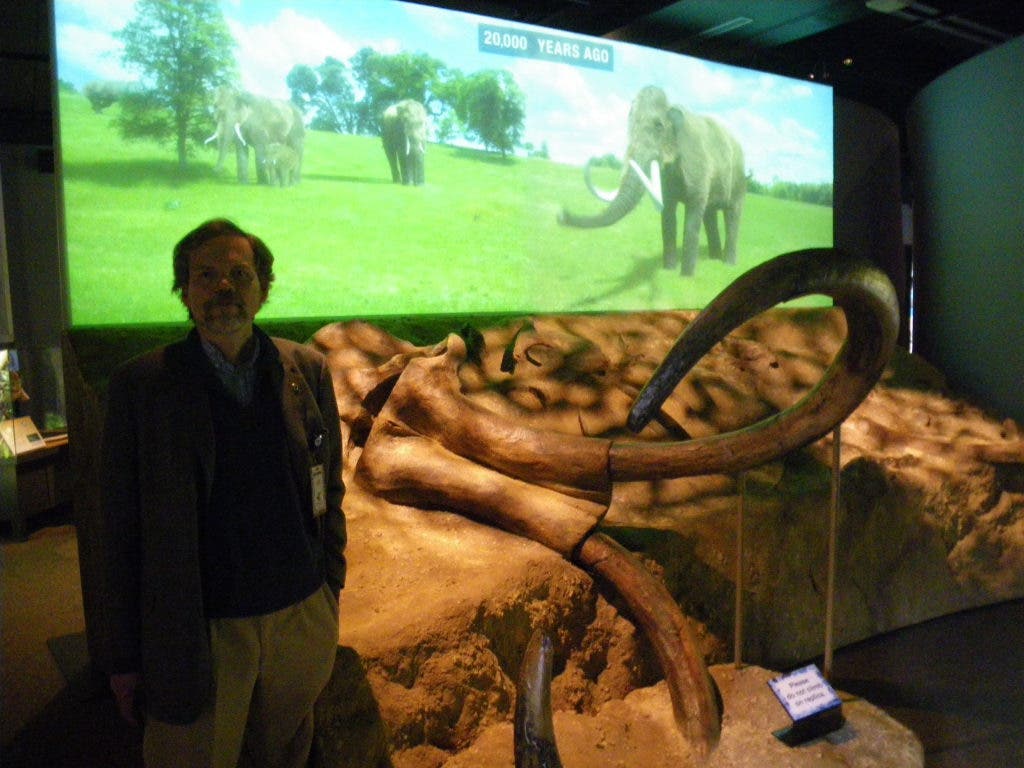
On the other side of the entrance, a replica of a partially excavated mammoth skeleton, with curved tusks projecting out, rests at the base of a large screen that allows visitors to travel back to the days of mammoths and mastodons. It starts with a view of downtown St. Louis as it appears today before going back in time. With a counter showing how long in the past the view on the screen is, buildings deconstruct and disappear, then older buildings appear, then the land alternates between lush forest and Pleistocene ice and snow before finally reaching 20,000 years ago. At this point, woolly mammoths arrive, wandering the grassy savannah and trumpeting like elephants.
Mastodons and mammoths both arrived on the scene about 700,000 years ago, during the Pleistocene, which ranged from 1.8 million to 10,000 years ago. They lasted into the Holocene, which dates from 10,000 years ago to the present, and co-existed with man. Mastodons pre-date mammoths in history, and also became extinct first, Lobbig said. But they did share territory and managed to co-exist in history because their diets were different. Mastodon teeth were suited to grinding heavy material like tree branches, while mammoths tended to favor grazing on grass. The exhibit includes teeth from both mammals, and the mastodon teeth are sturdier, with deeper ridges.
The last mammoths known to exist lived on Wrangel Island in Siberia until 3,700 years ago. As a reference point, Lobbig said, that’s around the time the Egyptians were building the pyramids. One display features tusks from these last mammoths, cut in half to reveal growth rings similar to what trees have, with good years and lean years.
Early man hunted these great creatures, and may have been responsible for their extinction. In addition to over-hunting, something mankind is known to do, other possible causes of the demise of the mastodons and mammoths include a devastating meteorite impact that caused massive fires, climate change, and widespread disease, according to the exhibit.
While they are gone, these magnificent beasts are not forgotten. Among the treasures in the exhibit are mammoth skulls, jaws and tusks, with the skull alone weighing about 300 pounds, plus teeth, hair and skin. A truly significant find, represented in this exhibit by a replica and several displays, is of a one-month old woolly mammoth that drowned or suffocated and was almost perfectly preserved. This female mammoth, named “Lyuba,” which is Russian for “love,” died 42,000 years ago in Siberia. She was just discovered in 2007, and scientists are understandably excited about the
possibilities.
“It’s just incredible,” Lobbig said. “She is the most intact, best preserved specimen of her kind. It really tells a story. It’s like aving an encyclopedia handed to you.”
Luckily for scientists, many mammoths lived and died during the icy Peistocene, and their remains were preserved well enough to leave
plenty of material for study.
“It’s important to know these animals through analysis of DNA,” he said.
Other displays show predecessors to the mammoths and mastodons, early proboscideans like Deinotherium, which had a shorter trunk and tusks that curved down. There are also several “Please touch” interactive displays that give visitors a chance, for instance, to see how the trunk of a mammoth works, or feel the hair of a woolly mammoth (actually musk ox hair, but it’s very similar).
Another kid-friendly hands-on display shows visitors what was necessary for a mammoth or mastodon to walk around without their 150-pound tusks causing their heads to droop.
The interaction of people and massive mastodons and mammoths is shown with displays and dioramas depicting hunting. A replica cave allows a virtual walk-through that includes cave paintings of these burly beasts and an educational discussion of what the paintings represent.
“It’s an impressive interactive,” Lobbig said. “I’ve never seen one quite so effective at describing what it is you’re learning about. It’s really very vivid.”
Ken and Karen Cella of St. Peters, who came because they love learning and have a fascination with elephants, were very impressed by the exhibit.
“It’s great,” Ken Cella said.
“I’ve already texted two pictures to my son, to get him to bring my grandson,” Karen Cella added. “This is the most awesome exhibit. We are loving it.”
The last part of the exhibit is devoted to the estimated 600,000 African and 30,000 Asian elephants left in the wild. They started in the same family tree as the mastodons and mammoths, and without protection, they could be headed for the same fate.
“It really brings us into the present day,” Lobbig said. “You look in the eyes of an elephant, and you realize that’s a close relationship to a mammoth or a mastodon. There’s intelligence there that’s really quite remarkable, and you have to imagine it was there in species like mammoths and mastodons.”
Getting There
The Missouri History Museum is at 5700 Lindell Blvd. at the intersection of DeBaliviere at Forest Park in St. Louis. Museum hours are 10 a.m. to 5 p.m. daily, and 10 a.m. to 8 p.m. Tuesdays, when admission is free to residents of St. Louis city and county.
Admission to “Mammoths and Mastodons: Titans of the Ice Age” is $15 adults. $13 seniors, students, groups and active military, and $10 for children 4-12. Children age three and under are admitted free, as are K-12 school groups with reservations. For more information, call 314-746-4599.