Health & Fitness
It's All About the Poinsettia!
If you thought all poinsettias were red and poisonous, think again. There are more types than you can shake a stick at!

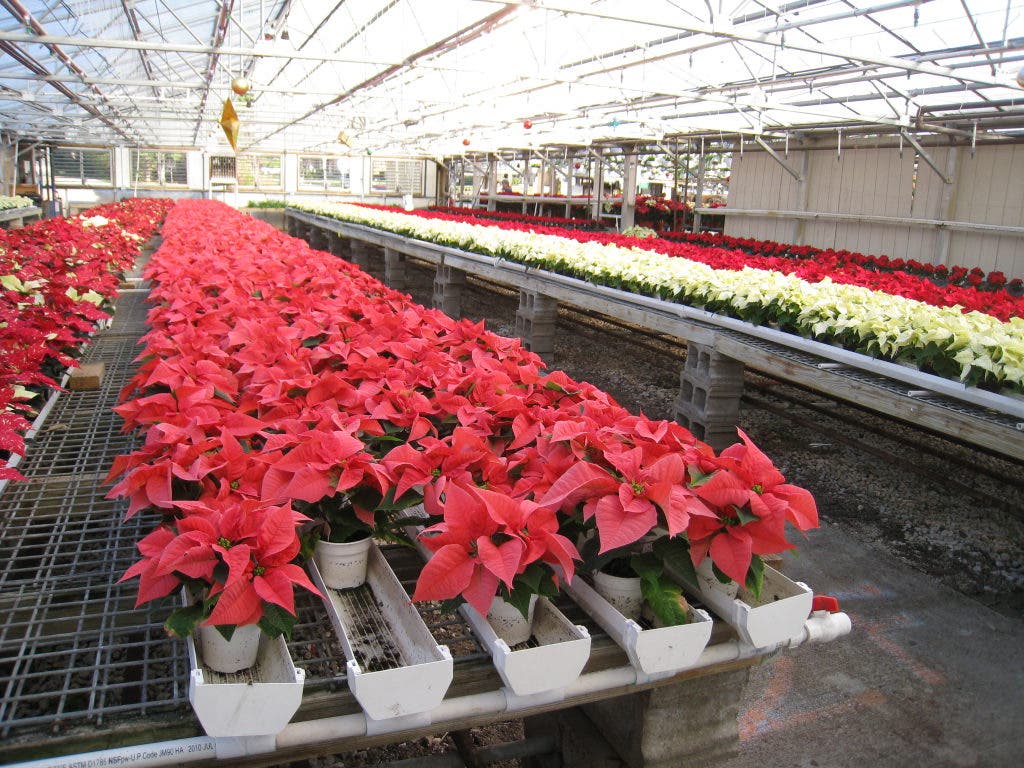


For sheer volume of plants purchased for the holiday season, the Poinsettia wins the prize. Sure, there is the intoxicatingly fragrant Paper white; the classic forced bulb, the Amaryllis, and traditional bouquets of red and white Chrysanthemum. But when the numbers are crunched, the Poinsettia reigns supreme.
They’re so popular in fact, that they comprise 85% of all potted plant purchases during the holiday season. The stats made me desirous to go online and learn a little more about this popular holiday plant.
I did know that Poinsettias are members of the Euphorbia family. Many popular plants belong to this family. One of my favorites, ‘Diamond Frost’ Euphorbia is a heat-tolerant, sun- loving bedding plant that has dainty white blooms all summer long.
Find out what's happening in Town And Country-Manchesterfor free with the latest updates from Patch.
It also has a milky white sap that is emitted when a stem is broken. This sap can cause an allergic reaction in some people. I can personally vouch for this reaction.
I had some Euphorbia’s in my flowerbeds that needed thinning out this summer. I spent about 30 minutes pulling them and placing them in my yard waste. When I went inside to wash up, my nose began to run and my eyes started stinging. By the time I got to my bedroom the pain in my eyes was so bad that I couldn’t even open them. And my nose was a virtual faucet!
Find out what's happening in Town And Country-Manchesterfor free with the latest updates from Patch.
The sap in the Euphorbia caused this unusual reaction. After a call to my internist and an emergency run (my husband, not me!) to the drugstore, steroids did the trick and I was feeling better. But, it was pretty scary!
So, there is a slight chance, if you handle Poinsettias a lot, you may react to the sap. If your eyes begin to sting and your nose turns on the waterworks, make a call to your doctor ASAP.
A common misconception about Poinsettias is that they are poisonous. I have to admit that I was in the group that believed this. After some investigating, I came to find out that lots and lots of Poinsettias needed to be ingested in order to render you unwell.
A study at Ohio State University showed that a 50-pound child would have to eat 500 Poinsettia bracts in order to complain of a stomachache. That’s a lot of Poinsettias! Hopefully Mom or Dad would notice “Junior” eating plant after plant and stop him before he ate every Poinsettia in the house!
Another fun fact about Poinsettias is that they’re a real boost to the economy of the United States. The good old USA produces 90% of all Poinsettias worldwide.
They’re grown in every state, but California produces the most. This is because the Paul Ecke Ranch in California was the first to begin propagating the Poinsettia. The plant was native to Mexico and introduced to the United States in 1825 by Joel Poinsett. The Ecke family improved the plant and the rest is history. To this day, 80% of all Poinsettias are grown in California at the Ecke Ranch.
Now let’s talk about all the different types of Poinsettias- there are actually 100 of them!
Last weekend George and I went to Wiethops to buy some Poinsettias. We buy our annuals and perennials from Wiethops, but George has never seen the array of Poinsettias there. We arrived on opening day to an amazing sight. Greenhouse after greenhouse filled with Poinsettias of all colors, sizes and shapes. To say that George was impressed would be an understatement.
As we wandered about, he suggested that I write about Poinsettias in my blog. Luckily, I carry my camera in my purse and I began snapping away.
Sure, you’ll find the basic bright red Poinsettia. We’re all familiar with it and it’s a traditional staple in December. You’ll also find pale pink Poinsettias with cream-colored trim; bright red leaves with splashes of pink along the margins; red leaves looking as if a painter splashed pink on the leaves. You will even find blue, gold and purple Poinsettias that are dusted with glitter. If you celebrate Hanukah, blue Poinsettias are a great addition to your holiday decorations.
At Wiethops, you’ll find Poinsettias as inexpensive as $2.50. Yup, I said $2.50. That’s not a typo. And it’s not a tiny plant, either. The most expensive Poinsettias are less than $30.
You’ll also find red Poinsettias planted in the same pot with white Chrysanthemums. There’s even a Poinsettia called “Winter Rose” that has super strong stems and a smaller, curlier leaf shape. George and I purchased “Ice Punch” Poinsettias. Most of the leaf is red, but there is a bright pink center in each leaf. If you like cream-colored Poinsettias, “Polar Bear” is for you. “Marble Star” is one of my favorites. It has a salmon-pink leaf with cream outlines.
You’ll find more colors than you can shake a stick at when you go to Wiethops.
If you notice the first photo on my blog, it shows a stunning waterfall with what looks like a Poinsetta in front of it.
George was in Nepal last month, volunteering for the Himalayan Family Healthcare Project. During a 9-hour trek up the mountains to set up the clinic, he came upon this scene in Chyamje. The Poinsettia was the traditional red and 8 feet tall! What a great photo and a surprise for him and the others in his group.
Finally, do you know how to pick out fresh Poinsettias? It’s actually very easy.
The plant should have sturdy bracts and leaves with no sign of weeping or dropping foliage. The flower clusters should show very little pollen. If the clusters are open and full of pollen, the plant is past its prime.
Buying from a nursery or greenhouse that turns its plant inventory quickly will yield a fresh plant. No need to overwater these guys, just keep the soil evenly moist. Keep them away from heating vents and you’ll have a great show all season long. Given that it is very difficult to get Poinsettias to rebloom, I compost mine after the New Year.
So, get out there and take a field trip to your favorite nursery to check out what’s new in Poinsettias. I think you’ll like what you see!