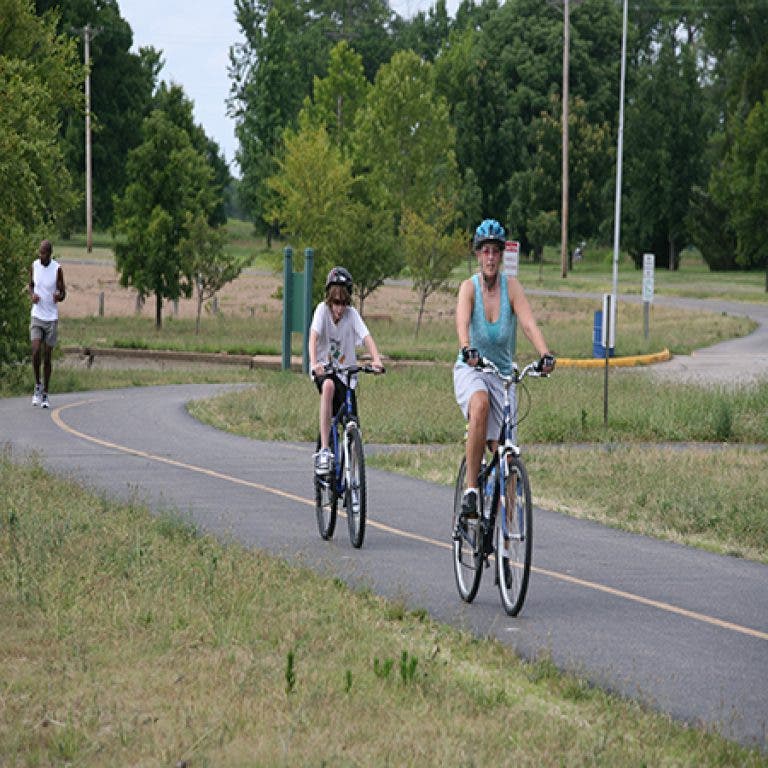


Greenway trails connect residents, increase safety in St. Louis neighborhoods
By Pam Powell, The Hauser Group
The power of a greenway is in the connections that it makes.
Find out what's happening in University Cityfor free with the latest updates from Patch.
With every project the Great Rivers Greenway District undertakes, improving the quality of life for residents within the communities is of upmost importance. As a result, over the past several years, the District’s greenways have transformed many unused or unsafe spaces in various neighborhoods into safe, walkable and accessible pathways to schools, parks, shopping, public transportation and other neighborhoods.
The Centennial Greenway, for example, is touching the lives of many residents and students who live, work and go to school in or around University City. In 2011, Great Rivers Greenway completed greenway trails that provide safer access to the Delmar Loop, as well as to Washington University. At the intersection of Delmar and Melville, the District put in a pedestrian crosswalk and as a result, created traffic issues and unsafe crossing conditions for pedestrians. Great Rivers Greenway also installed signals and synched them with traffic flow to create a safer environment for both drivers and pedestrians on Delmar. From Delmar to Washington University, Great Rivers Greenway widened an existing pathway so residents now have room to safely bike and walk, and the District also installed pedestrian-level lighting and several blue light safety phones and cameras, paid for by Washington University, along the trail. The cameras rotate 360 degrees, and coupled with the phones, give law enforcement greater capacity to identify perpetrators.
Find out what's happening in University Cityfor free with the latest updates from Patch.
“The Centennial Greenway along Melville is a great asset for the Delmar Loop and Washington University,” said Cheryl Adelstein, Director of Community Relations and Local Government Affairs for Washington University in St. Louis. “The greenway creates a great environment for pedestrians and cyclists traveling back and forth to Washington University. The enhanced lighting, the blue light phone system and designated bike path all create a safer and more pleasant experience.”
A little further west, a nearly two-mile-long portion of the Centennial Greenway that runs along I-170 from Shaw Park in Clayton, through University City and north to Olive Blvd., is giving nearby residents a safe and accessible path to various shopping centers. Before the trail was built, they could only get around via a poorly maintained and unsafe narrow sidewalk. While the trail won’t officially be complete until April, it is already making a world of difference to area residents.
“I feel safer walking on the new trail than I did before,” said Edie Sobel, a resident of nearby Crown Center Senior Living Community and member of the center’s walking group, who uses the trail to get to the Ladue Crossing Shopping Center. “It is so much easier to use and so much more comfortable. In the past, if there were bikers, you had to walk on the grass. Now you can just move to the side and they can easily ride by. When I’m with friends, since the path is wider and more even, we can easily walk side by side.”
Perhaps the most compelling example of a greenway that is helping to create a safer environment for residents is the St. Vincent Greenway trail, running nine blocks through Porter Park in the West End neighborhood in the City of St. Louis. Great Rivers Greenway worked to transform the park, which had fallen victim to crime and deterioration since it was first built in 1968. Knowing that access to well-maintained public parks significantly reduces crime, Great Rivers Greenway worked closely with residents, the City of St. Louis Parks Division staff and local law enforcement to identify specific improvements that would improve the usability and safety of the park. More than 25 hills were removed throughout the park to improve visibility for both trail users and local law enforcement, and new ornamental light fixtures were installed along the trail. Curbs at streets and alleyways were also sloped to ensure that people of all abilities could use the trail for fitness, recreation or as a transportation option.
“The biggest positive about the greenway is the new lighting,” said St. Louis Comptroller, Darlene Green, who has lived near the greenway since 2009. “The trail is now a well-lit, paved area that allows people who are walking around after the sun goes down to feel safe along the path.”
After several years of planning, the new park and trail opened in 2012, giving the neighborhood a bright future and creating a safe green space for children and neighbors to enjoy.
Further north on the St. Vincent Greenway on the University of Missouri-St. Louis campus lies the Wayne Goode Trail. A recent extension of the trail opened last September, providing students and residents with direct access to 4.3 miles of the St. Vincent Greenway, as well as to the 2.2-mile Ted Jones Trail and North County Bikeway. As part of the Wayne Goode Trail extension construction process, Great Rivers Greenway purchased and installed two blue light emergency telephones that are linked into the campus telecommunications system and are now monitored by campus police. The District also identified a potentially hazardous pedestrian crossing and installed a lighted tunnel to help residents and students safely cross the street without having to deal with traffic.
Tunnels can also be found along the Hamilton Carr Trail, which lies in the Western Greenway in the City of Wildwood. The tunnels have significantly helped residents, pedestrians and cyclists avoid crossing traffic on both Highway 109 & Old State Road. Great Rivers Greenway and Wildwood shared the cost of funding both tunnels.
Another trail in Wildwood has helped reduce trespassing issues since it opened in 2010. The Rock Hollow trail, which was also funded evenly by Great Rivers Greenway and the City of Wildwood, sits on the site of an abandoned road that was thought to be haunted. The dilapidated area would bring out swarms of teenagers in search of ghosts, and since the road has been transformed into a beautiful nature site, there has been significantly less trespassing.
In Bridgeton, the incorporation of a trail helped clean up another area that had seen its share of crime. In 2007, Great Rivers Greenway cut the ribbon with the City of Bridgeton and the Missouri Department of Conservation on the Riverwoods Park and Trail along the Missouri River Greenway. Prior to the development of the trail, the City of Bridgeton Police Department had repeated calls for service in this location. Most of the calls were for dumping, however, two meth labs were also found in the woods during the construction process. Since the development of the park and trail, the dumping and drug activity have disappeared. Now the typical call for service received by the City of Bridgeton for the area is when someone locks their keys in their car.
“The development of the park and trail really cleaned up an area where we had constant problems with dumping and other illegal activity,” said Walt Siemsglusz, Director of Parks at the City of Bridgeton. “[This area] has now been transformed into a recreation area for residents. The park and trail have made the area much more attractive, and the police department feels it is much safer now.”
As Great Rivers Greenway continues work on its planned River Ring, the District will continue to focus on ways to improve the quality of life of each individual in the region, helping to make each St. Louis community safer and more accessible than ever before.