Schools
'Splendid Heritage' Features Native American Artifacts
The Missouri History Museum's exhibit examines Native American art and culture.
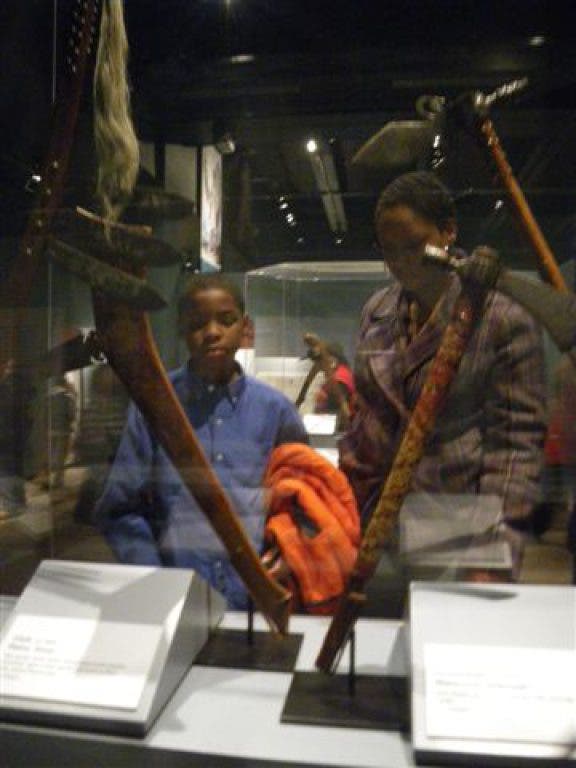


A throng of fifth graders from Arrowpoint Elementary School in Hazelwood poured through the entrance to the “Splendid Heritage: Perspective on American Indian Art” exhibition at the Missouri History Museum.
As they flowed through the exhibit space, increasing the decibel level to something around the intensity of a tribal rain dance, most of the boys headed to the weapons artifacts in the "Warriors and Hunters" display while many of the girls were drawn to the dolls in the "Woman’s Domain" section.
“It’s pretty popular with the kids so far, which is nice,” said Katie Van Allen, managing director of museum services.
Find out what's happening in Wentzvillefor free with the latest updates from Patch.
The exhibition, from the private collection of John and Marva Warnock, was organized by the Utah Museum of Fine Arts in 2009. The Missouri History Museum is the only Midwest venue to host the traveling exhibition. It opened Feb. 12 at the History Museum and will be on display through April 24.
“It’s a stunning show,” Van Allen said. “We’re happy to host it.”
Find out what's happening in Wentzvillefor free with the latest updates from Patch.
Splendid Heritage features about 140 objects representing 27 different tribes of Plains, Plateau and Northeastern American Indians. The displays are divided into categories, "Warriors and Hunters," "Celebrating Life," "Woman’s Domain" and “Artistry and Identities." Items range from weapons, clothing and cradles to ceremonial objects, such as pipes and dance sticks. The exhibit was a natural fit for the history museum.
“It has to have some connection to Missouri or our mission,” Van Allen said. “So the reason we brought (this exhibit) here is, of course we had Indians living in Missouri, and they’ve all been removed, for the most part, mostly living in Oklahoma. We have (access to) a significant American Indian collection, and we think it’s important to bring those cultures here. So anything, really, with a historical connection, and a story we can’t necessarily tell ourselves, we like to host (as) traveling exhibits.”
The exhibit examines the items as works of art and cultural artifacts.
“It’s pretty interesting because it’s a blend of art and history in one exhibit,” Van Allen said.
Each display is accompanied by a card identifying the object, when and where it was made and the tribe of the artist, plus brief text describing the art and culture related to the item. For example, a brightly colored beaded rawhide bag depicting a rider on horseback has an art description that states, “Unlike the more common geometric decorations found in Plains art, this bag is decorated with a pictographic image. The central figure of a man on horseback is portrayed in an energetic manner, his head breaking through the edge of the frame formed by white beads. By contrast, the geometric quality of the squares and triangles are a static counterpoint to the fluid figure of the horseman.”
The culture description says, “Plains Indian women created a variety of rawhide cases, painted in vibrant geometric designs, to accommodate the shapes and sizes of the objects they held. ... When not in use, owners often hung such bags directly over their beds, where they were believed to provide spiritual protection for their entire families.”
The artifacts are in good condition, particularly considering they date to the 18th and 19th centuries. They are colorful, ornate, and originally had specific uses in the daily lives of the tribespeople who created them.
“All these pieces have a function,” Van Allen said. “They weren’t just designed to be pretty.”
Lesley Moore, accompanying her son Langston Moore and his class from Arrowpoint School during the field trip, was impressed.
She pointed to a knife made by an American Indian living in the Plains area in 1840. A small but detailed figure was carved into the knife’s wooden handle.
“There’s a man--there’s literally someone there,” she said. “There’s color. So this is what I’m amazed at, because I know this has to take time, this has to take effort.”
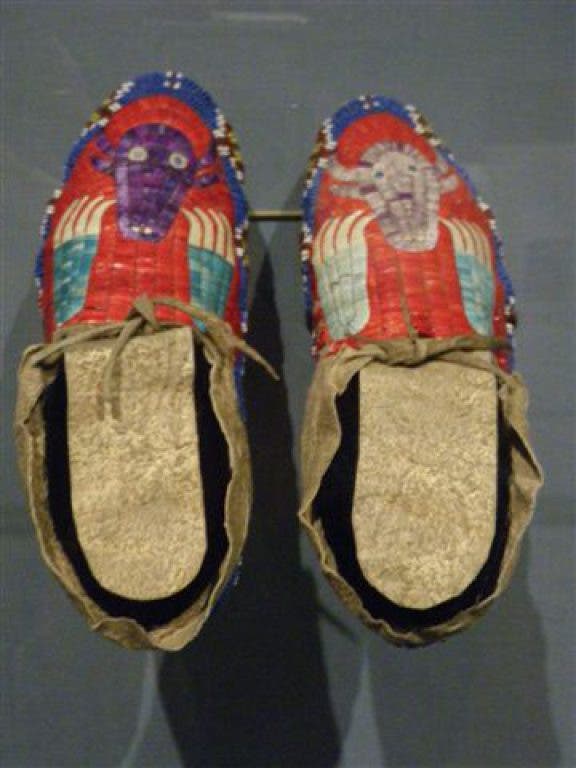
Footwear was essential, but it didn’t have to be decorated with a rainbow hue of beads and dyed quillwork--that was for flair or spiritual purposes.“Moccasins had a functional purpose, but they wanted it to be beautiful,” Van Allen said.
One pair of moccasins in the display uses porcupine quillwork and beads to design a buffalo head flanked by bear claws. The image is situated so it can be correctly viewed by the person wearing the moccasins. As the text accompanying the display indicates, “The buffalo and the grizzly bear are powerful spiritual symbols for Plains Native people; such a design may have derived from a vision or a dream.”
There are subtle history lessons woven into the fabric of the exhibit. The Indian Removal Act of 1830 caused greater associations among disparate tribes as they were placed together on reservations.
“Tribes were interacting with each other on the reservations, so you see a blending of the artifacts,” Van Allen said.
The Indian Removal Act led to the infamous Trail of Tears westward migration, which caused great suffering and many deaths among Indian tribes. An exhibit like this can make history come alive for schoolchildren.
“We’re talking about Native Americans and how they were pushed out of their areas,” said Nathan Williams, a teacher at Arrowpoint. “In social studies, we’ve talked about the Trail of Tears.”
There is also evidence of the introduction of European culture. The Native Americans acquired the iron and brass used in some of their weapons by trading with European settlers. Also, the Indians learned some of their artistic techniques from Europeans.
“For example, there are some moccasins over there,” Van Allen said, pointing to a display, “that the Huron women crafted, and they have floral designs that are embroidered. They were taught that by nuns, in what is now Quebec.”
Van Allen has a couple of favorites. One is a courting whistle, a long, thin reed-like instrument with an open-mouthed bird’s head carved into one end. It was made in 1885 of ash wood and porcupine quills, with a little sinew to hold things together.
“It was kind of a wooing technique,” she said. “Just like love songs in any society at any time. If you managed to do a good enough job, maybe you won the lady.”
Porcupines must have wanted to head the other direction when Native Americans approached, because their quills were used extensively for decorating many common items. Basically, the quills were split so they could be applied to flat surfaces, and sometimes dyed to add color. Van Allen is a real fan of the artistic skill required.
“I think it’s lovely,” Van Allen said. “I admire it because I think it would have taken such work to do. You’ll see some of these really intricate patterns and colors and shapes, and it’s all being done with quillwork.”
Pipe bowls, many of them carved with animal figures, also had a significant place in Native American art and culture.
“These are stunning,” Van Allen said, standing in front of a case in the exhibit’s “Celebrating Life” section. “They are separate from their stems because they are sacred objects. So to be displayed, they have to be separate. The pipe ceremonies were used for any number of celebrations, acknowledging relationships, and for business deals essentially. So you’ll see those represented for all the tribes.”
The exhibition has interactive elements, including a touch screen area that gives a behind-the-scenes look at the exhibit and a hands-on section where visitors can feel replicas of some of the objects displayed. There are also several lift panels that pose a question on the outside of the panel and have an answer that is revealed by lifting the panel.
A question panel near a horse dance stick on display asks, “What is a horse dance stick?” The answer underneath is, “The horse dance stick is an effigy. Effigies are sculptures that represent a particular person or animal. Each horse dance stick is created to honor a horse that has died or been wounded.”
Most of the clothing items, including moccasins, dresses and jackets, are in the “Artistry and Identities” section. The jackets and dresses, most of which have colorful, elaborate decorations, are displayed so they can be viewed from all sides.
“You can almost imagine people just wearing them,” Van Allen said. “Instead of flat and static, it sort of comes to life.”
Admission to “Splendid Heritage” is $8 for adults and $5 for seniors 65 and older, students, active military and children ages 6-12. Children younger than 6 are admitted free.
Related EventsTrail of Tears, presented by the St. Louis Repertory Theatre's Imaginary Theatre Company.
- Dates: March 25-April 3
- Time: Student matinees, 10 a.m. Fridays; general public, 2 p.m. Saturdays and Sundays
- Where: Lee Auditorium, lower level, Missouri History Museum
- Cost: $6; $5 for Missouri History Museum members and groups
Researching Blended Families: Native Americans in the African American Family
- Date: Saturday, April 16
- Time: 1-3 p.m.
- Where: AT&T Foundation Multipurpose Room, lower level, Missouri History Museum
- Cost: Free
American Indian Art: Imagery and Meaning
- Date: Tuesday, April 19
- Time: 7 p.m.
- Where: Lee Auditorium
- Cost: Free
The Missouri History Museum in at the northern edge of Forest Park, with the front of the building facing Lindell Boulevard at DeBaliviere Avenue. Take Interstate 64/40 east to McCausland Avenue.
Turn north on McCausland, which becomes Skinker Boulevard after crossing Clayton Road. Take Skinker to Lindell and turn east (right). Take Lindell to DeBaliviere and turn right (south).
Parking surrounds the museum.