Politics & Government
23% Of Residents 'Somewhat Or Very Likely' To Leave The Granite State In Next 5 Years: Carsey School
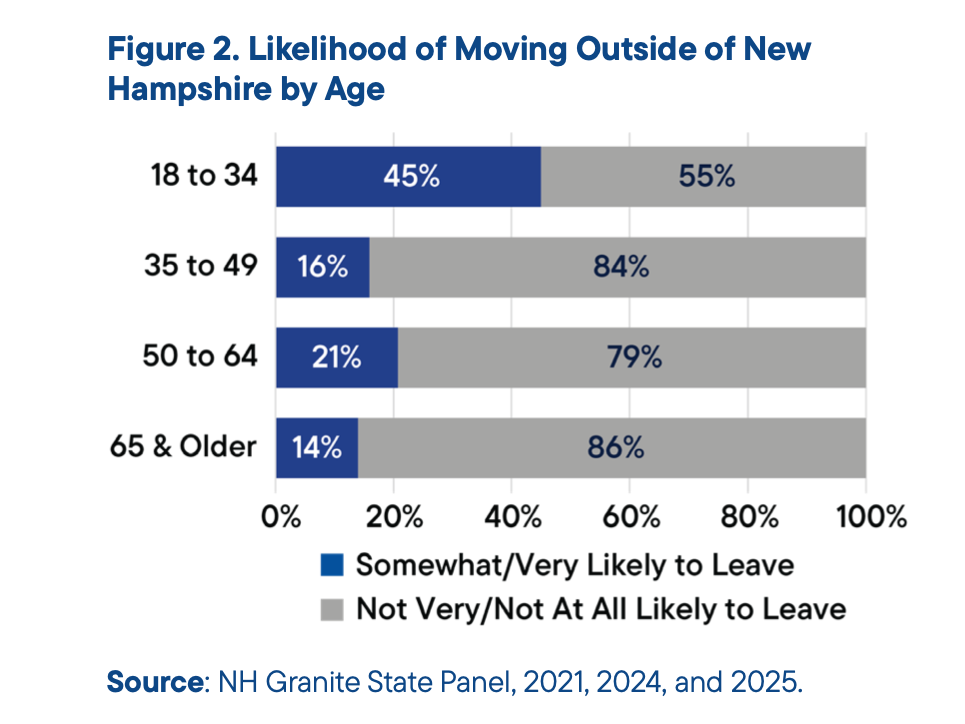
Younger, unmarried people were the most likely demographic to move out of state — with 54% saying they would likely leave New Hampshire.

New research from the University of New Hampshire (UNH) Carsey School of Public Policy provides insight into migratory patterns in and out of the state—who is more likely to leave, the factors driving people out of the state, and what could potentially keep more people from leaving.
UNH researchers pooled together data from three Granite State Panels conducted in 2021, 2024, and 2025, providing a representative sample of over 3,500 New Hampshire residents. Participants were asked about their likelihood of moving out of New Hampshire within the next five years, as well as the reasons behind their potential departure.
Find out what's happening in Across New Hampshirefor free with the latest updates from Patch.
They found that about 23% of New Hampshire residents are somewhat or very likely to leave the state in the next five years, regardless of people’s different characteristics and life experiences, meaning over three-quarters of those surveyed said they planned to stay in the state.
Younger and unmarried people were the likeliest demographic to move out-of-state, with over half (54%) claiming it was likely they would leave. There were no significant differences in likelihood of leaving New Hampshire by gender, race/ethnicity, household income, political party, or educational attainment, however.
Find out what's happening in Across New Hampshirefor free with the latest updates from Patch.
The researchers noted that New Hampshire has seen a longstanding trend of more people moving to the state than leaving it. In 2024, New Hampshire gained 8,100 residents, as 48,700 people moved in from other states while 40,600 people moved out.
Notably, nearby states reflected larger portions of people stating they were likely to leave, including residents of Vermont (42%), Connecticut (40%), Rhode Island (35%), and Massachusetts (34%).
So, what could be driving people out of New Hampshire—and what needs to be done to keep them in the state?
The top reason among those likely to leave was to seek cheaper housing or cost of living, nearly half (49%) responded. That was followed by the desire for a different political or social environment (37%), a different climate (31%), and new adventure or more excitement (29%).
What to do about those reasons is a bit less straightforward, the researchers pointed out. While economic reasons are the most prevalent, they don’t happen in a silo. Respondents showed that those reasons are often intertwined with climate, relationships, and new adventure.
With that in mind, the researchers explained that policies supporting a lower cost of living, more affordable housing, and greater employment opportunities do address some of those concerns, but since many people consider multiple factors in their decision to leave they are less likely to be convinced by improving one single factor.
“Policy changes to improve housing cost and availability, child care, and the quality and cost of education might tip the balance and dissuade some from leaving,” the researchers wrote.
UNH professor of sociology, senior demographer, and co-author of the report Kenneth Johnson told InDepthNH that the survey data used does not provide detailed breakdowns of each region of the state to clue into where people are more frequently migrating to and from in New Hampshire.
This story was originally published by InDepth NH.