Politics & Government
29,000 Granite Staters Could Lose Their Health Coverage, New Study Says
Unlike regular Medicaid, where costs are split, the federal government pays 90 percent under Granite Advantage.

CONCORD, NH — A new study by the NH Fiscal Policy Institute indicates from 23,000 to 29,000 New Hampshire residents will lose their Medicaid health insurance coverage by 2028 under new federal and state regulations and requirements set to begin Jan. 1.
The federal and state program provides health insurance to the poor, the disabled, the infirm and children with the impact from the changes largely falling on those in the Granite Advantage or Medicaid expansion program.
Find out what's happening in Across New Hampshirefor free with the latest updates from Patch.
Unlike regular Medicaid where the state and federal government split the costs, under Granite Advantage, the federal government pays 90 percent of the costs and the state 10 percent.
Those eligible are adults 19 to 64 with incomes up to 138 percent of the federal poverty level, or $22,025 for a household of one in 2026, or essentially the working poor.
Find out what's happening in Across New Hampshirefor free with the latest updates from Patch.
The new work requirement includes greater verification and administrative barriers for the 75 percent of adults enrolled in Medicaid who are working.
The study, New Medicaid Work Requirements Threaten Health Care Access for Up to 29,000 Granite Staters, With Several Implementation Decisions Still Left Up to the State, examines current Medicaid enrollment, the new federal requirements, decisions made by New Hampshire lawmakers and the potential consequences for residents and the state’s health care system.
The changes will impact those receiving health coverage in rural areas, as well as large cities like Manchester and Nashua, and people with disabilities or health conditions.
The changes could also impact already struggling hospitals and other health care providers who could see their uncompensated care increase as those losing insurance gravitate to emergency rooms for treatment or can’t pay their medical bills.
And ultimately the changes could increase health insurance premiums for private insurance as providers seek to offset the lost revenue.
Beginning Jan. 1, most adults enrolled in the state’s Medicaid Expansion program, or Granite Advantage, will be required to document at least 80 hours per month of work, community service, education or other qualifying activities.
States have flexibility in how they implement and enforce the requirements, and the group’s analysis notes the New Hampshire legislature this year adopted requirements stricter than the federal mandates.
Instead of having to document your work, community service or education hours every six months, the legislature passed a law this year requiring recipients document their hours every three months.
The state no longer allows those who claim they are working to self-certify as many states do, which would simplify the necessary documentation.
The state has other decisions to make that could further affect how many state residents will lose their health coverage.
The state has to determine the requirements for medical frailty exemptions, whether existing data may be used to automatically verify eligibility, to establish parameters for additional hardship exemptions, and how to coordinate outreach with health care providers and community organizations.
“The reality is that people who are working or who qualify for an exemption could lose their health coverage under the new federal law because they aren’t able to navigate the new, complex and time-consuming reporting requirements,” said Jessica Williams, Senior Policy Analyst at NHFPI and the author of the study. “New Hampshire still has important decisions to make about how these rules will work in practice, and those choices could make a significant difference in how many people get to keep their access to health care.”
As of Aug. 30, there are 166,607 state residents on Medicaid, with 47,954 on the Granite Advantage program and the rest on “regular Medicaid” of one kind or another.
Using 2025 census figures, about 13 percent of the state’s residents are on Medicaid, while about 7 percent of the adults from 19 to 64 are on the Granite Advantage program, which is about one-third of the total.
About 34 percent of the state’s children are enrolled in Medicaid, representing more than 44 percent of the total enrollment.
Medicaid enrollment varies across the state with 88 communities having a higher percentage than the state average of 13 percent.
The highest percentage in the state is the Coos County town of Stratford, which decades ago was a thriving paper mill town, but now has 30 percent of its population enrolled in Medicaid.
Other communities with high rates include Stewartstown, 28.8 percent, Warren, 27.3 percent, Claremont, 26.4 percent and Berlin, 25.4 percent. Berlin and Stewartstown are also in Coos County, while Warren is in Grafton County and Claremont in Sullivan County.
There are other places with nearly 25 percent of their population on Medicaid such a Manchester, 23.6, Franklin, 23.8, Newport, 24.9, Winchester 24.5, Lisbon, 24.1, Laconia, 24.5, and Northumberland or Groveton, 24.
Then there is New Castle on the Seacoast with 1.9 percent of its population on Medicaid, along with Hanover, at 2.1, Durham with 2.3, and Waterville Valley, 3.3.
Thirteen communities had less than 5 percent of their residents enrolled in Medicaid.
In terms of numbers, Manchester has 27,526 individuals on Medicaid; Concord, 7,647; Rochester, 6,635; Derry 4,277, and Portsmouth 2,302.
Medicaid enrollment peaked in 2022 when 240,849 residents were on Medicaid during the second year of COVID and almost 90,000 were on Granite Advantage.
During the COVID pandemic, those on Medicaid did not have to requalify for the program from year to year and the federal government upped its share of the cost from 50 percent, but not near the 90 percent it covers for the Granite Advantage program.
Beginning in 2025, the state began trimming back its Medicaid enrollment and began the process of requalifying those on the program.
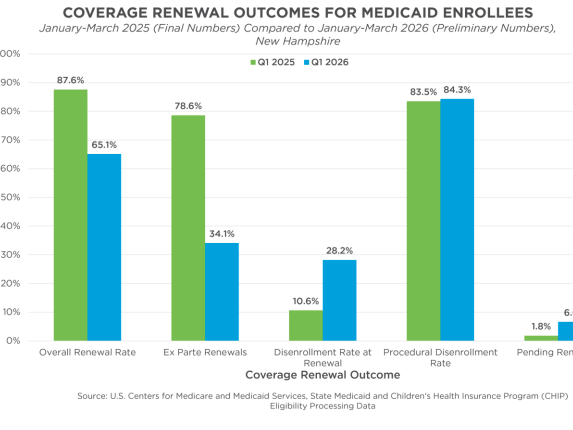
During the first quarter of this year, 28 percent of those up for determination lost coverage and most for procedural reasons not because they were not eligible, according to the study.
Changes in federal law caused some of the losses such as tightening up the definition of medically frail by requiring that the person must be “significantly impaired.”
The federal government also tightened the exemption for caregivers and narrowed the exclusion from the work requirement for substance abuse and treatment.
All of the changes are expected to mean from 23,000 to 29,000 state residents will lose coverage over the next year, including an estimated 4,000 to 6,000 young adults from 19 to 24 years old.
The Granite Advantage program reduced the uncompensated care costs for hospitals from its inception in 2014 to 2022 by 64 percent for emergency room use, by 54 percent for in-patient care, and 49 percent for out-patient care, according to figures from the New Hampshire Hospital Association.
Whether those figures hold if nearly 30,000 Granite Staters lose their health insurance is doubtful.
“These changes could affect more Granite Staters than only those who lose their Medicaid coverage,” said Williams. “When more people lose health coverage, hospitals and other health care providers may be left covering the costs of care that patients can’t afford to pay for. Those costs could ultimately be passed on to Granite Staters with insurance, including private insurance plans, through higher premiums. How New Hampshire implements these requirements could have major consequences for the state’s health care system as a whole.”
You can read the full study, New Medicaid Work Requirements Threaten Health Care Access for Up to 29,000 Granite Staters, With Several Implementation Decisions Still Left Up to the State, at
Garry Rayno may be reached at garry.rayno@yahoo.com.
This story was originally published by InDepth NH.