Politics & Government
Active With The Activists: Execution Is Wrong No Matter How It Is Carried Out
Alpert: The repeal of the death penalty passed the House and Senate in 2000, only to be vetoed by Democrat and then-Gov. Jeanne Shaheen.


Above, then-Sen. Martha Fuller Clark congratulates Rep. Renny Cushing, both Democrats, for his work overturning the death penalty in New Hampshire in this file photo after Gov. Chris Sununu’s veto was overridden on May 30, 2019. Rep. Cushing died March 7, 2022 PAULA TRACY photo
As Tennessee’s failed attempt to kill Christa Pike unfolded earlier this month, my thoughts returned to my entrance into the movement for the death penalty to be abolished. The year was 1985 and the state’s attorney general, Steve Merrill, had proposed changing the state’s method of execution from hanging to injection of lethal chemicals.
Find out what's happening in Across New Hampshirefor free with the latest updates from Patch.
At the time, I was four years into my tenure at the local office of the American Friends Service Committee, a group founded on the principles and practices of the Religious Society of Friends including a commitment to nonviolence and opposition to capital punishment.
To Merrill, hanging was considered so barbaric that juries would be unlikely to sentence anyone to death. As a more humane way to kill people, he argued, lethal injection would be more likely to get used and therefore make the death penalty a more effective deterrent to those considering homicide.
Find out what's happening in Across New Hampshirefor free with the latest updates from Patch.
New Hampshire Quakers were appalled. Deciding the proper way to kill people was the wrong question. When the state deliberately kills a human being, they said in a letter to lawmakers, “it tends to foster a general disrespect for life and sets a poor example for others who may be tempted to kill or inflict harm for revenge or punishment.” Instead of debating the method used by the State to kill people, they wrote, “executions should be eliminated as an available form of punishment.”
I accompanied Marian Baker, who served as clerk for the Quaker meeting at which the letter was approved, to deliver the statement at a House hearing. A decade later, I was among the founders of the NH Coalition to Abolish the Death Penalty, which spent two more decades working for the state’s death penalty to be repealed.
Oddly enough, it was a series of murders in 1997 that propelled the repeal movement. The killings of three police officers, the rape and murder of a six-year-old girl, and the murder of a judge and a journalist — all within a two-month period — created political conditions that made death penalty expansion politically popular, regardless of the fact that those killings were largely covered already by the state’s capital murder statute. When the 1998 legislative session opened, Republican leaders of the state House and Senate teamed up with Democratic Gov. Jeanne Shaheen to introduce a bill greatly expanding the list of crimes punishable by execution. Passage appeared likely.
With leadership from the NH Council of Churches, participation of Concord’s rabbi, the local ACLU, AFSC, several Quakers, and a few legislators, we organized to defeat the expansion proposal. On the day of the vote, two of our legislative allies decided that instead of simply arguing against expansion, they would call for the death penalty to be abolished altogether.
Rep. Clifton Below, then 42 years old but already a veteran legislator, was the son of a Protestant minister and brought a preacher’s touch to his speech on the House floor. “When possible,” he said, “we should choose life over death, good over evil, the possibility of redemption over destruction, of healing over revenge, love over hate.” Speaking about the potential of every human being — even those who have committed brutal violence — to repent and gain redemption, Below lifted up the example of John Newton, a slave ship captain who was responsible for the death of scores of men, women, and children. Seeking redemption from such evil, Newton became an activist in the movement to abolish the slave trade and wrote the beloved hymn, “Amazing Grace.”
“Who are we to deny the possibility of redemption, true change, and healing?” Below asked.
Rep. Renny Cushing followed, addressing the 350 House members from his perspective as the son of a homicide victim. Ten years earlier, he recalled, his father was watching the Celtics on TV when he answered a knock at the front door. “Two shotgun blasts were fired through the screen, lifting him up and hurling him backwards, the shrapnel lifting the life out of him before my mother’s eyes.”
“The most difficult thing I have ever had to ask anyone was for help in getting my father’s blood cleaned off the floor and walls,” he explained.
“If we let those who murder turn us to murder,” Cushing said, “it gives over more power to those who do evil. We become what we say we abhor. I do not want the state of New Hampshire to do to the man who murdered my father what that man did to my family.”
The repeal measure failed that day, but so did expansion. For death penalty opponents, it was a moment of awakening to the fact that abolition was possible, that moral arguments had weight, and that the stories of murder victim family members who rejected retribution could be transformative. Joined by faith leaders, wrongly accused death row survivors, civil rights activists, along with former judges and prosecutors, we worked for years to overcome the notion that it was beneficial for the State to kill people who had killed people to show that killing people was wrong.
Death penalty repeal passed the House and Senate in 2000, only to be vetoed by then-Governor Jeanne Shaheen. We kept the abolition campaign going. Another repeal measure passed in 2018 but was vetoed by then-Gov. Chris Sununu. Finally, repeal was adopted by a wider margin in 2019 and again vetoed by Sununu. But this time, with Rep. Renny Cushing still leading the way, two-thirds of the House and Senate members voted to override the veto. The death penalty was repealed.
Four bills which would have brought back the death penalty were proposed in 2026. Murder victim family members, including Cushing’s sisters and one of his daughters, returned to testify in opposition. Virtually no one showed up to speak for the proposals. With so little support, the reinstatement bills went down to defeat on the House consent calendar, their rejection so non-controversial that no debate was needed. “The overwhelming majority of New Hampshire citizens do not wish for the death penalty to be reinstated under any circumstances,” said Rep. Terry Roy, the Republican chair of the Criminal Justice Committee.
Arguments about the methods used to execute people have never been central to the debate in New Hampshire. Instead, opponents focused on the frequency of errors in the criminal legal system, racially biased application, moral objections, and the absence of evidence that the death penalty deters those who would commit homicide. As Gilles Bissonnette of the NH ACLU said recently, “New Hampshire repealed the death penalty in 2019 because it is inhumane, unjust, racist, and error-prone—things that are all still true today.” Yet, the story of Christa Pike surviving two attempts to kill her with toxic chemicals and the plans of Secretary of Defense Pete Hegseth to livestream an execution are evidence that the death penalty’s use is barbaric.
If that’s too strong a word, try “cruel,” the word used in the 8th Amendment to the U.S. Constitution and Article 33 of New Hampshire’s. The method doesn’t matter. As Amnesty International puts it, any methods used to commit execution are “inhumane and unacceptable.”
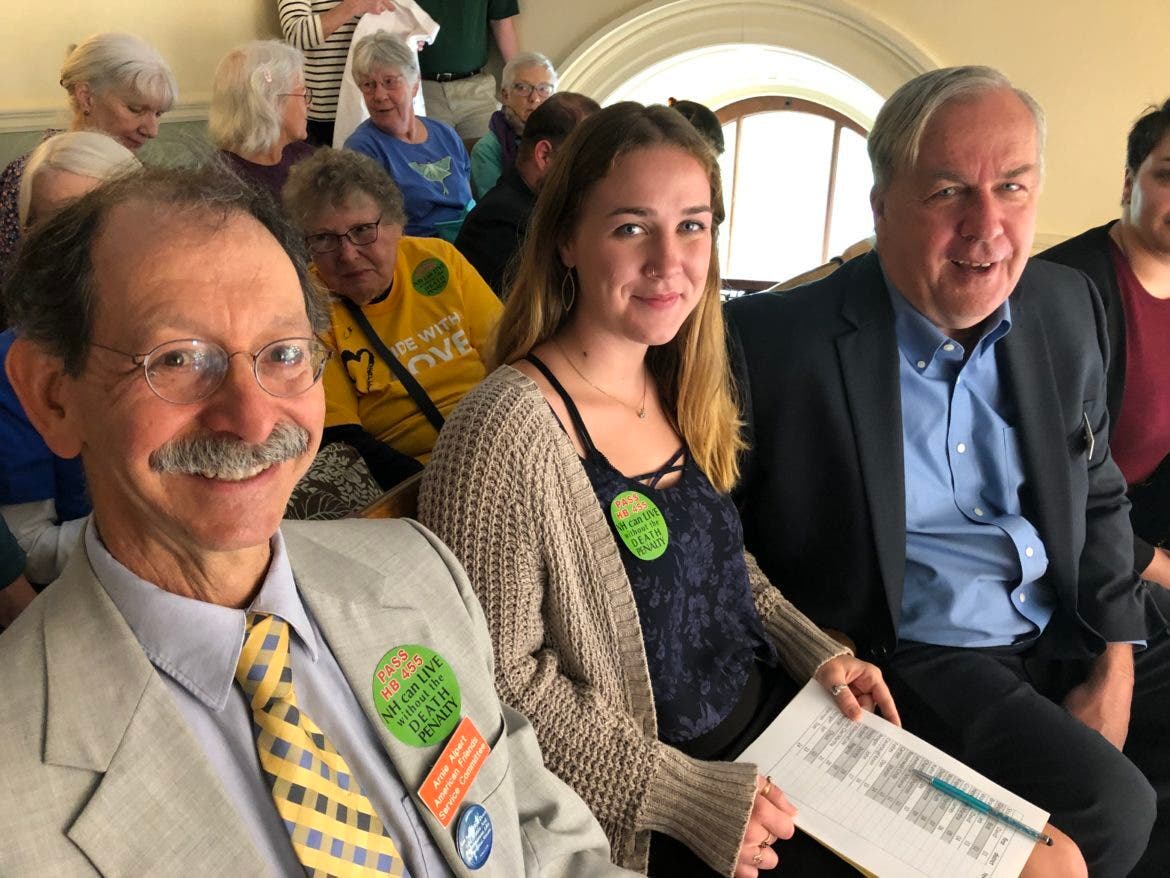
Editor’s note: Below, Arnie Alpert is pictured speaking to Paula Tracy, InDepthNH.org, on May 31, 2019.
The other constitutional term is “unusual,” which appears both in the U.S. and NH constitutions, paired with “cruel.” No one has been executed in New Hampshire for 87 years and since 2019 no one can be sentenced to death. By any interpretation, that qualifies execution as unusual.
In New Hampshire a single person, Michael Addison, sits in prison sentenced to be killed by the state in retribution for a murder he committed twenty years ago. As his attorneys have argued, the people of New Hampshire through their legislators have agreed that the death penalty is cruel. And since Addison is the only person who could be killed by the State, his defense team has stated, his execution would surely be unusual. When Addison next returns to Court, the judge should agree and rule the application of capital punishment to be unconstitutional.
Steve Merrill ultimately succeeded in changing New Hamshire law regarding the method of execution, which now can be either hanging or toxic injection. When all uses of the death penalty have been deemed illegal, the means used to perform this act of cruelty will no longer matter.
Arnie Alpert spent decades as a community organizer/educator in NH movements for social justice and peace. Officially retired from the American Friends Service Committee since 2020, he keeps his hands (and feet) in the activist world while writing about past and present social movements. You can reach him at arnie.alpert@indepthnh.org.
This story was originally published by InDepth NH.