Politics & Government
Attorney General Wants Claremont Education Decisions Overturned
NH AG John Formella argues the Supreme Court's decisions and those following it were "wrong as a matter of constitutional text, purpose."

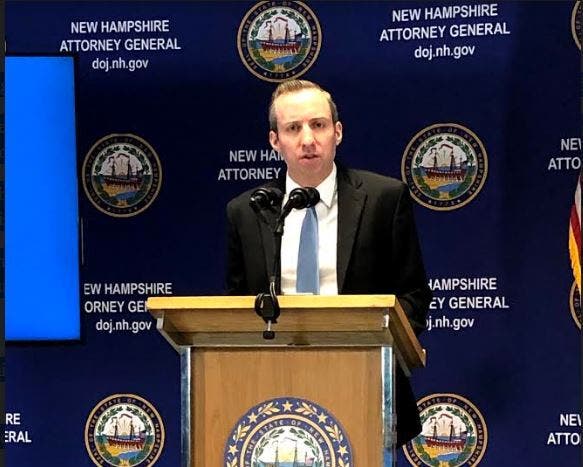
CONCORD, NH — The two original Claremont education funding decisions should be overturned in whole or in part, the state argues in its 125-page brief in its appeal of the superior court’s Rand decision.
The Claremont decisions have been the foundation of the state’s education system since they were issued three decades ago.
Find out what's happening in Across New Hampshirefor free with the latest updates from Patch.
Claremont I found the state has a constitutional duty to provide an adequate education for the state’s children and to pay for it, while Claremont II found the education funding system dependent on widely varying local property taxes was unconstitutional.
The Rand decision found that the state has failed to meet its obligation to provide an adequate education as well as special education services, to fund both, and the funding system is still unconstitutional.
Find out what's happening in Across New Hampshirefor free with the latest updates from Patch.
In its brief filed Friday, the Attorney General argues the Supreme Court’s decisions and those following it are “wrong as a matter of constitutional text, structure, purpose, history and tradition, are poorly reasoned, and, as a result, have led to the impractical and unworkable state of affairs that exists today in our education funding law.”
Without a clear ruling that the decisions should be overruled, the Attorney General argues, the cases present the risk of dissolving into judicial chaos and violating the separation of powers principle.
They also argue the issue of constitutional funding is a “non-justiciable political question” that negates the plaintiffs standing to bring the case making their claim non-viable.
“. . . a local education property tax authorized by a municipal entity is not converted into a state tax simply because that municipal entity chooses to spend such revenue to cover an adequate education cost; and that the State is not required to fund the full measure of special education costs incurred by school districts,” Attorney General John Formella writes.
If the court is not willing to overrule the Claremont I and Claremont II related decisions, the state wants the court to count the contributions of both state and local governments together so that local property taxes can count toward the state’s constitutional responsibility to pay for an adequate education.
The heart of the Claremont II ruling is that local property taxes with widely varying rates cannot be used as a state tax when the state constitution requires proportional and reasonable taxation.
That ruling was upheld in both the Rand case and the ConVal case which the Supreme Court upheld in July 2025.
The state’s brief also offers a series of narrower ways to throw out the Rand case without ruling on the larger questions, including the standing of the plaintiffs, the legal treatment of local taxes, the parties named in the lawsuit, the evidence presented at trial, and the funding of special education, according to a statement from the New Hampshire School Funding Fairness Project.
“At the highest level, the state is asking for the current system to stay exactly as it is while taking away every meaningful way for students, taxpayers, and communities to question whether the State is doing enough,” said Zack Sheehan, Executive Director of the New Hampshire School Funding Fairness Project. “The costs do not disappear because the State refuses to define or confront them. They continue to be paid through local property taxes, school budget cuts, and unequal opportunities for students. The State now wants credit for those local taxes as though that were the State fulfilling its own responsibility.”
Since the original rulings, no subsequent Supreme Court decision has disagreed with the original principles in the two cases and the Legislature has to date failed to bring the state education system into compliance with those two Claremont rulings.
The argument presented by the Attorney General for overturning the Claremont decisions echo a brief filed by former Representative and attorney Gregory Sorg that the court relied on the wrong section of the law in making its original Claremont decision.
The brief was filed on behalf of House Speaker Sherman Packard and much of the House leadership at the time.
A similar argument is the basis for House Bill 1815, which passed this year and was signed by Gov. Kelly Ayotte, which requires a “shared responsibility between the state and local government” to provide and pay for an adequate education without setting a floor for the state’s contribution.
The bill described local governments and school districts as “indivisible from the state,” said State and local entities function collectively, and changed the adequacy formula so that it is merely “computed toward” the cost of an adequate education.
The language in the bill is similar to what the Attorney General argued in the brief.
In the Rand and ConVal cases, the state presented no evidence of what constitutes an adequate education or what it costs, and the Supreme Court’s ruling in the ConVal case noted that.
“The State now argues that Claremont created an impossible moving target and lawmakers cannot know what the courts will consider enough,” Sheehan said. “But before arguing that the constitutional standard is impossible to satisfy, the State should have to show that it seriously tried to satisfy it. In ConVal, Judge Ruoff found, and the Supreme Court confirmed, that the State did not present any affirmative evidence showing that its existing funding level was sufficient.”
The State also argues that these cases have allowed courts to intrude on decisions that belong to elected officials. But the ConVal ruling illustrates the limits courts have placed on their own role.
“In the ConVal ruling, the Court enforced the Constitution, but it did not write the State budget,” Sheehan said.
“It recognized the Legislature’s role in developing a solution while preserving the judiciary’s basic responsibility to make sure constitutional rights are not ignored.”
The ConVal ruling said it was incumbent upon the legislative and executive branches to remedy the constitutional deficiency.
The Attorney General filed the brief Friday with the State Supreme Court, which had been expected to hold oral arguments by the end of the year, although that may change as Chief Justice Gordon MacDonald is on medical leave leaving four justices to decide cases.
Earlier the Plaintiffs had asked four of the five justices — including MacDonald — to rescue themselves citing prior involvement in either the original Claremont case or subsequent ones, including ConVal or prior statements about the original Claremont decisions.
The four justices refused to take themselves off the appeal of Rand.
“At the end of the day, the State is asking the Court to make the school funding problem harder to challenge instead of actually solving it,” Sheehan said. “Families will still receive the property tax bills. School boards will still face impossible budget choices. Students will still have different opportunities depending on the property wealth of the community where they live. Calling that ‘shared responsibility’ does not make it adequate, fair, or locally controlled.”
Garry Rayno may be reached at garry.rayno@yahoo.com.
This story was originally published by InDepth NH.