Politics & Government
Botteri: NH IOP At 25 — A Founder's Perspective
Advisor: My hope is the Institute's success will always be measured not only by who comes to speak but how many students are in the room.

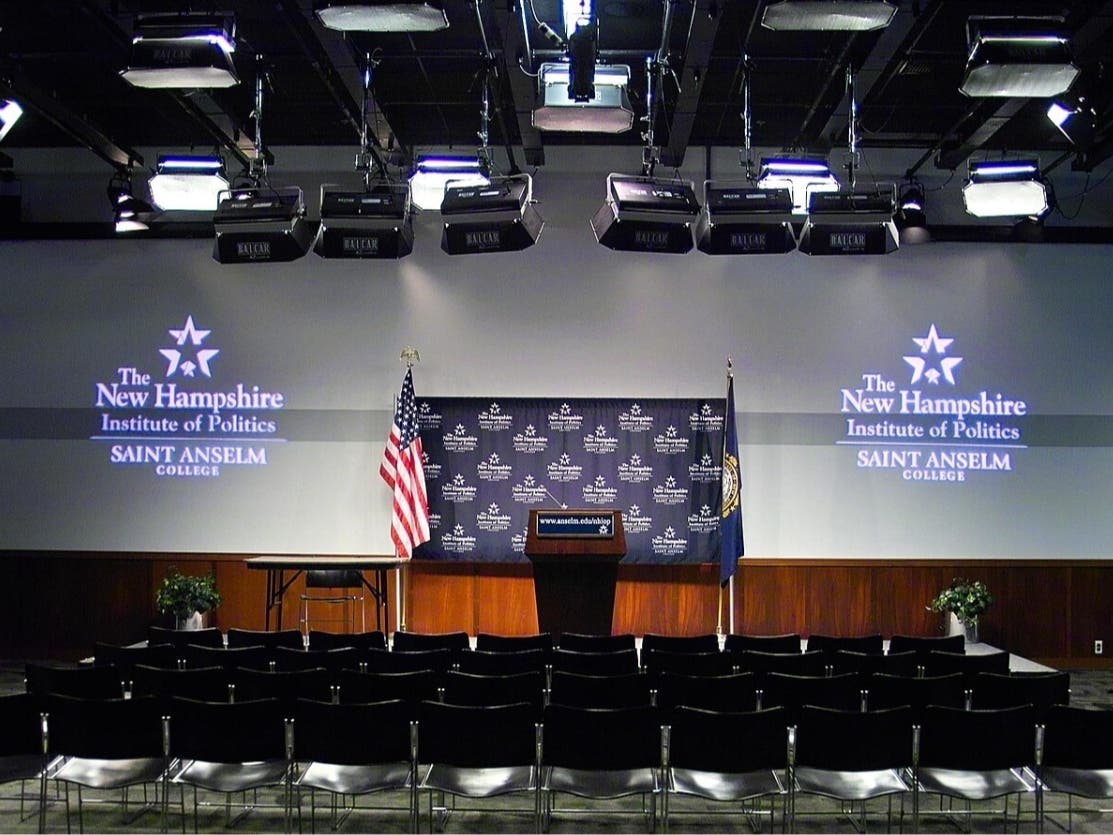
The 25th anniversary of the New Hampshire Institute of Politics at Saint Anselm College has rightly received attention from New Hampshire Journal and other news organizations. The Institute has earned it. Over a quarter century, it has become an important venue for presidential candidates, journalists, elected officials, and political leaders.
As one of the NHIOP’s three founding executive directors, I have been grateful to see that history recognized. But this anniversary is also an opportunity to remember the larger idea behind the NHIOP, one that extended well beyond candidates and debates.
Find out what's happening in Across New Hampshirefor free with the latest updates from Patch.
Long before the Institute opened its doors, political candidates had been welcomed to Saint Anselm. The Institute was created to build on that strength — to connect politics, public policy, and civic life more intentionally to a Saint Anselm education for students of every major.
The premise was simple: Whatever students chose to study, life after college would include responsibilities as citizens. A college degree wasn’t just about getting a job.
Find out what's happening in Across New Hampshirefor free with the latest updates from Patch.
A nursing major would encounter questions about health policy. A business major would confront regulation, economic policy and ethics. A theology major might consider the role of religion in public life. The Institute could bring those questions out of the textbook, giving students opportunities to question candidates, public officials, journalists and thought leaders.
Faculty were essential to making that possible. They brought their disciplinary expertise and intellectual rigor to the Institute’s work, helping students connect what they heard in its auditorium to what they were studying in their classrooms. They challenged assumptions and helped put the political questions of the moment into historical, economic, ethical and social context. And many times, they set aside the day’s planned lecture to welcome a governor or senator into the classroom discussion.
That educational mission is the most important part of what the Institute has accomplished over 25 years. Saint Anselm graduates who experienced the NHIOP have gone on to careers in journalism, government, public policy, advocacy, lobbying, Capitol Hill and other arenas of public life. Students who once sat in those rooms asking questions are now participating in consequential conversations themselves.
For a Catholic liberal arts college, creating the NHIOP was a bold commitment, but one entirely consistent with Saint Anselm’s intellectual tradition. Its emergence as a nationally recognized venue for presidential politics is worth celebrating, as is former U.S. Sen. Judd Gregg’s extraordinary partnership. Gregg strongly believed that Saint Anselm — with its liberal arts curriculum, strength in the humanities, and commitment to educating engaged citizens — was well suited to the idea. The Institute was made possible by that vision and by a Saint Anselm president and Board of Trustees willing to take a risk on an ambitious idea, including transforming a former military facility into a center for political and civic engagement. It was sustained by Saint Anselm’s Benedictine community, by faculty and staff and, most of all, by the students for whom it was created.
The NHIOP’s founding purpose may be even more relevant today.
At a time when colleges and universities are wrestling with how and whether to engage in difficult political and civic questions, Saint Anselm continues to embrace the work of civic engagement. That commitment is worth celebrating.
And as we celebrate, my hope is that the Institute’s success will always be measured not only by who comes to speak or how much national attention it attracts, but by how many students are in the room, what role they play in the conversation and what they carry with them after they leave Saint Anselm.
Anne Botteri is a communications strategist and advisor to colleges and universities. She previously served as a founding executive director of the New Hampshire Institute of Politics and as chief communications officer at Saint Anselm College, where she worked from 1990 to 2011. She wrote this for NHJournal.com.
This story was originally published by the NH Journal, an online news publication dedicated to providing fair, unbiased reporting on, and analysis of, political news of interest to New Hampshire. For more stories from the NH Journal, visit NHJournal.com.