Politics & Government
‘CHARLIE Act' HB 1792 Creates Fear Not Protection, Committee Told
HB 1792 would prohibit public schools from teaching "critical race theory, LGBTQ+ ideologies, identity-based ideologies, Marxist analyses."

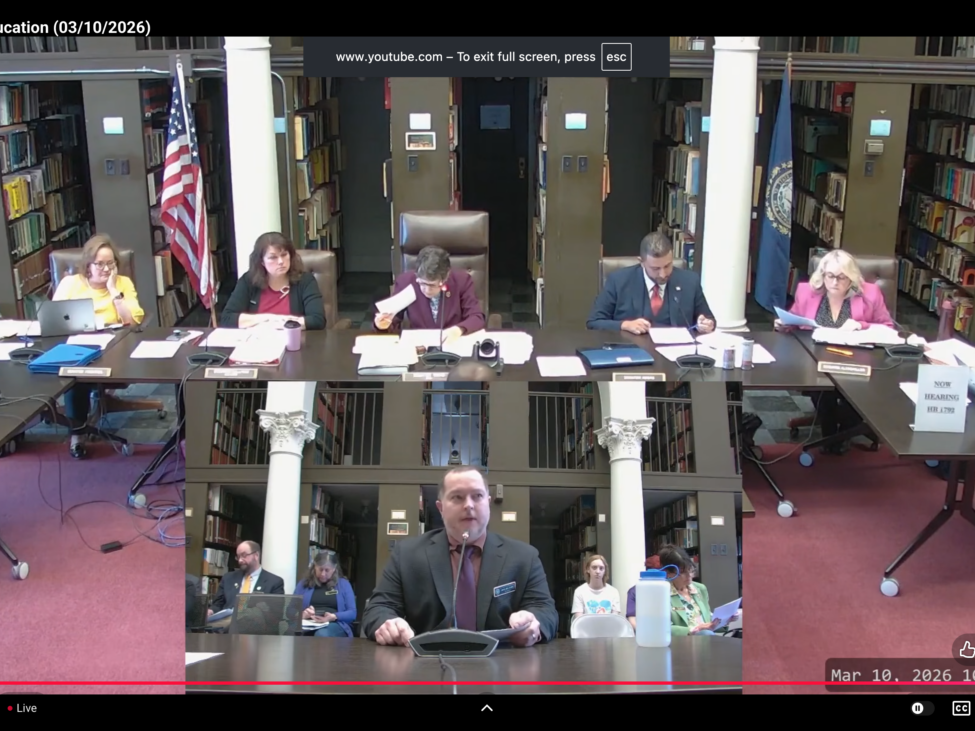
CONCORD, NH — The sponsor of the “CHARLIE Act" told a Senate Committee Tuesday he seeks to restore neutrality to public education.
But another Representative testifying said it is not neutrality when you target left-wing ideologies, but not right-wing ideologies, to ban from public schools.
Find out what's happening in Across New Hampshirefor free with the latest updates from Patch.
House Bill 1792, known as the "CHARLIE Act" for Charlie Kirk, would prohibit public schools from teaching “critical race theory, LGBTQ+ ideologies, identity-based ideologies, and Marxist analyses.”
It would also ban “pedagogical practices and praxis, derived from Hegelian or Marxist dialectical analysis, Paulo Freire's critical pedagogy emphasizing ‘critical consciousness’ or conscientização, Gloria Ladson-Billings' culturally relevant pedagogy, Kimberlé Crenshaw's intersectionality framework, critical race theory (CRT), critical legal theory, LGBTQ+ ideology as a prescriptive world-view, and similar approaches, often promote purposeful division by framing society through lenses of inherent oppression, liberation narratives of overthrowing systems and hierarchies, systemic inequity based on identity groups, or anti-constitutional narratives.”
Find out what's happening in Across New Hampshirefor free with the latest updates from Patch.
The bill would establish a private right to civilly sue a district and a teacher if a person believes the law has been violated. The school district and teacher could be fined up to $10,000 and the teacher could lose his or her teaching license.
The bill’s prime sponsor, Rep. Mike Belcher, R-Wakefield, said under his bill education could not be anti-American or anti-Constitution, but instead would be Pro-American and not about divisions.
“I sponsored this bill because parents have watched their children’s classroom become more and more politicized,” Belcher told the Senate Education Committee Tuesday. “They are teaching children what to think, not how to think.”
Belcher claimed his bill does not infringe on a teacher’s free speech, noting no teacher has the right to say whatever he wants to children who are held captive.
Teachers are bureaucrats, he said, and they must follow the policies set by the legislature.
Belcher said he followed the lineage of theories and pedagogies in place today, back to Hegel and Karl Marx and claimed they have intentionally been embedded in the curriculum of teacher colleges and are intended to divide people into the oppressors and the oppressed, and teach that certain races have inherent qualities.
But Rep. Nicholas Germana, D-Keene, a professor of European History and Hegel scholar, took issue with Belcher’s interpretation of Hegel’s and other lines of thought, saying ideological lineage is a very dangerous phrase and you could trace the lineage all the way to Aristotle.
“You will find that no one teaches this in any of our public schools,” he said. “To say this is not a ban on ideology and is neutral is not an accurate description. It is not remotely accurate about neutrality when it refers to just left-wing ideology. What about right-wing ideology?”
Where does the line get drawn? Gemana asked.
Germana was not the only one taking issue with Belcher’s bill, as the sponsor was the only person speaking in favor, and the rest of the people testifying in the nearly two-hour hearing opposed the bill as did about 1,300 people filing testimony in opposition to the bill when it was before the House, while about 350 people supported it.
The bill passed the House on a 184-164 vote nearly down party lines.
The Attorney General’s Office also opposed the bill saying it will meet the same fate as two other similar bills the legislature passed in the past few terms, one banning divisive concepts from being taught and the other mirroring President Trump’s executive order banning diversity, equality and inclusion programs from public schools.
Both bills have been enjoined and the divisive concept bill was found to be unconstitutional and the other is expected to have the same fate when that ruling is released.
Senior Assistant Attorney General Sean Locke, the head of the Civil Rights Unit, said his office opposes the bill as written as it conflicts with other state laws and — like the other attempts before — it will be challenged on its vagueness.
Locke said schools cannot discriminate against students in Kindergarten to the 12th grade, and have to provide a safe environment for all students, but the bill would put both schools in a “Catch 22” when using the tools they have to prevent students from bullying someone in one of a protected class.
While Belcher said his bill would not increase the Attorney General’s budget if it were challenged because the justice department was already involved in the two other cases, Locke said that is not true it would be a new case and require additional funding.
Locke noted there had not been a groundswell of complaints filed when the other bills passed saying there was only one complaint that came through his office.
He said people may not be filing complaints now because they know the last bill to pass was enjoined by the federal court.
A number of teachers or former teachers testified in opposition to the bill.
Deborah Nelson of Hanover, who taught high school English and history for 30 years and is a current member of the Hanover School Board, said the bill weakens local control as the local school board sets curriculum not the state.
The bill also weakens equal access to information and is a threat over the heads of teachers, she said.
She quoted the old New York Yankee sage Yogi Berra, “It’s deja vu all over again.”
Nelson said she taught American Studies for many years where students debated some very complex issues and there was never any subversive dialogue nor did anyone ever file a complaint.
They learned how to question, how to do research, how to understand and how to rewrite, she said.
“High school students are not as easily influenced as some fear,” Nelson said.
Robert Moore of East Kinston, a retired science teacher, said there was a time when academic freedom was not challenged.
He said the bill challenges certain frameworks that could be used to discuss racism and noted the era of redlining when financial institutions made it impossible for black people to get loans to move into specific neighborhoods.
That practice took a federal law to end, he noted.
To discuss the history of redlining is not indoctrination, it is simply part of the country’s history, Moore said. “You should have the academic freedom to share this history.”
It would be a disservice to a student studying for an AP exam who did not have that history, he said.
To discuss ideology in the classroom and do it safely, is not indoctrination, Moore told the committee.
Brian Hawkins of the National Education Association NH said the bill is vague which can lead to subjective interpretations and therefore arbitrary enforcement.
He is worried the bill would impede competency based teaching saying teachers may be reluctant to discuss certain issues brought up by students.
He said reports of widespread indoctrination is a fictitious narrative.
The other similar bills have led to an unhealthy pall over teachers and led to attrition and retention issues, Hawkins said. “Let’s not add to the pall.”
James McKim, of Goffstown, and the vice president of the Manchester regional chapter of the NAACP said he travels all over the state to schools as a consultant and said there is no merit to the implication that students are being indoctrinated.
He is also a plaintiff in the lawsuit filed challenging the DEI prohibition bill.
“No child should be made to feel inferior because of who they are,” he said. House Bill 1792 rests on the dangerous idea that the use of certain pedagogies equates to indoctrination, McKim said, and that is not happening in classrooms and not what a confident democracy does.
“The real harm lies in how this bill tries to control pedagogies, the way teachers teach by banning approaches that encourage discussion, empathy and critical thinking,” he said, “and block students from understanding the lived experience of people of color and other marginalized groups.”
When a teacher fears honest discussion is punishable, they go silent, McKim said, and when there is silence students learn less, especially about those who have already been ignored and that is not protection, that is fear.
“What HB 1792 tells families like mine, is that race, gender identity and sexuality are too controversial to discuss,” he said. “That does not make us safer, it makes us smaller.”
The public hearing on HB 1792 was continued until next Tuesday.
Garry Rayno may be reached at garry.rayno@yahoo.com.
This article first appeared on InDepthNH.org and is republished here under a Creative Commons license.