Politics & Government
Don't 'Mass Up' SNAP: High Error Rates Leave Taxpayers Facing The Bill
Massachusetts had a fiscal year 2025 payment error rate of 12.49%. New Hampshire, by comparison, had an error rate of 8.85%.

Don’t “Mass Up” food stamps.
That’s the lesson Granite State leaders can take from a new report on how states administer the federal Supplemental Nutrition Assistance Program (SNAP), formerly known as food stamps, including how accurately they determine eligibility and calculate benefits.
Find out what's happening in Across New Hampshirefor free with the latest updates from Patch.
The Massachusetts Fiscal Alliance Foundation released a report on Tuesday, “SNAP in Massachusetts: How the Food Stamp Program Is Failing Bay State Taxpayers,” which found the state had a fiscal year 2025 payment error rate of 12.49%, the highest in New England.
Under reforms included in the One Big Beautiful Bill Act signed by President Donald Trump last year — and opposed by every Democratic member of New England’s congressional delegation — states with error rates of 6% or higher will be required to cover between 5% and 15% of their SNAP benefit costs beginning as soon as October 2027.
Find out what's happening in Across New Hampshirefor free with the latest updates from Patch.
New Hampshire, by comparison, had an error rate of 8.85%. That is still above the penalty threshold, but it is below both Massachusetts and the national average. New Hampshire had the second-lowest rate in New England, behind Vermont’s 5.38%.
Payment error rates, calculated by the U.S. Department of Agriculture, measure SNAP overpayments and underpayments resulting from inaccurate eligibility or benefit determinations. The figures exclude retailer trafficking and, for the FY 2025 calculation, generally exclude discrepancies of $57 or less per month, or $684 annually.
“If anything, this is a dramatic understatement of the true number of errors because of the way SNAP error rates are calculated,” the report reads. “Therefore, the true sum of all errors and fraud combined in Massachusetts is substantially higher than the reported error metric.”
USDA cautions that payment errors can result from mistakes by recipients or state administrators and do not necessarily involve intentional wrongdoing.
The findings are not entirely unexpected in Massachusetts, which has faced scrutiny over its high error rate since at least February 2024, when the Biden administration sent a letter raising concerns about the state’s oversight of the federal benefits.
The Trump administration characterizes the new policy as making states financially accountable for inaccurate payments. USDA says the national FY 2025 error rate was 10.62%, representing $10.1 billion in combined overpayments and underpayments.
In Massachusetts, SNAP fraud has dominated Bay State headlines since earlier this year, when 37-year-old Fitchburg resident Raul Fernandez Vicioso pleaded guilty to using more than 100 stolen identities to obtain more than $1.1 million in SNAP and pandemic unemployment benefits across several states.
Fox News reported in June that 15 people, including 11 people living in the country illegally, were charged as part of a $1.4 million crackdown on fraud involving multiple benefit programs. Later that month, state Auditor Diana DiZoglio identified $4.1 million in SNAP fraud during FY 2025, the largest amount of fraud identified among the state’s public assistance programs.
The Boston Herald also reported that a Mattapan convenience store owner was sentenced to two years in prison in July for committing $7 million in SNAP-related fraud.
New Hampshire can learn a lesson from Massachusetts, says state Sen. Victoria Sullivan (R-Manchester), and it needs to.
“While it is no surprise that Massachusetts has the worst error rate in the region, knowing that New Hampshire is ranked ‘best’ with an 8% error rate shows the problems within the program,” said Sullivan, an outspoken advocate in the legislature for SNAP reforms.
“These error rates are a real cost to taxpayers. They also put the program at risk for our most vulnerable who rely on it. To address these issues, we need to close the administrative loopholes, tighten work requirements and have regular eligibility reviews.”
Still, New Hampshire is in better shape than the Bay State.
Under the One Big Beautiful Bill Act reforms, states with error rates between 6% and 8% will be required to cover 5% of their SNAP benefit costs. States between 8% and 10% will pay 10%, while those at 10% or higher will pay 15%.
Based on its FY 2025 rate, New Hampshire would be responsible for 10% of its SNAP benefit costs beginning in October 2027, an estimated $15 million annually. Massachusetts would be required to cover 15%, an estimated $350 million annually.
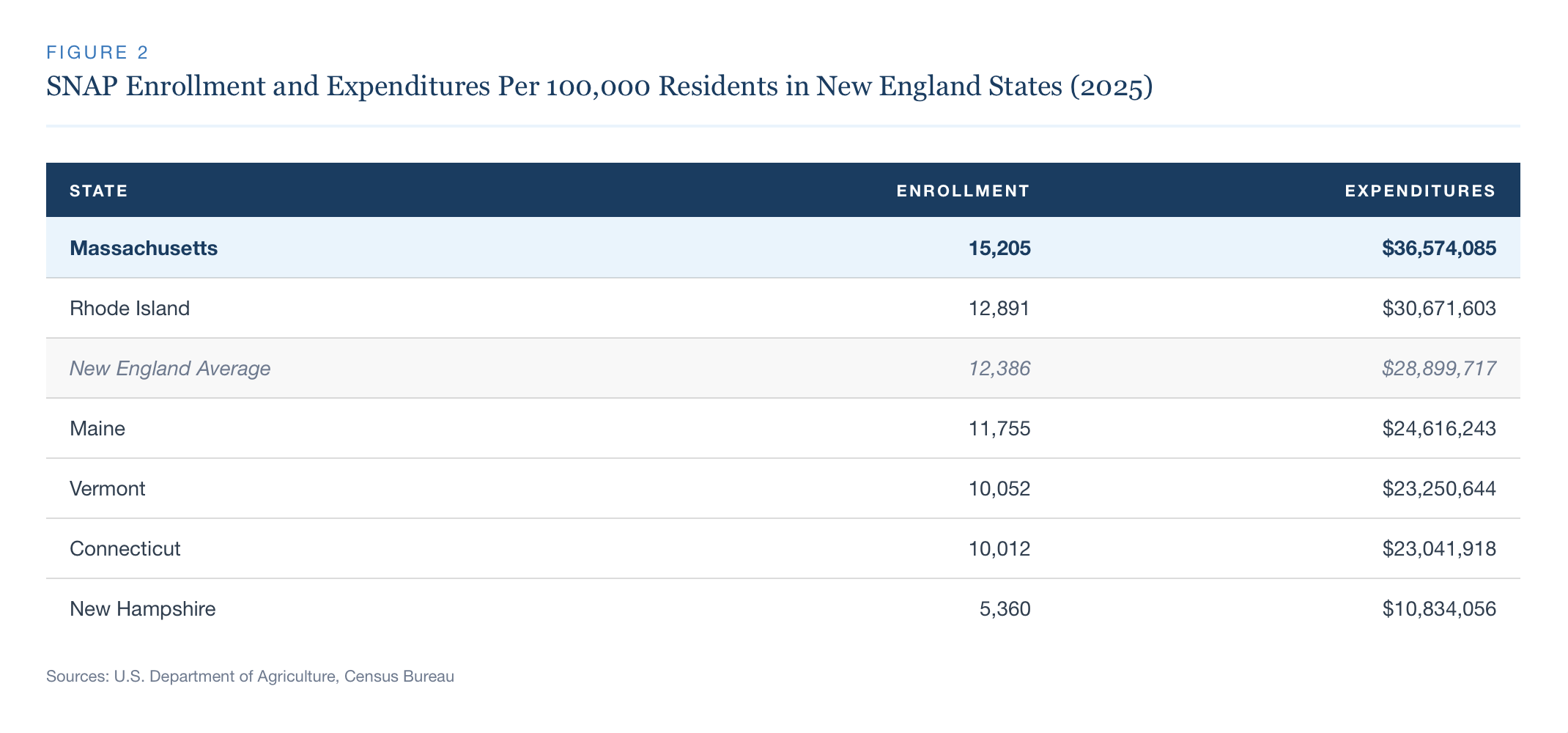
New Hampshire also has a far smaller percentage of residents who rely on SNAP. Just 5,360 out of every 100,000 Granite Staters receive benefits, the lowest rate in New England. Massachusetts has the highest rate, at 15,205 recipients per 100,000 residents.
“Massachusetts taxpayers are about to be penalized because of Massachusetts state government’s failure to properly administer the SNAP program,” said Fiscal Alliance Foundation Executive Director Paul Craney. “When state government fails to prioritize welfare spending, waste, errors and fraud become more common.”
This story was originally published by the NH Journal, an online news publication dedicated to providing fair, unbiased reporting on, and analysis of, political news of interest to New Hampshire. For more stories from the NH Journal, visit NHJournal.com.