Politics & Government
Free State Project's PorcFest Hosts Tours Of The State House
"PorcFest XXIII: Spontaneous Order" was the 23rd festival hosted by the Free State Project, with 10 mini-festivals that ran last week.

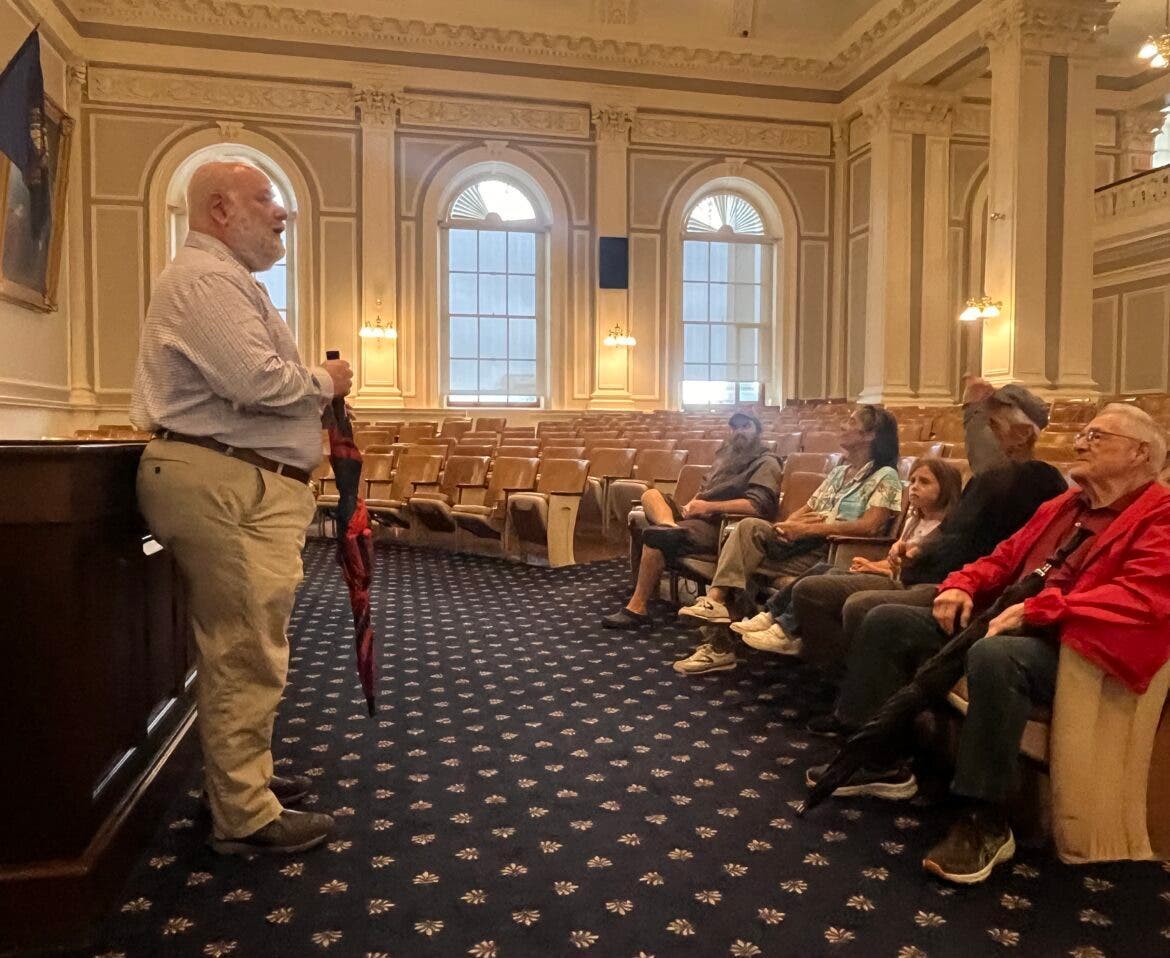
CONCORD, NH — As part of this year’s week-long PorcFest with events around the state, short for Porcupine Freedom Festival, the Free State Project hosted tours of the State House each day from Monday to Friday, conducted by Rep. Dan McGuire, R-Epsom.
McGuire, who moved from Washington state to New Hampshire for the Free State Project back in 2005, was first elected as a state Representative in 2010 and is currently in his non-consecutive 5th term and noted he does not currently plan to run for reelection, though he may again in the future. During the last tour on Friday morning, eight people rallied inside the State House for a history lesson, though none of them were associated with PorcFest. Throughout the week, he said about 17 people attended the tours.
Find out what's happening in Across New Hampshirefor free with the latest updates from Patch.
“PorcFest XXIII: Spontaneous Order” is the 23rd festival hosted by the Free State Project and will run from June 21-28, with 10 mini festivals scattered throughout the state. The Free State Project began in 2001 with plans for a mass migration of libertarians to one small state to “create a more centralized community,” according to its website, which states that thousands of people have since moved to the Granite State.
The tour began in the Hall of Flags — formerly known as Doric Hall — which is a historic exhibit filled with dozens of flags as old as the Civil War-era that have been encased behind glass since 1900, according to McGuire (he noted the building first opened in 1819). Also featured are flags from World Wars I, II and the Vietnam War.
Find out what's happening in Across New Hampshirefor free with the latest updates from Patch.
He said the room now used as the visitor center and gift shop was formerly the military office, where men would sign up to join the army and return to drop off military gear once they came home. After the flags were stored in the former military office for years, McGuire said: “At some point, they said, ‘Wait a minute, we should do something to preserve these.’”
McGuire pointed out the Roll of Honor, a bronze plaque that he said honors the more than 600 New Hampshire troops that lost their lives in World War I, which he added was “particularly deadly for the troops.”
“It was before the Geneva Convention. They fought with gas, and that wiped out troops left and right (and) also, they had almost no medical technology. So, anybody who got wounded frequently died later of infection. But by the time World War II came along, they had penicillin… they had much better medical care,” he said.
Another eye-catching spot McGuire took the group to experience is the massive Civil War mural hung on the wall near the elevator, which is a copy of the original depicting Confederate Gen. George Pickett’s charge on the third day of the Battle of Gettysburg, attacking the Union forces.
McGuire explained how it ended up at the State House: “One of the Executive Councilors, Dave Wheeler, found this painting rolled up in a box in his barn. It had belonged to his grandfather. He didn’t know it was there. He opened the box and said, ‘Wow, look at this,’ and he tried to donate it to his town, which I believe is Milford (NH). And they didn’t have a wall big enough. So, they donated it to the state, and I think this is about the only place we could display it.”
According to the plaque on the mural, the state formally received it on May 8, 1990.
Then, he took the group up to the second floor and gave them a rundown of how House sessions work in the Hall of Representatives. They got to sit in the front row and see the button mechanisms legislators use to vote (green for ‘yes,’ red for ‘no,’ etc.).
McGuire said when legislators go to vote, there’s three ways it can go: a voice vote, where Representatives shout ‘yay,’ or ‘nay’; he said if the vote is close, somebody will yell ‘Division,’ which results in Representatives using the buttons to cast their vote; or a roll call vote if 10 members call for it, and another 10 second that motion.
Four years ago, McGuire had just returned from a six-year break as a legislator, and spent that time volunteering with a group called New Hampshire Granite State Ambassadors (NHGSA), which “adds value to state agencies, local businesses, and individuals through a training and service support network that sustains and enhances the New Hampshire experience. As a 501(c)(3) non-profit, charitable organization, NHGSA serves hundreds of travel and tourism-related businesses,” per its website.
McGuire said typically when giving tours of the Hall of Representatives or the Senate Chambers, an individual from Granite State Ambassadors would be present with the Representative giving the tour. He said he was allowed to bring them into the hall since he has lots of experience giving tours.
Other stops along the tour included the Secretary of State’s office, the Executive Council chambers — and also McGuire’s favorite part — a huge framed document titled “The Administrators of the United States Government at the Beginning of the 2nd Century,” and memorializes the first 100 years of the country, according to McGuire. He explained it was signed by President Ulysses S. Grant, all of the members of his cabinet, all the members of the Supreme Court, all the members of the U.S. Senate (and) House. He said there were only two made, with the other located in the Library of Congress in Washington, D.C.
He finished the tour by ending it in the former “military office” now visitor center and gift shop, where he showed off a copy of the U.S. Declaration of Independence in a room where people could buy their own “New Hampshire” merchandise like hats, sweatshirts, and stickers.
He met his wife, Carol, a Republican Representative from Epsom, while they were studying engineering at Massachusetts Institute of Technology. In a follow-up interview, he recalled how later in life, the two had recently retired while living in Washington state and McGuire said he was “open for other things to do.”
“We came to the meeting of PorcFest in June 2004. We went up to Roger’s Campground, met everybody, and it was pretty good, I thought. After that, in September of 2004, we (Free State Project) had the vote on which state would be chosen to be the target location. New Hampshire won easily, I think Wyoming was second by about 30% less, and we were back home in Washington State… We said, ‘If we’re going to move, why not just move?’
“The way the Free State Project works, if you signed up for it at the time, you make a commitment that says, ‘Once there are 20,000 signers, then you’ll commit to move within the next five years,’ or something… We signed, we were sitting there in Washington state (and) thinking to ourselves, ‘There’s nothing stopping us from moving now.’ We moved that following spring,” he said in the interview.
Bridget Powers, co-founder of the local advocacy group Central NH Indivisible, expressed her concern about the impact the Free State Project has had on the state of New Hampshire.
“I think many Granite Staters, without regard for party affiliation, are concerned about the cost of living in New Hampshire, and in particular, our ever-increasing property taxes. Our increasing property taxes are a direct result of the Free State and New Hampshire Liberty Alliance agenda. As an educator, I am particularly concerned about their goal of dismantling public education. The millions going to the Education Freedom Account (EFA) funds are largely delivered to the wealthiest of us… Decreasing the business tax also serves the top 1% and not the average citizen in New Hampshire,” Powers said.
McGuire said in response: “In my opinion, all of those comments are incorrect. The reason that property taxes are high is that local voters have voted for a lot of spending… When I moved to Epsom, we had almost 500 students in our local school, and the school had 65 employees. Today, there’s 100 less students, but there’s something like over 100 employees. So, you can imagine what’s happened to our property tax. The reason we have so much spending and have so many employees, we used to be able to teach 475 students with 65 employees, and now it takes more than 100 employees to teach 375 students. That’s all local, there’s nothing about the Free State Project, or me, or anything causing that school to spend like that.”
This article first appeared on InDepthNH.org and is republished here under a Creative Commons license.