Politics & Government
House Republicans Pass New Hampshire School District Budget Cap
HB 1300 would place a cap on the portion of property taxes raised for a school district's budget and a fixed cap on central office costs.

CONCORD, NH — The House on Wednesday approved Republicans’ latest attempt to curtail public school funding by passing a requirement that school districts vote on a spending cap every two years.
Last session and this session, Republicans tried to approve a statewide spending cap for districts tied to the consumer price index and the number of students, but both efforts failed.
Find out what's happening in Across New Hampshirefor free with the latest updates from Patch.
This year, House Bill 1300 would place a cap on the portion of property taxes raised for a school district’s budget and a fixed cap on central office administrative spending.
The question would appear on the ballot during the November general election, and if approved would be in place for the following two years.
Find out what's happening in Across New Hampshirefor free with the latest updates from Patch.
The measure passed the House on a 177-160 vote.
After the vote, House Majority Leader Jason Osborne, R-Auburn, said the cap has been a two-year project.
“For years, big-spending school administrators have hidden behind a rigged process, packing deliberative sessions, running out the clock and bulldozing taxpayers who dare to push back. That era is over,” Osborne said. “House Republicans have spent two years building this plan, and today we delivered. If school boards want to jack up your property taxes, they're going to have to convince voters at the ballot box, not outlast them in a gymnasium at midnight.”
But Megan Tuttle, president of the National Education Association NH, had another opinion of the bill, saying lawmakers need to meet their constitutional obligation to fund an adequate education before passing spending caps.
“For more than a year, Granite Staters have overwhelmingly and repeatedly spoken up and voted against efforts to arbitrarily cap local school budgets,” Tuttle said. “But some out-of-touch lawmakers won’t take no for an answer. Instead of fixing our state’s broken public education funding system, these politicians are pushing yet another attempt to implement arbitrary school budget caps that will make it very difficult for school districts that are already underfunded to provide a quality education to all their students.”
Tuttle said HB 1300 fails to take into account real costs, like rising utility bills, health care costs and special-education services.
“We implore the New Hampshire State Senate and Gov. Ayotte to put an end to this misguided legislation that will lock in the existing education funding disparities around our state,” Tuttle said.
The House also passed House Bill 1817, which would permit any child to attend their own district school if they are in the Education Freedom Account program.
Currently, students in charter schools or homeschool programs may participate in public school classes and co-curricular programs, but the bill would expand that to EFA students who would also be allowed to participate in the career and technical education programs, competing with public school students for spots without reimbursing the public schools.
That shifts the burden to local taxpayers because districts do not receive adequate funding for those students, said Rep. Loren Selig, D-Durham.
Rep. Muriel Hall, D-Bow, called it double-dipping and said it shifts the costs from the student’s family to those in the district.
The EFA program is supposed to be an alternative to public schools, instead public schools are being used to supplement the program, she said.
The bill was approved on a 179-156 vote.
House Bill 1268 would rewrite the state’s homeschooling statutes, relaxing many regulations and making a distinction between the homeschooling and EFA programs, which many long-time home school advocates want.
The bill also would eliminate the home school advisory committee and open public schools to students from other programs.
The bill passed on a 174-166 vote.
House Bill 1132 would restrict flags displayed in public schools to those of the United States, the State of New Hampshire and POW/MIA flags, with exceptions for those used for instruction and others like town flags, but prohibits displaying political or ideological flags.
Supporters said the bill would bring neutrality to schools, but opponents said it violates first amendment rights and freedom of speech.
The bill passed on a 182-156 vote.
House Bill 1358 would establish a commission to study transitioning the state’s public schools to public charter schools and the best method to use to convert them.
Opponents said the commission has few public school stakeholders on it.
The bill passed on a 169-163 vote.
The House killed House Bill 1561, which would have prohibited national Chinese graduate students from attending any university or college in New Hampshire.
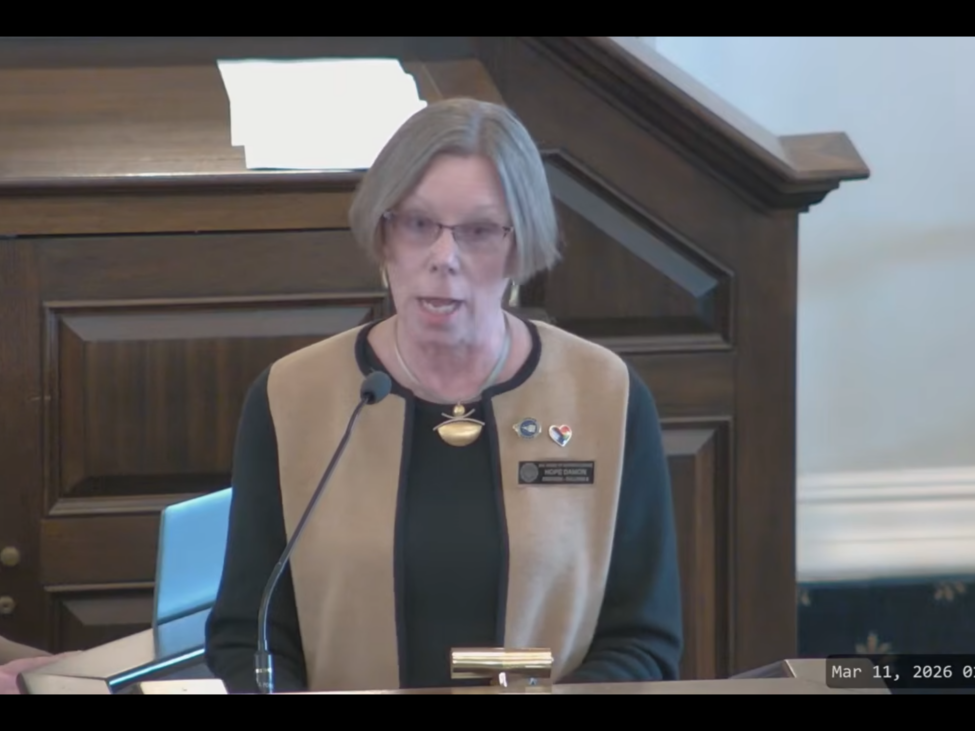
The bill would likely be illegal, said Rep. Hope Damon, D-Croydon, and could cost universities millions of dollars in research grants and awards.
The bill failed to pass on a 173-157 vote.
Garry Rayno may be reached at garry.rayno@yahoo.com.
This article first appeared on InDepthNH.org and is republished here under a Creative Commons license.