Politics & Government
Humane Organizations Oppose Bill To Change Laws Related To Livestock Cruelty
Humane organizations panned a bill, which already passed the House, that relates to cruelty of livestock.

CONCORD, NH — Humane organizations panned a bill, which already passed the House, that relates to cruelty of livestock.
While state Sen. Howard Pearl, R-Loudon, offered an amendment, Representatives said House Bill 1766-FN still is problematic. The bill was offered by state Rep. Barbara Comtois, R-Center Barnstead, its prime sponsor, and it passed on a voice vote out of the House.
Find out what's happening in Across New Hampshirefor free with the latest updates from Patch.
Kurt Ehrenberg, New Hampshire director of NH Humane World for Animals said even the amendment does not change "this crazy, weird bill" during the hearing before the Senate Committee on Energy and Natural Resources, Thursday.
"We are strongly opposed to this bill," he said. "It adds barriers and prolongs animal suffering by weakening key protections for abused or neglected horses and other farm animals. It restricts timely intervention. It limits expert, non-profit involvement. It risks returning animals to harmful situations. And it forces unnecessary euthanasia.
Find out what's happening in Across New Hampshirefor free with the latest updates from Patch.
"It revokes the authority of licensed humane societies and eliminates their role in the seizure or temporary protective custody of livestock. Removing them disrupts this well-established and effective public-private relationship, it burdens law enforcement and leaves animals at risk," he said.
The amended analysis of the bill states it provides procedures for the potential confiscation of livestock involved in cruelty to animal cases.
Sen. Pearl's amendment was not immediately available at the hearing or online, but he said it was intended to help alleviate some of the concerns expressed by animal rights groups and would allow the animal to be adopted by a third party or group before euthanizing them.
The original version of the bill says "If the treating veterinarian believes that livestock which has been confiscated is in a state of suffering and that the cost to alleviate the suffering will exceed the amount of allowable reimbursement as set by Agr 3504.01(c)(8), unless the owner pays for the care, the animal shall be euthanized."
Sen. Cindy Rosenwald, D-Nashua, expressed concern that the bill separates out livestock from other animals and their care and protection and that all animals should be treated humanely.
She asked Agriculture Commissioner Shawn Jasper why there was not a fiscal note attached to the bill to see what it would cost the state to implement after the Office of Legislative Budget Assistant asked for that information on Nov. 5, 2025 and December 9, 2025.
"I am afraid this may initially have run under the radar," he said. "... I can't even keep track of all the legislation as much as I want to," Jasper said. "There are only so many hours of the day."
He apologized and said, "I have been running around and I think probably the only person who can appreciate this as much as I is that Sen. Pearl had been running around like a chicken with my head cut off as you probably understand."
"This is livestock. And livestock has a value whether it is a horse or anything else and the important part that was not addressed was unless the owner pays for the care. So the health care fund is not going to run out of money but we have established limits for how much we can spend per animal..." he said, but could not recall that financial limit.
He said if the owner is not going to pay for it and the cost exceeds the value, then "the veterinarian is put in that case of being the judge, jury and executioner" which is not fair to them.
Pearl said a third option, in his amendment, is to offer an alternative for a third party to pay that cost, short of euthanasia.
Jasper said his concern is that there should be a time limit if the animal is suffering.
Sen. David Watters, D-Dover, expressed concern about the absence of language such as suffering that "can't be alleviated" and also the absence of the word "extreme" in terms of suffering and the difference between "may" or "shall" be euthanized.
He said the current law has given legal protection to those animals and he worried about future lawsuits.
Jasper said there is no definition of animal "suffering." It is subjective and based on the view of the attending veterinarian.
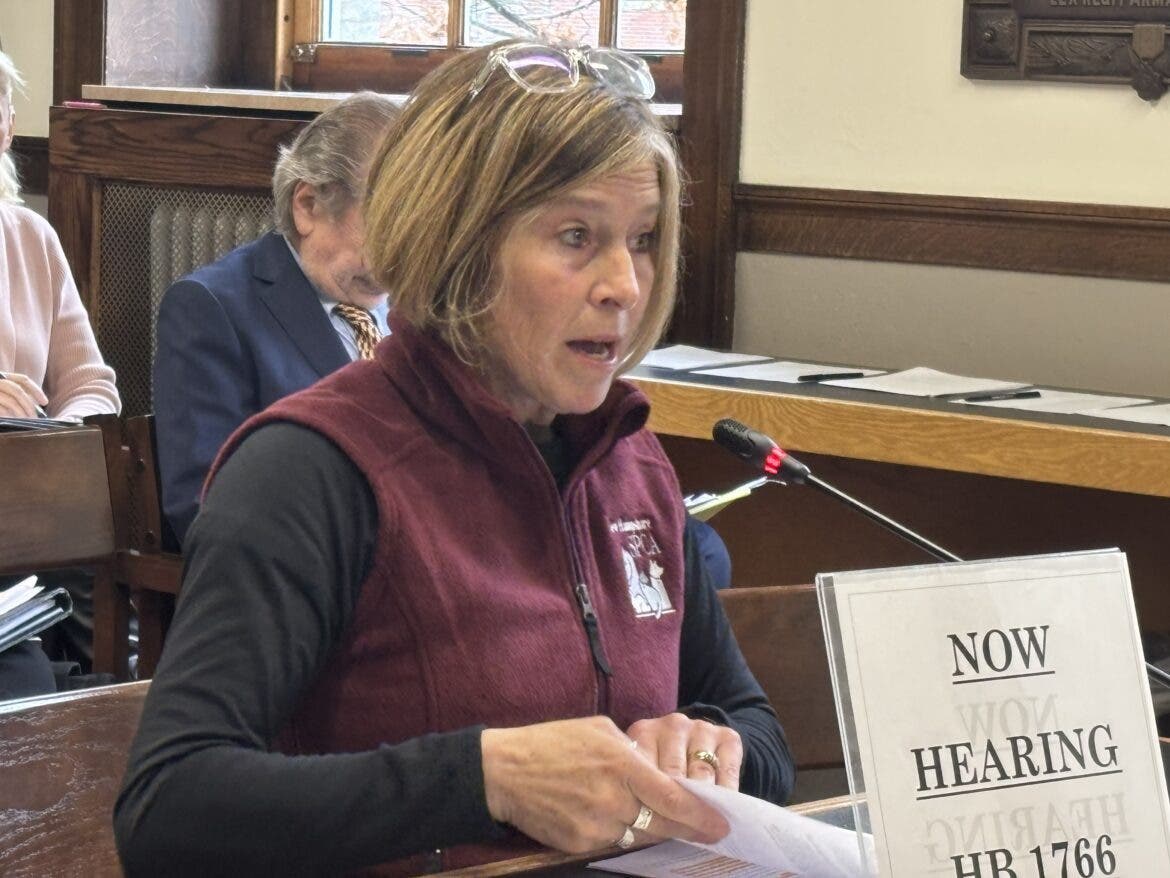
Michelle Murch, a retired law enforcement officer of 24 years who is the equine and farm program manager for the NH Society for the Protection of Cruelty to Animals, opposed the bill.
She said people such as she would be removed from the livestock provision in the bill.
Murch said these are not cases that are routine for police and are very complex and when officers call they don't necessarily know when a horse is emaciated.
She said the state veterinarian is not in a position to investigate every situation.
"This is not a realistic solution," she said of the bill. The committee did not immediately vote on the bill.
This article first appeared on InDepthNH.org and is republished here under a Creative Commons license.