Politics & Government
Mother Of DUI Victim Joins Ayotte Push To Close 'DUI Loophole'
While NH is safe, the first-term Republican says there is more work to be done, particularly in road safety and preventing impaired driving.

We’re number one, but we’re still trying harder.
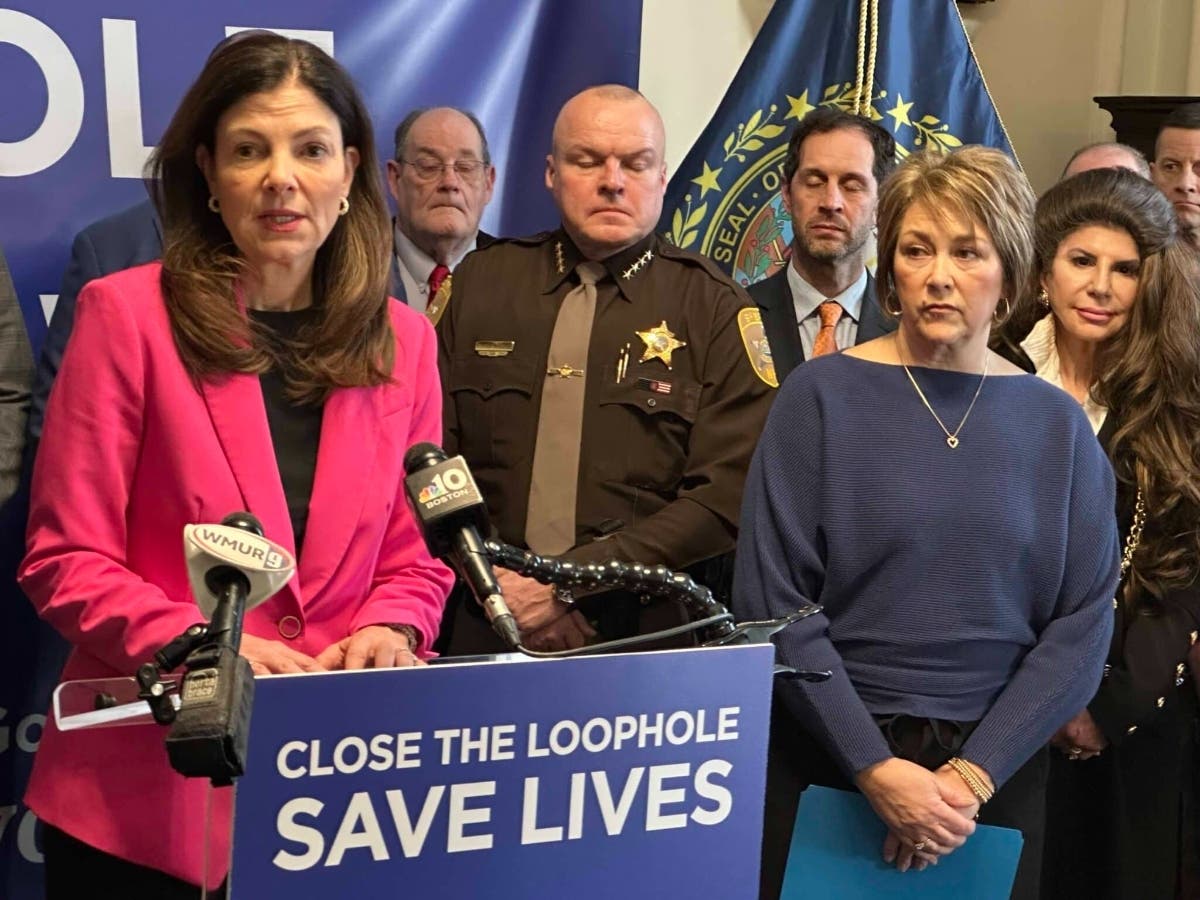
That was Gov. Kelly Ayotte’s message at a press conference urging New Hampshire legislators to close the so-called “DUI loophole” and improve highway safety.
Find out what's happening in Across New Hampshirefor free with the latest updates from Patch.
Ayotte acknowledged that New Hampshire is ranked “the safest state in the nation.” But the first-term Republican said there is more work to be done, particularly in road safety and impaired driving prevention.
“New Hampshire has the second-highest refusal rate for taking the breath alcohol test in the country,” Ayotte said. “Seventy percent of drivers stopped for impaired driving refuse to take a breath alcohol test. That is completely unacceptable.
Find out what's happening in Across New Hampshirefor free with the latest updates from Patch.
Ayotte highlighted another significant statistic. “Since 2018, we have lost over 260 Granite Staters to crashes that are caused by impaired drivers. Every single one of these crashes is preventable.”
One of those victims was 20-year-old Tyler Shaw, killed by a drunk driver in Bow, N.H., in 2018. His mother, Beth Shaw, spoke in support of the legislation.
 Beth Shaw speaks at a press conference advocating for tightening the state’s DUI laws on March 10, 2026.
“Weeks before Tyler’s death, he made a list of 29 life goals,” Shaw said. “Number one, he wanted to make a million dollars. Among others, he wanted to become a top general contractor in the state, own a house by 25, maintain a successful marriage, learn to be a great father, and make his family proud.
“None of those dreams or goals will ever be realized, all because one person decided to drink and drive,” Shaw said.
Previous efforts to tighten the punishment for refusing a breathalyzer have failed in the GOP-controlled House, where some libertarian and Free State members object to what they see as an unacceptable expansion of the state’s power over citizens.
Rep. James Spillane (R-Deerfield) voted against the previous version of the bill.
“My vote was based on a fundamental legal principle: every person has a constitutional right against self-incrimination. In my view, that principle also applies when the state asks someone to submit to a test that could be used as evidence against them,” he told NHJournal.
“This does not mean I support impaired driving, far from it,” Spillane added. “Driving under the influence is dangerous and should absolutely be prosecuted.
“The question is whether the state should impose additional penalties simply for exercising the right to refuse a test. I believe protecting the right against self-incrimination is an important civil-liberties principle.”
Sen. Bill Gannon (R-Sandown) told NHJournal he’s updated his approach in the new bill to address concerns like Spillane’s. And he’s also added a mix of carrots and sticks for drivers facing breathalyzer tests to encourage greater cooperation.
“I understand the argument about ‘giving up your rights.’ That’s why this legislation uses an administrative suspension of your license. And it looks at the issue from a contractual basis. When you got your driver’s license, you signed a contract. You agreed to submit to a blood alcohol test. If you don’t, you’ve broken your contract.”
Gannon’s bill would:
- Double the penalty: Increase the automatic license suspension for a first-time test refusal from six months to 12 months.
- Harshen repeat penalties: Extend suspensions to three years for subsequent refusals.
- Reciprocity: Include out-of-state DUI convictions and refusals when calculating a driver’s penalty in New Hampshire.
At the same time, the bill also incentivizes drivers who may have had too much to drink to take the test and accept the consequences.
“We’re going to take into account if it’s your first offense,” Gannon said. “If you’re willing to submit (to the test), you’re willing to go to courses on this, and we can get you off the road, then we can (end your driving suspension) in two or three months. And that will get our compliance rate up.”
“Right now, the law incentivizes you to stay silent and hope a good lawyer can get you off. We are changing that math.”
 Col. Mark Hall, director of the New Hampshire State Police.
So, do drivers pulled over for potential DUIs really strategize about whether or not to take a breathalyzer?
“Absolutely,” said Col. Mark Hall, director of the state police. “First, the numbers speak for themselves. Yes, this is a strategic move on the part of offenders.”
Senate President Sharon Carson (R-Londonderry) was at the press conference supporting the legislation. She agrees with Ayotte that, while the state’s safety numbers are good today, the trend is heading in the wrong direction.
“If you’ve watched what’s happened in New Hampshire over the past two years, how people are using our highways as speedways, then adding alcohol into that is a very dangerous mix,” Carson said.”Our job is to be concerned about all the people who travel on our highways.”
For Shaw, the issue is personal.
“The worst thing that ever happened to me was answering my door in the middle of the night to three officers telling me that Tyler was tragically killed by a drunk driver. Our lawmakers need to pass this bill to save someone from having to answer that door.”
This story was originally published by the NH Journal, an online news publication dedicated to providing fair, unbiased reporting on, and analysis of, political news of interest to New Hampshire. For more stories from the NH Journal, visit NHJournal.com.