Politics & Government
New Brief In Rand Case Urges Supreme Court To Uphold Claremont Education Funding Decisions
The amicus brief refutes much of the state's arguments for overturning the original Claremont I and II decisions 30 years ago.

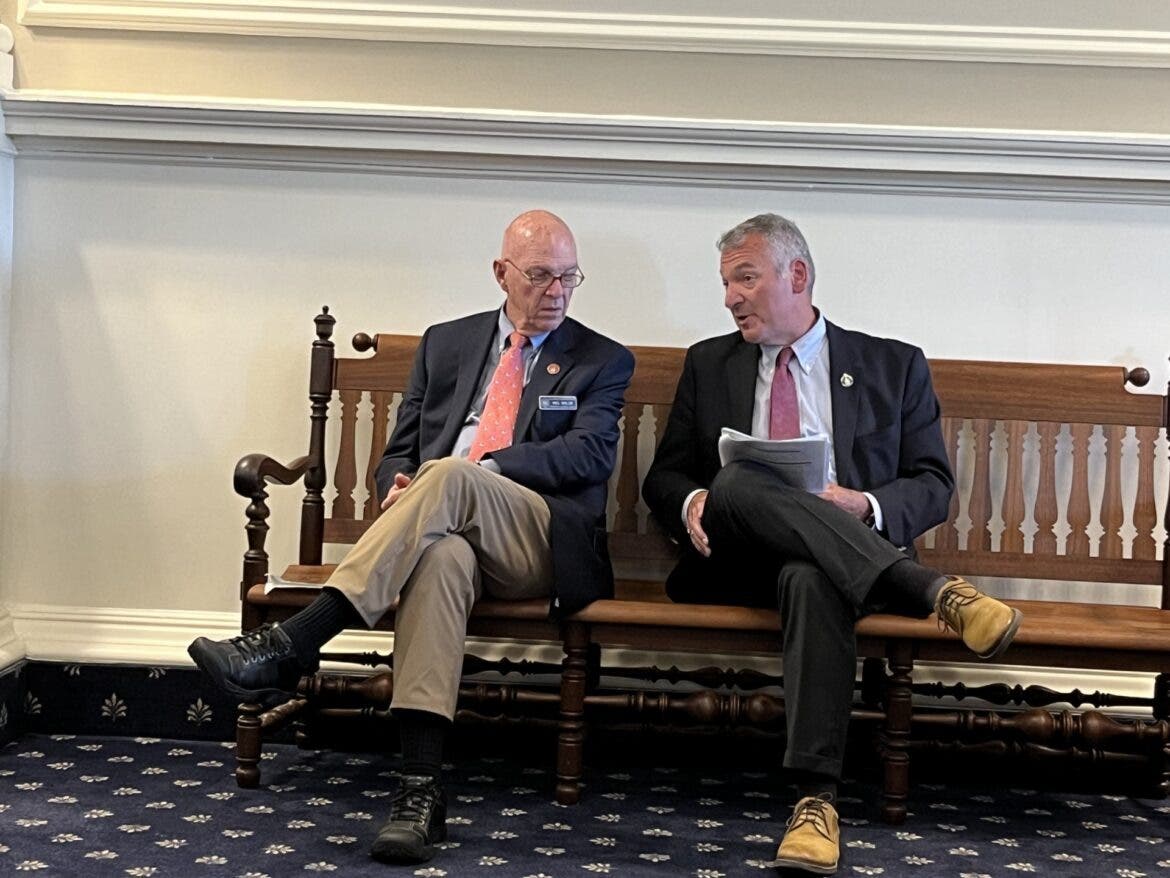
CONCORD, NH — Five members of the Education Funding Commission, which met six years ago, filed a brief with the state Supreme Court in the Rand education funding case Friday urging the court to reject the state’s request to overturn the landmark Claremont education funding decisions.
The group also said the court should clarify the Legislature’s constitutional authority to send more state aid to school districts with the greatest educational and financial needs.
Find out what's happening in Across New Hampshirefor free with the latest updates from Patch.
In its brief the State urged the court to overturn the long-standing Claremont decisions and subsequent educational funding decisions, claiming the earlier courts misconstrued the constitutional text and cited the wrong section in making its decisions.
The amicus brief refutes much of the state’s arguments for overturning the original Claremont I and II decisions 30 years ago.
Find out what's happening in Across New Hampshirefor free with the latest updates from Patch.
The brief reflects the commission’s findings, said its chair Rep. David Luneau, D-Hopkinton, that any reform of the state’s broken education funding system needs to improve student equity and create a more progressive tax system that provides the greatest state aid to the districts with the greatest challenges because of higher costs and their diminished ability to meet those expenses.
Luneau and other committee members, Reps Dick Ames, D-Jaffrey, Mel Myler, D-Hopkinton, and Mary Heath, D-Manchester, along with attorney and former member William Ardinger, who wrote the brief and filed the brief today.
Luneau said the commission’s final report stressed the need to provide equitable opportunities for all the state’s children by providing sufficient state aid so that all school districts have the resources to provide an adequate education.
Districts with a greater percentage of students in poverty and with special education needs have higher costs, he said, but are hit with a double whammy of poor property wealth which makes it much more difficult to raise the money needed to address those educational challenges.
He compared the Berlin and Portsmouth school districts and then New Castle and Newport, where New Castle has a local education tax rate of 16 cents per $1,000 of valuation, while Newport has a rate 100 times higher.
“The system is unfair to students and to property taxpayers,” Luneau said, “and the brief gets at having the state recognize that.”
In the brief, the former members argue the state constitution requires the State to ensure an adequate education for every child, but does not require state aid to be distributed uniformly on a per-pupil basis, nor to have the state pay the full cost of education.
Instead, the Legislature is required to guarantee that districts have the resources to provide an adequate education by sending greater resources to the districts facing the greatest barriers to student success and to districts with the most difficulty raising the money.
The commission found that student outcomes in communities with lower property values were below those of students living in more affluent communities.
The commission did not make a specific education funding recommendation for reforming the system, although its consultants developed a system centered on a statewide property tax considerably higher than the one currently in place.
Bills reflecting the commission’s work have been introduced, but have yet to make it through the legislature after Republicans took control in 2021 and have retained it since.
The commission also found that New Hampshire had the most regressive education funding system in New England, where local property taxes with widely varying rates fund the vast majority of public education costs, which results in those least able to pay shouldering a far greater percentage of the burden than those able to pay more.
New Hampshire has long been last in the country for its percentage of state support for both public and higher education.
In the brief, Ardinger notes the state’s contention there is a higher level duty created that would require the state to pay the costs of public education, while the Claremont decision requires the state to guarantee there are sufficient resources.
As he notes much of the state’s argument for overturning the Claremont I decision is really about the state’s obligation to pay all of the cost of an adequate education with money from a state taxing district, which the decision did not say.
Ardinger states the original Claremont I decision “represents one of the finest and most consequential decisions in the history of the New Hampshire Supreme Court.”
He said it is supported by the text and history of the state’s constitution and by a similar decision by the Massachusetts Supreme Court on the nearly identical constitutional text six months before the New Hampshire decision.
“The State’s broad request to overturn ‘Claremont I and its progeny’ must therefore be rejected,” Ardinger writes.
Luneau called the decision “rock solid. A child has a guaranteed right to an education. If you take that away the rest doesn’t matter.”The concept was established 400 years ago when the founding fathers recognized that kids need to learn to read, he said.
“Gov. Kelly Ayotte and (Attorney General) John Formella’s motion to overturn the Claremont decision would fundamentally take away a child’s right to an education and that is outrageous.”
That would reverse what has been a priority for nearly 400 years placed on literacy and education for all kids, he said, but that should not be a surprise when for the last decade the former education commissioner (Frank Edelblut) and state school board chair (Drew Cline) have been all about directing money away from public schools and imposing new requirements like book bans and outlawing trans sports participation. “What they are doing here is outrageous,” he said.
Luneau noted the state’s public schools are some of the best in the country and spend among the highest for public education.
A bigger share of state funds needs to be directed to the districts where the costs are higher due to poverty and special education needs, with fewer financial resources, he said. “That is where the state comes in.”What is needed is not the Augenblick formula, which is strictly targeted aid, Luneau said.
“You have to look at student outcomes and make sure the average kid in Newport has the same opportunities as the average kid in Hopkinton,” he said. “They need the same opportunities for a great outcome, not taking away a child’s right to an education.”
A copy of the brief and its appendix may be found here: https://drive.google.com/file/d/1T5yM6KP7A9cBE29u71I6QskgbxEZTEzK/view?usp=sharing .
Garry Rayno may be reached at garry.rayno@yahoo.com.
This story was originally published by InDepth NH.