Politics & Government
New Hampshire Income Tax Debate: Delaware Dream Or Connecticut Nightmare?
Critics say the problem with Andru Volinsky's 3-3 income tax plan isn't today's math but the fear there will be two higher taxes tomorrow.


When it comes to relationships, men may be from Mars and women from Venus. But when the topic is a New Hampshire income tax, Republicans are from Connecticut and Democrats from Delaware.
Former Executive Councilor and gubernatorial candidate Andru Volinsky’s proposal to shift state education funding to a three percent income tax and lower property taxes has created headlines, as well as headaches, for his fellow Democrats. The party’s likely nominee for governor, Cinde Warmington, has rejected the plan, as have Democratic leaders in the state legislature.
Find out what's happening in Across New Hampshirefor free with the latest updates from Patch.
However, these same Democrats have also voted against constitutional amendments to either ban a future state income tax or require a supermajority to enact one.
Meanwhile, Volinsky and his allies at “Cut Our Property Taxes!” continue to push their plan. They have released a detailed description of the math, including the NHTaxSavingsCalculator.com website, which they say lets Granite Staters calculate their savings under the “3-3 Tax Savings Plan” proposal.
Find out what's happening in Across New Hampshirefor free with the latest updates from Patch.
“Even with the income tax, most families will pay less than they pay in local property taxes,” Volinsky said.
The problem, critics say, isn’t the math but rather a lack of trust. Many taxpayers fear that creating a new tax to lower an existing tax today could result in two higher taxes tomorrow.
During a press conference announcing the plan, NHJournal asked supporters to respond to those concerns. The answer: “Look at Delaware.”
“Delaware’s system has been the same for years, and their property taxes are one-third what our property taxes are,” said Mark Fernald, the 2002 Democratic nominee for governor.
“In New Hampshire, the middle class is paying state and local taxes at twice the rate of wealthier people — those making half a million dollars a year and up are paying at half the rate of the middle class. In Delaware, they’re all paying the same rate with their system. So it works, and because it works, it’s stable.”
Republicans dismiss the Delaware example and point instead to Connecticut.
A website set up by the Committee to Reelect House Republicans warns, “Connecticut tried this. They promised an income tax would lower property taxes. It didn’t.”
Which state is the most accurate predictor of New Hampshire’s future with an income tax?
Don’t look to Delaware, says Charlie Copeland with the Caesar Rodney Institute, that state’s free-market think tank.
Copeland agrees with Granite State Democrats that Delaware property taxes are low and that the state’s top income tax rate of 6.95 percent is far below other East Coast states, such as New Jersey (10.75 percent) and New York (10.9 percent).
“But the truth of the matter is, Delaware’s income tax and Delaware’s property taxes have never had anything to do with one another, not in the least,” he told NHJournal.
“The reason we have relatively low property taxes compared to the Northeast is that somewhere around 30 percent of our state budget comes from the corporate franchise tax and major corporations that pay to incorporate here.”
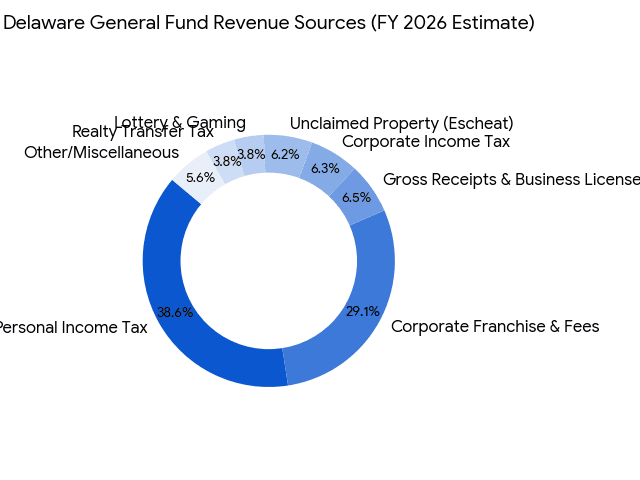 Delaware state revenue sources.
According to FY 2026 revenue estimates, corporate franchise taxes and fees account for a staggering 29 percent of the state’s general fund. That makes Delaware a national outlier: while the average state receives less than one percent of its revenue from such fees, Delaware generates billions from companies that may never set foot in the state.
And that’s not all.
“Delaware gets another 20 to 25 percent of revenue indirectly associated with that, such as from law firms with highly paid attorneys and other business services companies that are here to service those incorporation entities,” Copeland added. “That is what has really allowed Delaware to skate by on property taxes.”
Also, Delaware property taxes have remained artificially low because, until a 2020 court ruling forced the issue, the state’s three counties had not done a residential property tax reassessment in decades. One county hadn’t done a comprehensive reassessment since 1974.
The Connecticut model appears to be closer to New Hampshire.
Like the Granite State, Connecticut long avoided an income tax, relying instead on property taxes and a sales tax that eventually climbed to 8 percent, as well as taxes on capital gains, interest, and dividends.
In 1991, during a fiscal crisis and collapse of the real estate market, the state passed what became known as the “tax deal.”
Under the plan, Connecticut created a new flat income tax of 4.5 percent on earned income. In exchange, taxpayers got relief on the sales tax (cut from 8 to 6 percent) as well as lower taxes on interest and dividends.
Supporters argued the new revenue would eventually allow the state to increase aid to local communities, reducing property taxes as well. But that didn’t happen.
Instead, the income tax became what some policy analysts describe as a “revenue ratchet.” Rather than replacing existing taxes, the new tax gradually expanded while other taxes remained.
Within five years, Connecticut abandoned the original flat tax system. In 1996, lawmakers adopted a progressive income tax structure, adding new brackets and raising rates over time. The state also created a property tax credit against the income tax in 1994, allowing residents to offset part of their local tax bill. The credit eventually grew to as much as $500 by 2000.
But the relief proved temporary.
As budget pressures mounted in later years, lawmakers reduced the credit to $300 in 2011 and later capped or restricted eligibility several times.
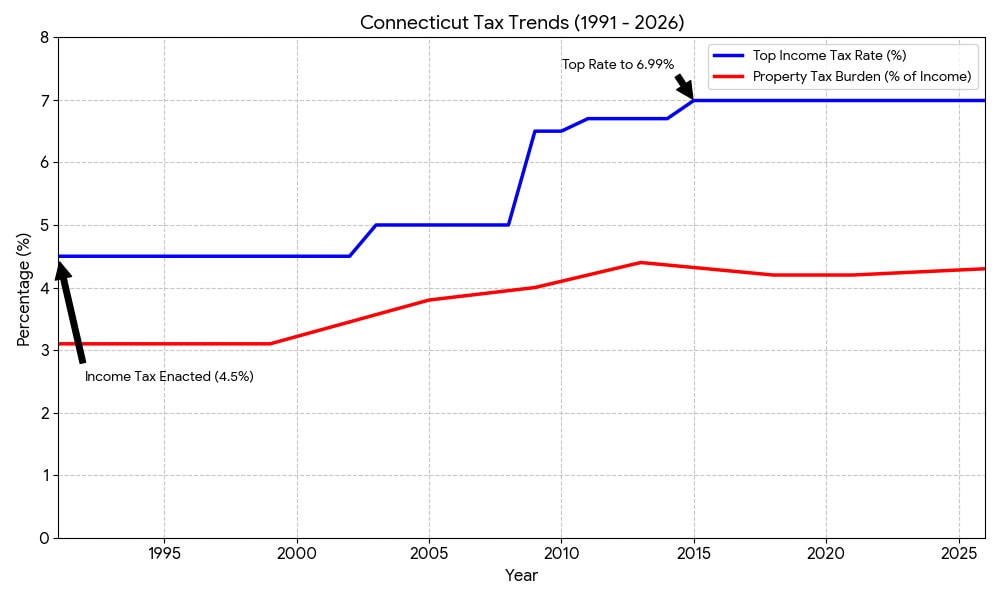 Income tax rates vs. property tax burden in Connecticut since 1991.
The final result: Connecticut still has an income tax with a top rate of 6.99 percent and the third-highest property tax rates in the country, even higher than New Hampshire.
“Connecticut’s experience with a state income tax should serve as a cautionary tale for other states considering a similar policy,” said Jack DeOliveira, policy director at the Connecticut-based Yankee Institute.
“Once established, an income tax creates a durable revenue stream that is politically difficult to reduce or eliminate — leaving taxpayers with a system that rarely shrinks, only grows.”
This story was originally published by the NH Journal, an online news publication dedicated to providing fair, unbiased reporting on, and analysis of, political news of interest to New Hampshire. For more stories from the NH Journal, visit NHJournal.com.