Politics & Government
New Hampshire Vehicle Inspection Repeal Gets Green Light From EPA
The EPA proposed removing the state from the ozone transport region and conditionally approved its request to end emissions inspections.

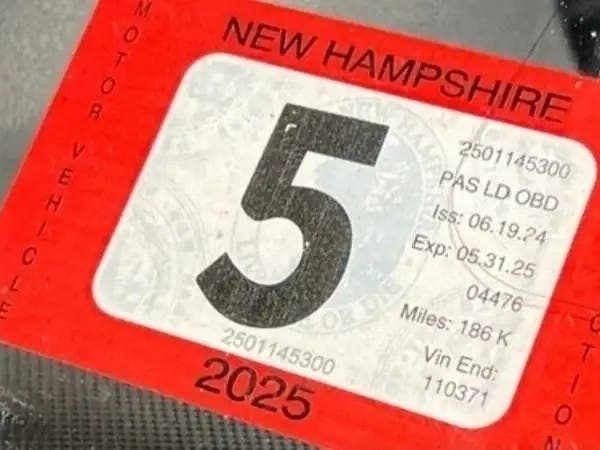
“Live Free and Drive.”
That’s the response from New Hampshire GOP leaders to the U.S. Environmental Protection Agency’s move Thursday to clear the last major federal roadblock to the state’s repeal of mandatory vehicle inspections.
Find out what's happening in Across New Hampshirefor free with the latest updates from Patch.
The EPA proposed removing New Hampshire from the federal Ozone Transport Region (OTR) and conditionally approved the state’s request to eliminate its vehicle emissions inspection program from its federally enforceable air quality plan.
If both proposals are finalized, New Hampshire will be free to end the emissions testing requirement without violating the federal Clean Air Act.
Find out what's happening in Across New Hampshirefor free with the latest updates from Patch.
“EPA is committed to working collaboratively with states to reduce unnecessary regulatory burdens while maintaining strong environmental protections and following our statutory obligations,” said EPA Administrator Lee Zeldin. “This is the best way to provide clean air for all Americans.”
The proposals are not yet final. EPA will hold separate 45-day public comment periods on the two actions, along with a public hearing on removing the Granite State from the OTR.
Gov. Kelly Ayotte signed legislation in June 2025 repealing New Hampshire’s annual safety and emissions inspections for most passenger vehicles. Her Democratic opponent, former Executive Councilor Cinde Warmington, also supports ending the inspection mandates.
The program was suspended in February, but the emissions component remained part of New Hampshire’s federally approved State Implementation Plan, or SIP.
That created a conflict between the state repeal and federal clean air regulations.
New Hampshire has been part of the OTR, a collection of northeastern states required to maintain certain ozone-reduction measures even when they meet federal air quality standards. Because vehicle emissions testing is one of the measures included in New Hampshire’s plan, the state needed EPA approval to remove it.
New Hampshire petitioned EPA in December to leave the ozone region and revise its air quality plan. Zeldin pledged during a March visit to the state to accelerate the review.
“The Trump EPA understands states are best positioned to understand the needs of their local communities and therefore should be given the flexibility to implement air quality programs within the scope of the Clean Air Act,” the agency said Thursday.
The issue, opponents of inspection mandates say, is not air quality. New Hampshire has some of the cleanest air in the country. A recent analysis using EPA fine-particle pollution data ranked the Granite State third nationally, behind Wyoming and Hawaii.
House Majority Leader Jason Osborne (R-Auburn), one of the leading advocates for repealing the inspection mandate, celebrated EPA’s announcement.
“Today’s decision by the EPA is a victory for Granite Staters,” Osborne said. “No matter how much out-of-state corporations and unaccountable federal judges tried, House Republicans fought to ensure that mandatory vehicle inspections stay six feet under the asphalt.”
“It’s a rare day when I can say it, but the feds actually got it right,” Osborne joked.
The out-of-state corporation referenced by Osborne is Gordon-Darby, the Kentucky-based contractor that operated New Hampshire’s emissions testing system. The company sued to stop the repeal, arguing the state could not end testing while it remained part of the federally approved air quality plan.
U.S. District Court Judge Landya McCafferty initially issued an injunction requiring New Hampshire to continue the program. However, the 1st U.S. Circuit Court of Appeals later halted that order, concluding Gordon-Darby’s Clean Air Act lawsuit was premature. The company subsequently dismissed the case while leaving open the possibility of future litigation.
EPA’s proposed actions would largely eliminate the federal conflict underlying that lawsuit if they become final.
“EPA is grateful for New Hampshire’s partnership as we work together to protect human health and the environment,” said EPA Regional Administrator Mark Sanborn.
State Rep. Henry Giasson III (R-Goffstown), a member of the House Transportation Committee, said the lengthy federal rulemaking process had made it practically impossible for lawmakers to change the inspection law without facing litigation.
“With the EPA’s rulemaking taking 18 months to two years and the New Hampshire legislature serving in biennial terms, there was no practicable way to address the law while maintaining compliance,” Giasson said.
Executive Councilor John Stephen (R-Manchester), one of the leaders in the fight to end the inspection mandate, praised the EPA’s announcement.
“I thank Administrator Zeldin and Regional Administrator Sanborn for respecting the will of New Hampshire’s elected officials and for moving on this in months rather than years. That is what it looks like when the federal government works with a state instead of against it. I am also grateful to Gov. Ayotte, Department of Environmental Services Commissioner Bob Scott, and Attorney General Formella for making New Hampshire’s case every step of the way.”
EPA’s approval of the emissions program repeal would be conditional. New Hampshire would have one year to submit another air quality plan revision listing vehicle inspections as a possible contingency measure if ozone pollution in southern New Hampshire rises substantially in the future.
That condition would not reinstate annual inspections. It would preserve them as one option federal and state officials could consider if New Hampshire were to fall out of compliance with air quality standards.
In the meantime, regular passenger vehicles do not need inspection stickers, and stations cannot conduct official state inspections. Motorists are still required to keep their vehicles safe. Police can cite drivers for defective brakes, tires, lights and other equipment, while commercial vehicles remain subject to applicable federal inspection requirements.
“I am confident that this decision will be finalized and reach the finish line expeditiously,” Osborne said. “In the meantime, I encourage all Granite Staters to join me to ‘Live Free and Drive!’”
This story was originally published by the NH Journal, an online news publication dedicated to providing fair, unbiased reporting on, and analysis of, political news of interest to New Hampshire. For more stories from the NH Journal, visit NHJournal.com.