Community Corner
Protesters Rally Against Free State Project
About 100 protesters joined the Kent Street Coalition and other local advocacy groups at the State House on Thursday.

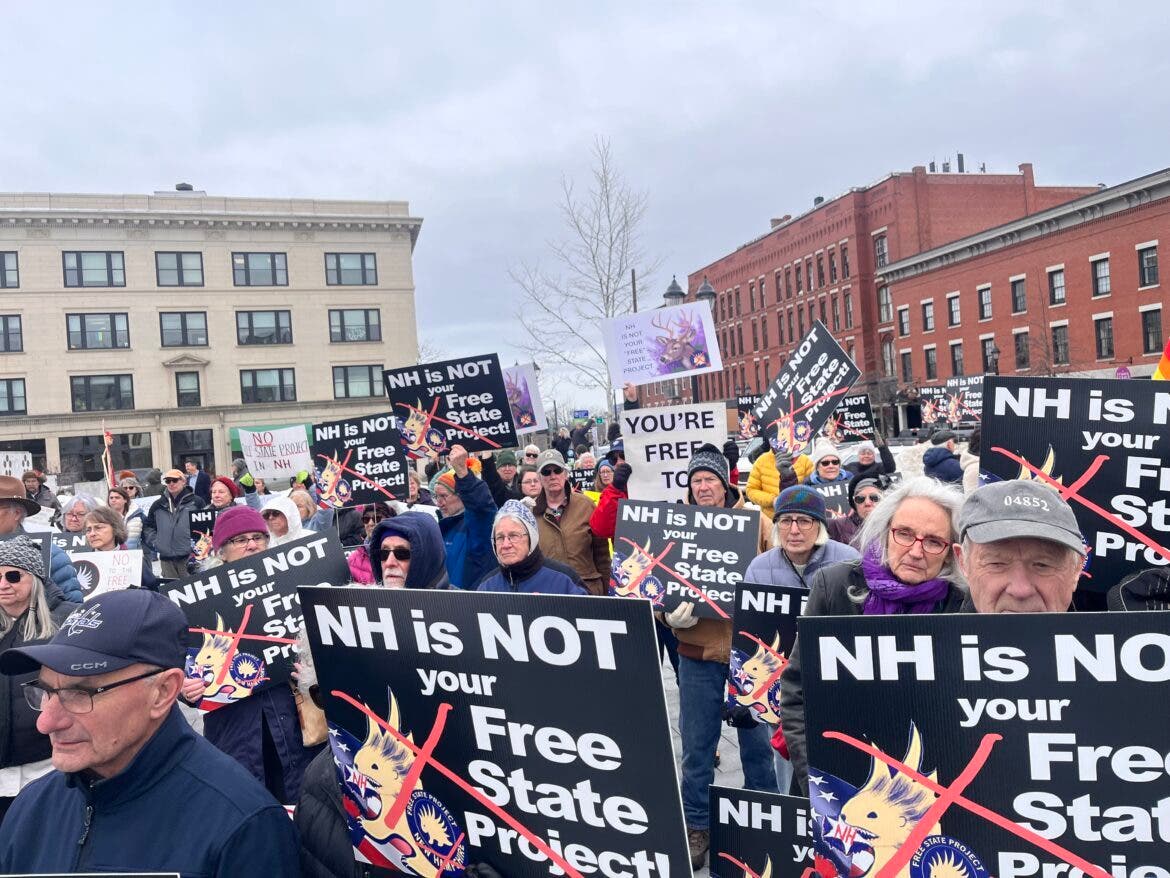
CONCORD, NH — About 100 protesters joined the Kent Street Coalition and other local advocacy groups at the State House on Thursday to protest the Free State Project in New Hampshire, which critics say attempts to influence state politics and dismantle public education.
Groups such as 50501 NH, Southern NH Indivisible, Granite State Matters, and Third Act NH joined the coalition to oppose the Free State Project, which was formed in 2001. Two years later the state was picked as the best destination to “reinforce and enhance an already existing libertarian culture.” Its mission — which began with the goal of a mass migration of more than 20,000 people — is to expand personal and economic freedom by concentrating liberty-minded people in New Hampshire.
Find out what's happening in Across New Hampshirefor free with the latest updates from Patch.
Kent Street Coalition Co-Founder Louise Spencer said the goal was for the organizations to gather at the State House in opposition to the Free State Project’s “dangerous and destructive agenda.”
“We’re extremely concerned about the agenda that does not comport with the values of the majority of Granite Staters. They want to do things like dismantle our public schools (and) get rid of our local and state government… We’re concerned that through gerrymandering, they’ve been able to control a lot of the agenda at the State House, but we feel that it does not, in any way, reflect the values and goals of the Granite Staters at large,” Spencer said.
Find out what's happening in Across New Hampshirefor free with the latest updates from Patch.
According to the organization's website, the project began in 2001 and was founded by Jason Sorens as an alternative and attainable strategy to the Libertarian Party's national strategy. In order to create a more concentrated community of libertarians, Sorens launched the idea of a "mass migration to concentrate libertarians in one small state." The concept was supported by a vote of the first 1,000 participants. Since then, the organization states that thousands have made the move to New Hampshire.
Free State Project Executive Director Eric Brakey said in a follow-up conversation that there are between 6,000 and 10,000 participants of the project.
Nancy Brennan, who is on the Kent Street Coalition leadership team said, “I’ve been watching the Free State Project do awful things in our state for the last several years, watching them try to ruin public education, and take away rights from everyone except their own group… so, I stand up whenever I can, for the kinds of things that make New Hampshire the state it’s always been: a state that cares about freedom, yes, but also one that cares about community.”
Attendee Besty Neville said what bothers her most is that she feels the project is trying to “crush public education.”
“We are concerned about Free Staters unduly influencing politics in the state. They have said they have a mission, and they’re going to use our state as a test case, and that they are going to take over the legislature and take over public support for things that are really important to people in our state… We are deeply against that,” Attendee Sandy Hodson said.
Brakey responded to the criticism and asserted that “there is no such thing as a ‘Free State Agenda.’”
Brakey said that the group is not a political party and does not operate with a centralized policy platform. He noted it’s a decentralized movement of people who believe the government should be limited to protecting life, liberty, and property. Citing the New Hampshire Liberty Association, he said there are about 100 liberty legislators at the State House, adding that whether they consider themselves Free Staters is “up to them, but they certainly have a lot of support from the Free Staters at the very least.”
He clarified that not everyone associated with the project runs for office, saying that people have different ideas on how best to promote liberty. He said some build businesses, homeschool networks, and community centers, and that those on the direct political path get a lot of attention “but culture building is equally important.”
Brakey also responded to the criticisms that the project aims to dismantle public education, “Many Free Staters support education freedom policies inspired by economists like Milton Friedman, who proposed empowering families with school choice rather than locking them into one-size-fits-all government school systems based solely on ZIP code. The goal is not to eliminate education, but to give families more options and control over how their children learn.”
He continued that every political movement seeks support from voters and works through the democratic process to advance its ideas. Brakey said that the reason libertarian-leaning policies have gained traction in New Hampshire is because this is the “Live Free or Die” state, where a strong culture of individual liberty has existed for generations.
“Free Staters run for office, vote, and participate in the same democratic institutions as everyone else. When ideas succeed here, it is because they resonate with the people of New Hampshire,” he said.
Brakey added, “The Free State Project has received criticism from some political activists, but many of those criticisms point to policies that have actually made New Hampshire stronger. New Hampshire remains the only state with no income tax or sales tax, strong protections for civil liberties, and one of the most vibrant small-business environments in the country.
“The Free State Project has helped attract thousands of people who want to build businesses, participate in civic life, and strengthen New Hampshire’s tradition of independence. We welcome dialogue with anyone who shares an interest in keeping New Hampshire free and prosperous.”
House Majority Leader Jason Osborne, R-Auburn, reportedly moved to New Hampshire in 2010 and signed the Free State Project pledge years earlier, according to an article by Washington Monthly. He said that he signed the pledge in college.
“I don’t think about it very much at all, it’s not something that affects my life on a regular basis other than listening to people complain about it… I did it when I was in college about 26-27 years ago, and I do remember when I saw it on the internet back then I thought, ‘Oh man, that sounds like a great idea,'” Osborne said.
He continued, “I think of all the political influences there are in NH, the Free State Project is the least out-of-state and the most in-state centric. If you look at all the other organizations on both sides of the aisle, they’re all coming from big money from outside the state. A lot of democratic money comes from California, and a lot of republican money comes from Texas or Florida. The Free State Project, as I understand it, gets no money from anywhere, let alone outside influence. These are the people who actually live here, and this is their home.”
Osborne added that he feels nobody knows how to define the term “Free Stater” any more, saying that opponents to the plan will “call anyone they don’t like a ‘Free Stater’, and yet proponents will adopt anyone they like and call them one. It’s terminology that has become almost meaningless, except as a pejorative.”
He also responded to claims from critics that the project looks to destroy public education: “I don’t think the organization has any particular position on public education. In general, the people who value liberty are going to be interested in reforming public education to the point where it reflects those values.”
“The Free State Project is neither right nor left, which is what makes it irrelevant for my life. They have Republicans, Democrats, and all kinds of others as well. There’s no real unifying ideology or purpose to it, just an amorphous notion of ‘liberty’ that can mean anything to anyone,” he said.
When asked about what bills or policies reflect beliefs aligned with the Libertarian Party or Free State Project, Osborne said, “In a very general sense, Free State values are expressed any time we roll back taxes or break down regulatory barriers standing in the way of citizens’ ability to live their best life. I would also include any time we empower our law enforcement agencies to better protect us from threats to our liberty from criminals."
Public tax filings for the Free State Project show the organization reported about $125,000 in contributions in its most recent filing in 2024. Brakey said the Americans for Prosperity Foundation — which was funded by Charles and David Koch — is a friend level sponsor of the Liberty Forum for $2,500. The forum is a weekend-long event that brings together like-minded people committed to creating and expanding functional communities rooted in freedom, per its website.
He explained that while the AFP is not a sponsor of the project’s other event Porcfest this year, some years it provides sponsorships and other years it doesn’t. Brakey added that they “do not represent a significant source of funding.”
“Other than a few sponsorships from AFP for events like Liberty Forum, we don't receive any significant funding like that… We are a small budget non-profit and our fundraising is driven by small-dollar grassroots donors — many giving $100 per year — and ticket sales from events,” Brakey said.
This article first appeared on InDepthNH.org and is republished here under a Creative Commons license.