Politics & Government
Report Cyanobacteria Bloom Suspects To The State When On Or Near The Water; Check List
NHDES posts and updates fecal bacteria advisories and cyanobacteria warnings or reports on its map daily during the summer.

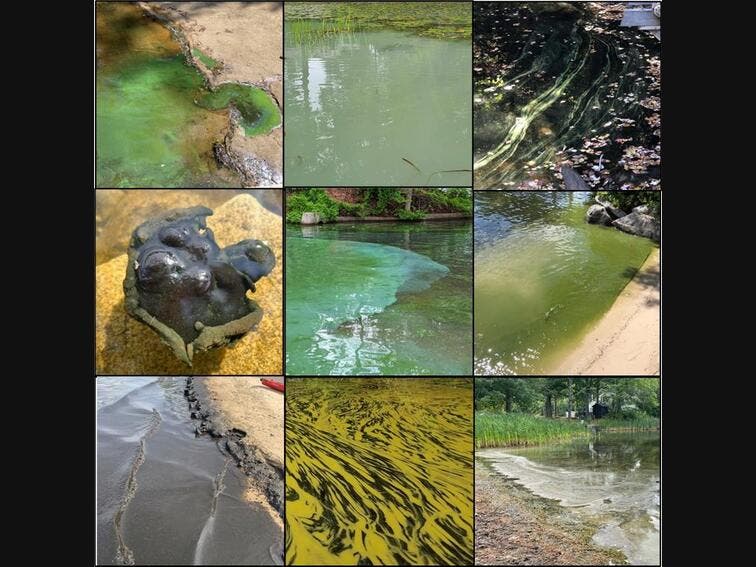
CONCORD, NH — If you are out paddling, swimming, fishing or just near the water this weekend, the state wants to hear from you if you spot a potential cyanobacteria bloom in the water.
There are reports currently being investigated on more than 10 New Hampshire bodies of water, including popular Pawtuckaway State Park, and Lake Winnipesaukee’s Meredith, Wolfeboro and Alton areas.
Find out what's happening in Across New Hampshirefor free with the latest updates from Patch.
While there are no current cyanobacteria warnings as defined by the state Department of Environmental Service’s online swimming mapper https://www.arcgis.com/apps/dashboards/8d84a6b03acb4efaab571b222c78447b# it shows a different picture for both fecal bacteria levels above normal and reports of cyanobacteria blooms.
Current fecal advisories in salt water are for Hampton State Beach, North Beach (The Wall) and in fresh water at Kingston State Beach issued Aug. 5 and White Lake State Park Beach on Aug. 13. The reports for both North Beach and Hampton were made on Aug. 12. In the case of potential cyanobacteria blooms, a spotter at Pawtuckaway photographed streaks or ribbons on the surface of the water with small chunks of bright green looking algae. In Meredith on Aug. 5 the DES confirmed that the photos of a snow globe appearance of a bloom to be gloeotrichia, a form of cyanobacteria.To report anything that looks like this fill out this survey: https://survey123.arcgis.com/share/151c9fc3c8214c2e93325f77e0f1d578.
Find out what's happening in Across New Hampshirefor free with the latest updates from Patch.
Other current cyanobacteria reports being looked into with reports dated are:
- Harris Pond, Pelham Aug. 11
- Keysar Pond, Henniker, July 28
- Long Pond, Henniker, July 31
- Milton Three Ponds, Aug. 5
- Townhouse Pond, Milton, Aug. 5
- Sunrise Lake, Middleton, Aug. 3
- Huntress Pond, Barnstead, July 31
- Upper and Middle Danforth Pond Freedom, Aug. 6 and July 29 respectively
- Northwood Lake, Deerfield Aug. 6
- Sebbins Pond, Bedford, Aug. 11
- Lee Pond, Moultonborough Aug. 11
- Winnipesaukee at Meredith Aug. 3
- Winnipesaukee at Alton Aug. 6
- Winnipesaukee Wolfeboro Aug. 6
- Shellcamp Pond in Gilmanton Aug. 6
- Catamount Pond in Allenstown Aug. 7
- Baptist Pond in Springfield Aug. 7
- Eastman Pond in Grantham, Aug. 8
Cyanobacteria, also known as blue-green algae, are a group of naturally occurring bacteria that when concentrated can make people and pets sick.
According to NHDES, it can look like scum, mats, spilled paint or paint chips. The color of the water can turn blue, green, white, yellow or brownish.“If you notice anything resembling cyanobacteria please refrain from wading, swimming…keep all pets out of the water,” the DES website reads.
Former Gov. Chris Sununu made a point to chastise the state Department of Environmental Services for its website information during an Executive Council meeting in 2024, during a particularly bad summer for cyanobacteria. See story here: https://indepthnh.org/2024/08/30/sununu-blasts-des-on-cyanobacteria-messaging-saying-it-does-not-kill-people/
He said the water was safe and that this “isn’t Amity,” referring to the fictional town in the movie JAWS! where the mayor insists that the shark-infested waters were safe for vacationers. It was just before Labor Day at an Executive Council meeting in Wakefield and there were cyanobacteria warnings for major water bodies where people swim, ski, and dogs play.
Since that time, the DES has changed its website and definitions for warnings and there are far fewer listed, though reported potential bloom reports are present.
The department will go out and sample reported cyanobacteria sightings. When going to the above website, to report a suspected problem, the survey will go directly to your location and ask what water body it is, locate the vantage either by water or shore, describe the sighting and ask you to upload a photograph among other questions.
On the mapper, if you click to a specific water body report it will show the history of reports, the suspected or confirmed type of cyanobacteria and the toxicity level.
A coastal beach advisory is issued if 1 sample exceeds 104 MPN/100 mL. A freshwater beach advisory is issued if 1 sample exceeds 158 MPN/100 mL or 2 samples exceed 88 MPN/100 mL.
Once an advisory is issued, resampling will occur the following day and will continue until the fecal bacteria levels do not exceed the state standard.
Current fecal bacteria advisories and cyanobacteria warnings or reports issued by NHDES are posted and updated on its map daily during the summer months.
“The Healthy Swimming Mapper provides individual cyanobacteria reports that represent a static point in time. It is important to continue to perform a cyanobacteria risk assessment before choosing to recreate as blooms are dynamic and frequently move around a waterbody based upon wind, weather, boat traffic, and lake morphology. NHDES does not close water bodies but does recommend avoiding swimming in water in the vicinity of a bloom,” the website reads.
“The Beach Inspection Program monitors public beaches for the presence of fecal bacteria from Memorial Day through Labor Day. A beach advisory is issued when a water sample contains fecal bacteria levels that exceed the state standard, indicating unhealthy swimming conditions. Enterococci is used as the indicator of fecal bacteria at coastal beaches while E. coli is used at freshwater beaches,” it reads.
“The Cyanobacteria Harmful Algal Bloom Program monitors water bodies when a potential cyanobacteria bloom is reported by a member of the public. A cyanobacteria warning is issued lake-wide when cyanobacteria cell concentrations exceed 70,000 cells/mL at multiple locations. Warnings are not based on toxin evaluation but occur at cyanobacteria cell count densities when toxin production may be likely. These are intended as a precautionary measure for short-term exposure to cyanotoxins.
“When a warning is issued, resampling is performed weekly until the bloom subsides. Warnings are issued from May 15 through October 15,” it reads.
This story was originally published by InDepth NH.