Politics & Government
Shaheen Calls Restructuring U.S. Forest Service A 'Crisis' Meeting With Environmental Leaders
Hassan: President Trump's plan to restructure the service and shutter some of this research threatens public and lands the state's economy.

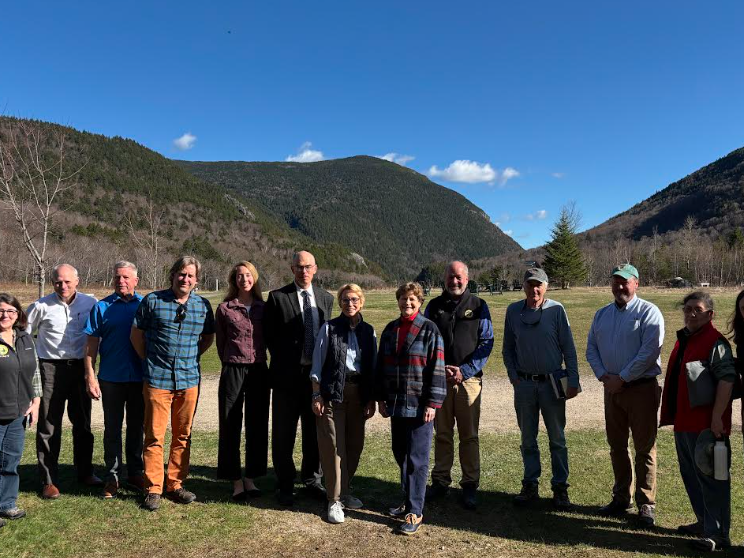
CRAWFORD NOTCH, NH — The reorganization of the U.S. Forest Service, which may include closing the Hubbard Brook Experimental Forest in Thornton, brought environmental leaders together with New Hampshire's two U.S. Senators Friday to talk about the dire situation laid out by the Trump Administration on April 1.
The Trump administration decision to shutter research facilities at New Hampshire’s Bartlett Experimental Forest and “further evaluate” facilities at Hubbard Brook Experimental Forest have raised major concern. Bartlett Experimental Forest has hosted nearly 100 years of research to benefit forest health, timber production, wildlife habitat and outdoor recreation.
Find out what's happening in Across New Hampshirefor free with the latest updates from Patch.
"We're in a crisis situation," said U.S. Sen. Jeanne Shaheen, D-NH. "The only way to respond to it is to get as much exposure as possible" and make a bipartisan argument that this is an important part of the state's economy and health.
Critical research at Bartlett Experimental Forest has informed management of northern hardwood forests in New England for nearly a century, Shaheen said.
Find out what's happening in Across New Hampshirefor free with the latest updates from Patch.
U.S. Sen. Maggie Hassan, D-NH, said: "President Trump’s plan to restructure the Forest Service and shutter some of this research threatens not just New Hampshire’s public lands but also the businesses that help power our state’s economy."
Attending the meeting at the Appalachian Mountain Club Highland Center Friday were officials from that organization, the Nature Conservancy, the Society for the Protection of NH Forests, the NH Timberland Owners Association, The Northern Forest Center, retired forest service officials and Anthea Lavallee, executive director of the Hubbard Brook Research Foundation.
Shaheen said while it is a national issue, "We need to see the governor...this needs to be a state issue...She needs to weigh in to the Administration." Shaheen said this needs to be a bipartisan push to retain these ecosystem study centers.
Patrick Hackley, state forester, said he has met with the Ayotte administration and said there will be an effort to brief Ayotte on the importance of Hubbard and ask her to advocate to the Trump Administration for the retention of the rich research legacy imperiled by these cuts.
Lavallee said research shows that there is a 30 to 1 return on investment due to research being done at these facilities on ecosystem science. "This is a solid good investment," she said.
The Administration announced it would close its research facility at Bartlett and is studying whether to also close Hubbard Brook, which includes about three jobs and another facility called Massabesic in Maine, which is also potentially on the chopping block.
Since 1955, the Hubbard Brook Experimental Forest, in Thornton and North Woodstock, has been a major center for hydrologic research in New England.
Here, they plow areas of snow to see how that would impact wood and water in snowless winters and recreate an ice storm with cold water and hoses on freezing days to study impacts. There is study on insects, climate change, moose habitat and more.
The work at Hubbard led to discoveries of forest decline due to acid rain in the 1980s that have fueled changes to the Clean Air Act.
Environmentalists described it as a proverbial canary in the coal mine. It found evidence of damage caused by smoke stacks in the Ohio Valley and how the wind carried it to damage the environment here with acid rain.
In 1963, researchers there recorded acidity levels nearly 100 times higher than would be expected in the region and the farther west it was tracked the higher the levels. This had negative impact on some aquatic species and forest health.
The evidence and data collected led to amendments to the 1970 Clean Air Act two decades after its passage. The collection of water samples has continued with nearly 30,000 samples and that has helped inform scientists on a number of other issues including those tied to climate change.
Located in the foothills of the White Mountain National Forest and visible on the left as drivers head north on Interstate 93 in the Thornton area, the large bowl-shaped valley is 7,800 acres. It has hilly terrain and can be almost seen as a microclimate.
In 1988 the Hubbard Brook was designated as a Long-Term Ecological Research site by the National Science Foundation.
The present second-growth forest is even-aged and composed of about 80 to 90 percent northern hardwoods and 10 to 20 percent spruce-fir.
The Robert S. Pierce Ecosystem Laboratory located at Hubbard Brook includes six offices, four laboratories, a conference room, six dormitory rooms, and a kitchen, baths, and showers. There is also a sample archive building and maintenance, storage, garage, and shop facilities, according to a U.S.D.A. website.
Experiments at Hubbard Brook, have shown that adding calcium to the soil helps Sugar Maple grow larger and have less winter injury.
Lavallee said this move impacts 80 experimental forests across the country and all of them have some common information that helps inform each other even though they are in different climates.
Jasen Stock, of the NHTOA said "at the end of the day this is a political issue."
He would like to see U.S. Sen. Susan Collins, R-Maine involved because of an imperiled experimental forest, Massabesic, in Maine.
"If we are going to be successful this has to be a political game," Stock said. As much as he hates the idea of the Forest Service being in Utah, that is not as important as saving the experimental forests and the data they continue to collect.
Shaheen said Trump always says the states can take this over, "Well, that's not acceptable."
Tom Wagner, retired supervisor of the White Mountain National Forest, said he feels that the intent is to take the agency apart.
Wagner said moving forest headquarters to Utah from Washington, D.C. will only shift more of the focus onto the West. The administration explains the "sweeping restructuring" of the USDA is to "move leadership closer to the forest and communities it serves."
This article first appeared on InDepthNH.org and is republished here under a Creative Commons license.