Politics & Government
In Tax Day Hearing, Democrats Dismiss NH GOP 'Gimmick' To Ban Income Taxes
New Hampshire Republicans got exactly what they wanted: a parade of Democrats publicly opposing a ban on income taxes in New Hampshire.

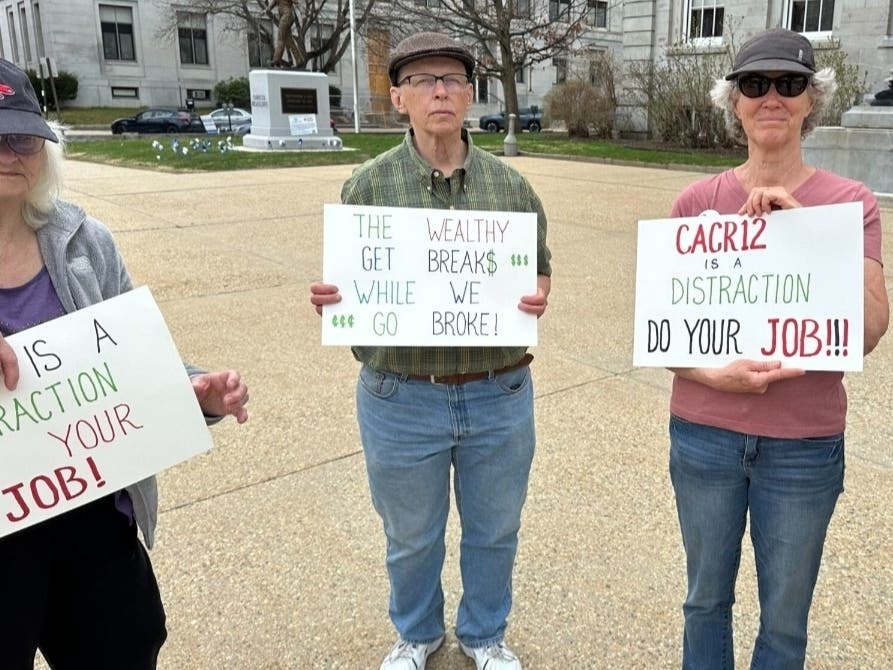
During Wednesday’s Tax Day hearing on a proposed constitutional amendment banning an income tax, Rep. Jonah Wheeler (D-Peterborough) said the legislation “is obviously a gimmick.”
But that doesn’t mean it didn’t work.
Find out what's happening in Across New Hampshirefor free with the latest updates from Patch.
From the handful of protesters outside the State House to the lineup of speakers denouncing the amendment before the House Ways and Means Committee, New Hampshire Republicans got exactly what they wanted: a parade of Democrats publicly opposing a ban on income taxes in New Hampshire.
Senate President Sharon Carson (R-Londonderry) summarized the GOP’s stance in her (extremely) short testimony: “No income tax. Not now, not ever.”
Find out what's happening in Across New Hampshirefor free with the latest updates from Patch.
Speaker of the House Sherman Packard said the legislation should be sent on to the people, the final step in the process of amending the state’s constitution.
“What are we afraid of?” Packard asked. “The people are our bosses. By God, let the people make the decision of whether they want an income tax or not.”
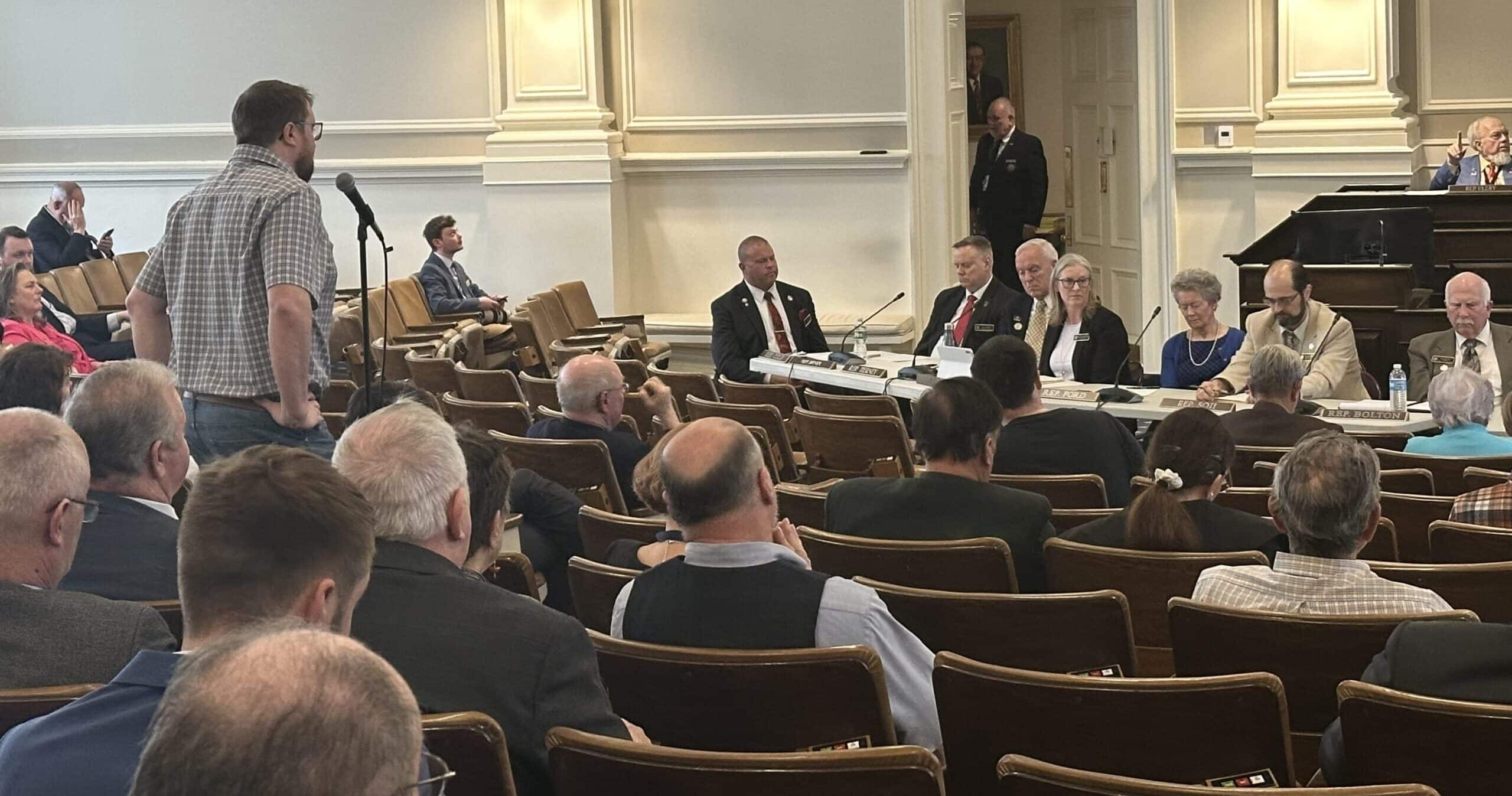 Rep. Ross Berry (R-Weare) testifies before the House Ways and Means Committee on April 15, 2026.
And Rep. Ross Berry (R-Weare) warned House Democrats — who have already voted against the income tax ban once this year — that they won’t be able to talk their way out of this issue.
“While members of the other party can say that they’re against income tax all they want, they’re probably going to vote this down,” Berry said. “There’s going to be a time when this bill comes to the floor, and the excuses are going to be gone. You guys need to pass this.
“Actions speak louder than words,” Berry added.
Democrats had plenty of words on Wednesday, the two most popular being “property taxes.” Speaker after speaker, as well as Democrats on the committee, such as Rep. Thomas Oppel (D-Canaan), argued that the lack of an income tax was the cause of the state’s high property taxes.
Carleigh Beriont, who serves as vice chair of the Hampton Select Board and is also seeking the Democratic nomination in the NH-01 congressional primary, made her party’s case from the social justice perspective: using property taxes instead of income taxes lets affluent taxpayers off the hook.
“New Hampshire ranks 48th in state aid to cities and towns,” Beriont said. “Someone has to pay for a government to function, and right now that someone is working families like mine. Not the wealthiest homeowners, not corporations — working families. Lower-income households pay a far greater share of what they earn in property taxes, and that is by design. It is unfair, it is regressive, and it is unsustainable.”
Oppel, who is advocating the “3-3 Tax Savings Plan” proposed by progressive Andy Volinsky to create a state income tax, also raised the equity issue. He asked Sen. Timothy Lang (R-Sanbornton), who testified on behalf of the amendment, if he was aware of a study “that suggests the lowest 20 percent of wage earners in the state pay three times more of their family income (in property taxes) than the top one percent of the state.”
“I haven’t read that study, I’ll take your word for it,” Lang replied. “But I’ll remind everybody again: New Hampshire is still the third-lowest taxing state in the country. And this burden is not going to help us.”
Lang was referencing a recent analysis from the Tax Foundation. Other rankings put the state’s tax burden even lower.
Many Democrats claimed that New Hampshire’s state government has “downshifted” costs, forcing local officials to raise property taxes for schools and local services. That claim is belied by the fact that state payments to towns and schools have gone up every year since at least 2017, when Gov. Chris Sununu was first elected.
Executive Councilor Karen Liot Hill (D-Lebanon) had a new take on the argument. Instead of blaming recent state funding decisions, she argued that major policy changes in the past — such as the state’s shift away from local pensions and failure to fulfill agreements on revenue sharing for the rooms and meals tax — have created a structural state deficit that’s put local governments behind the property-tax eight-ball.
“By my estimate, roughly $3 billion in costs have been shifted from the state onto local communities in just the last 15 years alone,” Liot Hill said. “That is the reality driving our high property taxes.
“And I do want to say this: I served as a city councilor for 20 years. Local officials are not the cause of this problem. They are the ones managing the consequences of it. So when we hear claims that high property taxes are simply the result of overspending at the local level, that does not reflect the reality on the ground. Now, instead of addressing the root cause, CACR 12 and its amendment take us in the wrong direction.”
But while Liot Hill opposes banning a state income tax, she was also unwilling to admit she supports one, either. Asked directly if she supports an income tax, Liot Hill answered, “That is not what I am here about today.”
Granite State voters have shown, both in polls and at the ballot box, that they overwhelmingly oppose an income tax. And yet Democrats organized opponents to file testimony online and show up at the State House to oppose the ban. The politics are problematic, to say the least.
“I don’t get it,” Gov. Kelly Ayotte said at a press conference Wednesday afternoon.
“The people of this state do not want an income tax. We are very different from our neighbors in terms of our view on fiscal policy: no income tax, no sales tax, no death taxes.
“We’re ranked the number one state for economic opportunity and freedom, and we also happen to be the number one state for the place to raise a family,” Ayotte added. “We are focused on our quality of life, and part of that is no income tax.”
This story was originally published by the NH Journal, an online news publication dedicated to providing fair, unbiased reporting on, and analysis of, political news of interest to New Hampshire. For more stories from the NH Journal, visit NHJournal.com.