Politics & Government
Two Attempts At Budget Caps Fail To Advance In New Hampshire House
Two attempts to impose budget caps on local government spending were turned away Thursday in the House.

CONCORD, NH — Two attempts to impose budget caps on local government spending were turned away Thursday in the House.
One bill would have imposed a statewide spending cap on municipal spending through a constitutional amendment.
Find out what's happening in Across New Hampshirefor free with the latest updates from Patch.
CACR 18 would impose a spending cap for municipalities based on inflation and population up to 2.5 percent. Initially, the cap would be determined by a four-year average increase.
Supporters said the cap is a way to control the upward trend in property taxes that has everyone concerned.
Find out what's happening in Across New Hampshirefor free with the latest updates from Patch.
But opponents said the cap would tie the hands of local officials and remove the flexibility they need to respond to local needs and emergencies.
The proposed constitutional amendment failed to garner the three-fifths majority needed to advance to the Senate with a 170-163 vote in the House.
A constitutional amendment needs a three-fifths majority vote from both the House and the Senate and a two-thirds majority from voters in the next general election to change the constitution.
The House also sent House Bill 1288 to interim study on a 175-164 vote. The bill would allow school district voters to cap the budget of its Supervisory Administrative Unit based on the rate of inflation and the student population.
The House Education Committee had suggested sending the bill to interim study due to the number of issues that needed to be resolved before bringing the proposal forward.
The day before, the House passed House Bill 1300, which would place a cap on the portion of property taxes raised for a school district’s budget and a fixed cap on central office administrative spending.
The question would appear on the ballot during the November general election, and if approved would be in place for the following two years.
The measure passed the House on a 177-160 vote.
But that was not all the House did to put its finger on the scales of local spending.
The House approved three different bills on default budgets in SB 2 towns or official ballot towns with a deliberative session and a separate day for the ballot votes on articles.
One bill would eliminate the default budget. When a town or school district fails to pass a budget option on the warrant ballot, a default budget goes into place, which is based on the current year’s budget with adjustments such as debt service, health-care expenses and labor contracts.
Rep. Diane Pauer, R-Brooklyn, said the bill would put an end to the constant increases in town budgets through the default process.
House Bill 1224 would define a default budget as the prior year’s operating budget, adjusted for debt service, contracts and other legally mandated obligations; reduced by one-time expenditures; reduced by salaries and benefits for eliminated positions; reduced by salaries and benefits for positions vacant prior to the previous year’s budget approval and remaining vacant; and adjusted to reflect the actual salaries and benefits of filled positions as of the public hearing.
The bill also would reduce the budget by one-time expenditures.
And House Bill 1575 would have the town’s or school district’s budget committee determine the default budget, not the selectmen or school board.
Another bill passed by the House, House Bill 1066, would require that long-term leases be put before voters as warrant articles and go through the same process as a bond with a public hearing and a two-thirds majority for approval.
Supporters said the bill would rein in the use of leases to get around the requirements for bond issues.
But opponents said it would tie the hands of selectmen and school boards to deal with capital expenses and emergency needs.
House Bill 1195 would establish statewide municipal zoning requirements for child day care providers, while House Bill 1319 would allow towns, village districts or school districts to adopt or rescind a local fiscal accountability committee.
And House Bill 1526 would change the way towns adopt budget committees and elect members.
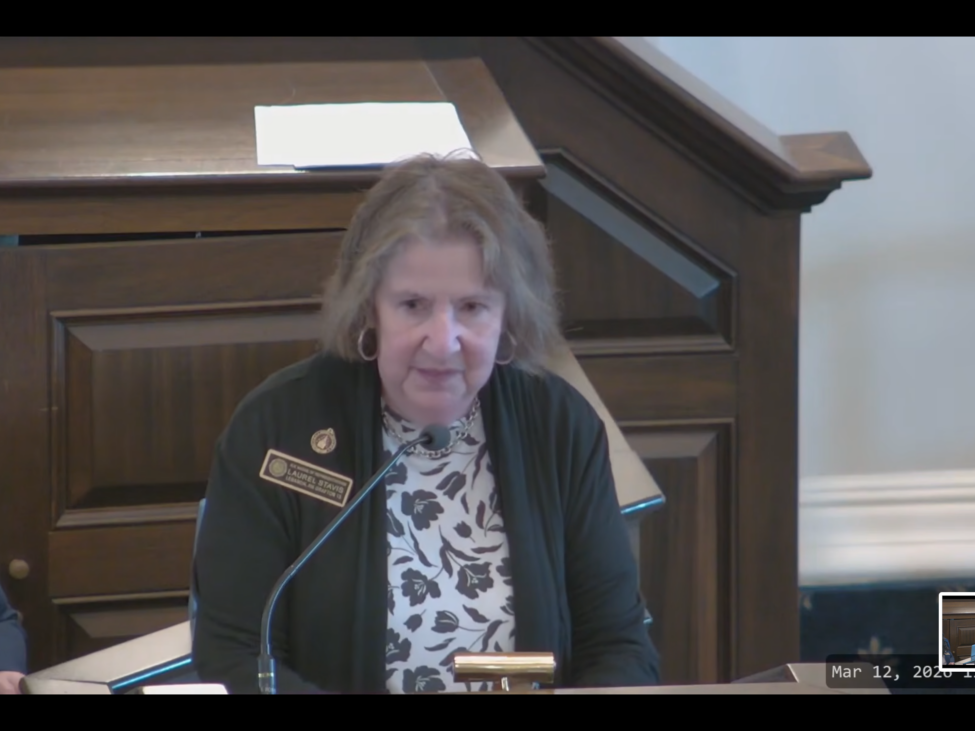
Rep. Laurel Stavis, D-Lebanon, commented on the parade of bills that impacted municipalities approved that day by the House.
“This is yet another barrage of bills intruding on the ability of towns and cities to conduct their business (and deal with their) state and federal mandates,” Stavis said. “It is difficult enough to manage a town or city without these constant recurring attempts to confuse, complicate and otherwise gum up the municipal works.”
And it was not just cities, towns and school districts under the spotlight for the House Thursday – labor also found itself on the receiving end.
The House passed House Bill 1043, which would eliminate the requirement that workers who are called into work outside of normal hours would be guaranteed two hours of pay.
The bill instead would require businesses and employees to negotiate what the payment would be.
“This is not a reduction in worker protections, but rather a shift toward a more adaptable regulatory environment that recognizes the ability of employers and employees to reach mutually beneficial arrangements,” said Rep. Brian Labrie, R-Bedford.
But Rep. Brian Sullivan, D-Grantham, said: “The bill allows an employer to establish a written policy that changes or eliminates the mandatory two hours of pay. This effectively eliminates an important 40-year-old employee right.”
The House also approved House Bill 1072, which would require Department of Labor inspectors to give a business 30-day notice before an inspection. Currently there is no such requirement.
House Bill 1245 establishes a legal framework for a business to set up voluntary portable benefits plans for independent contractors.
The bill would allow a fund to be set up that would be used for benefits to subcontractors.
Opponents said that would make it easier to avoid having to classify the workers for what they really are, which is employees of the business and not independent contractors.
On Wednesday night, labor won when the House indefinitely postponed House Bill 1704, which would have allowed an employee in a collective bargaining unit to individually negotiate with the company for salary and benefits.
Bills and similar content that are indefinitely postponed cannot come back before the House this term.
Garry Rayno may be reached at garry.rayno@yahoo.com.
This article first appeared on InDepthNH.org and is republished here under a Creative Commons license.