Politics & Government
Would Warmington Reject Federal Education Aid—Again?
Beginning Jan. 1, donors to nonprofit K-12 scholarship programs will be eligible for a federal income-tax credit of up to $1,700.

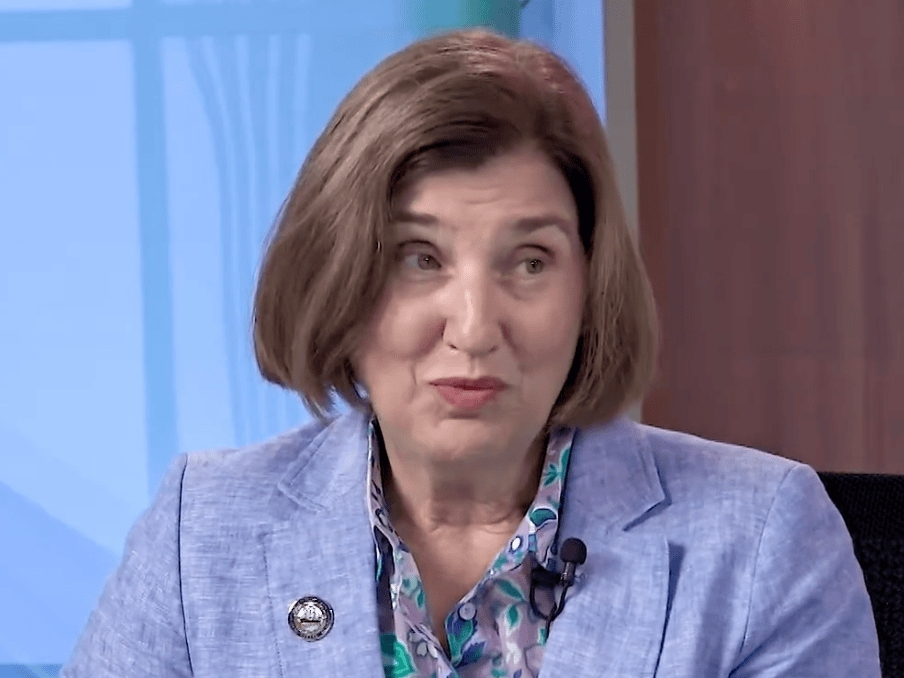
In 2021, then-Executive Councilor Cinde Warmington cast the lone vote against New Hampshire accepting a $10.1 million federal grant to expand charter schools in the state.
The money had previously been rejected by Democratic state legislators, inspiring then-Gov. Chris Sununu to ask, “Who turns down free money for at-risk kids?”
Find out what's happening in Across New Hampshirefor free with the latest updates from Patch.
When Republicans regained control of the State House following the 2020 elections, they reversed the Democrats’ decision and accepted the federal charter-school funding.
Now, the issue of federal support for education choice is back.
Find out what's happening in Across New Hampshirefor free with the latest updates from Patch.
The new federal school-choice tax credit was included in the GOP’s so-called One Big Beautiful Bill, which President Donald Trump signed into law on July 4, 2025. Beginning Jan. 1, 2027, donors to nonprofit K-12 scholarship programs will be eligible for a dollar-for-dollar federal income-tax credit of up to $1,700 annually.
The program is financed through private donations, and no state funds are involved. But states must opt in and submit to the IRS a list of approved scholarship-granting organizations, or SGOs. If a state does not participate, its students cannot receive scholarships funded through the program.
Scholarships can be used for private-school tuition as well as tutoring, classroom supplies, after-school programs and special education services. Students attending public schools are also eligible.
New Hampshire, which already has an Education Freedom Account program, had no hesitation about opting in. Earlier this month, Gov. Kelly Ayotte signed HB 1774, making New Hampshire the only New England state to fully participate in the federal tax-credit program.
“New Hampshire is proud to have some of the best schools in the country, and we’ve made our state an even better place to learn by expanding opportunities for parents to choose the education setting that is best for their child,” Ayotte told NHJournal. “I’m glad our state is able to partner with the federal government to keep growing education freedom and help deliver a best-in-class education for our kids.”
Meanwhile, Maine and Massachusetts — both governed by Democrats — remain on the sidelines. Neither state has opted in, though neither has formally rejected the program.
Massachusetts Gov. Maura Healey, who is running for reelection, has faced pressure from parent groups, education organizations and Republican lawmakers to participate. Her administration has said it is waiting for additional federal guidance before deciding.
Given Healey’s opposition to private-school vouchers and her political alignment with public-school unions, however, advocates acknowledge that persuading her to participate may be an uphill battle.
Corey DeAngelis, a school-choice advocate and research fellow at the Heritage Foundation, told NHJournal the program is “a win for every family and every school that actually wants more resources. Yet states like Massachusetts and Maine are still saying no.
“Meanwhile, two other Democrat governors — Colorado’s Jared Polis and New York’s Kathy Hochul — have already said they’re opting in. They get it.
“This blockade isn’t about protecting kids. It’s about protecting the monopoly,” DeAngelis added.
Children’s Scholarship Fund New Hampshire, which administers the state’s Education Freedom Accounts, told NHJournal that a state’s refusal to participate would also mean fewer opportunities for students who want to remain in public schools.
“This federal tax credit opens up scholarships to those who want to stay in their public schools alongside those who want to seek other options,” said CSF-NH Executive Director Kate Baker Demers. “These funds will be available for use in tutoring, electronics, after-school programs and special education services alongside tuition assistance, which is already offered.”
“There’s a need for families in New Hampshire for this funding,” Demers added.
Under HB 1774, it would take an act of the legislature to withdraw New Hampshire from the program. If Warmington and her fellow Democrats take power in November, will they pull the plug?
Warmington declined to respond to requests for comment, but she has made her position on education choice clear.
She has been a vocal critic of Education Freedom Accounts, which provide grants to parents seeking educational opportunities outside traditional public schools, and has vowed to “nuke” the program.
Warmington’s opposition to school-choice programs has come under fire from critics who note that she sent her children to Tilton Academy, a private boarding school in Tilton that charges approximately $70,000 per year.
“Most of the opponents of school choice either went to private school themselves or sent their own kids to private school,” DeAngelis said. “These Democrats are a bunch of hypocrites owned by the teachers union cartel.”
While Democrats claim Republican education policies have hurt New Hampshire schools, a new WalletHub analysis released Monday ranked New Hampshire’s public school system fourth-best in the nation. The state’s performance included one of the lowest dropout rates and the fourth-highest math scores.
“New Hampshire is proud to have some of the best schools in the country, and this new ranking is a testament to our dedicated teachers, supportive parents and hardworking students who helped make it possible,” Ayotte said.
This story was originally published by the NH Journal, an online news publication dedicated to providing fair, unbiased reporting on, and analysis of, political news of interest to New Hampshire. For more stories from the NH Journal, visit NHJournal.com.