Health & Fitness
Amherst Ways & Means FY14 Budget Analysis and Recommendations
Amherst Ways & Means Committee FY2014 Budget Analysis and Recommendations (as of January 15, 2013)


(Reccomendations as of Jan. 15, 2013)
This year, in its role “to examine and report on all appropriations and expenditures,” the Amherst Ways & Means Committee (W&M) focused on three activities:
- Promoting an integrated planning and budgeting process;
- Aiming for balance and equity in the funding of town departments;
- Helping to inform Amherst citizens about financial issues and tradeoffs.
W&M believes an integrated planning and budgeting process helps to understand the past, envision a desired future, and manage the present to link the two together. Planning addresses where Amherst should be heading, and why. Budgeting – a subset of planning – addresses the ways and means to get there. W&M held meetings with all town department heads, exploring a range of strategic and operational questions. This article outlines the:
Find out what's happening in Amherstfor free with the latest updates from Patch.
- Results of different W&M funding analyses;
- Our recommendations for FY2014 departmental funding – presented to the Board of Selectmen (BoS) in December; and
- Broader planning and budgeting recommendations.
The entire presentation with all charts and graphs is located on the Town website at http://amherstnh.gov/town-budget/.
OverviewThe town budget represents < 20% of the total tax impact on Amherst residents, since the majority of tax impact comes from the funding of the school systems. Nonetheless, the current town budget exceeds $10M and deserves ongoing scrutiny and management. The BoS has worked to keep budgets as flat as possible, asking departments what it will take to preserve core capabilities, as a way to keep costs in line with the wishes of residents during this recessionary period. Used repeatedly, this approach can erode departmental capabilities and quality of services, as certain cost increases (fuel, cost-of-living adjustments {COLAs}, healthcare, etc.) continue to reduce funds available for core services.
Find out what's happening in Amherstfor free with the latest updates from Patch.
W&M conducted three types of analyses:
- Six-years of department funding levels.
- Cumulative impact on department funding and the ability to provide adequate and timely services to residents.
- Specific areas where judicious investment will rebalance equity across departments.
[See attached Figure 1 on the proposed budget for FY2014 as of mid-December 2012.]
From FY2008 to the FY2014 proposed budget, department growth rates have been as follows:
[See attached Figures 2 and 3]
Department heads have been focused on making the most of the budgets they have, but not on strategic planning and communications. As a result, their multi-year plans for replacing equipment such as vehicles are often disrupted by uneven year-to-year decision making by the electorate, in part, due to the lack of a broader context for decision making.
Findings by DepartmentThe following dashboard depicts W&M’s assessment of how well each Amherst department is funded to fulfill its mission.
[See attached Figure 4]
Most departments are well funded in some areas, but underfunded in others. Departments have worked hard to maintain the quality and timeliness of services despite tight budgets but cannot continue to do so without modest-to-moderate investments in key areas.
W&M Budget Recommendations by DepartmentThe following W&M recommendations cover expenditures that were not covered in the proposed town budget at the time of our presentation in December, or have the strong endorsement of W&M even if they were in the budget.
Town Government
Equipment: All departments within this category are working with 10-year-old computers, which should be upgraded. New financial software should be evaluated in FY2013-14 and budgeted for in FY2015. How the $10K consulting fee for evaluating financial software would be used is ambiguous and should be clarified before being expended.
Facilities: Town Hall requires major structural work. The roof supports have rotted, posing safety issues for people using the building. Several large temporary wooden beams are now holding up the roof. But, a workable plan should be created and funded to address these structural and safety issues immediately.
Emergency Medical Services
Staffing: While we believe EMS has the right level of staffing, we, like BoS, feel they are quite underpaid. We endorse the BoS plan to increase salary levels at a cost of about $75,000. We also recommend that funding be through an increase in the budget line item.
Police Department
Staffing: The department should develop a succession plan for the sole administrator in anticipation of her future retirement. The goal would be to provide timely training for her replacement without disrupting operations.
Equipment: While the police have adequate equipment at this time, we recommend that a capital reserve fund be established for critical equipment such as firearms, radios, and light bars.
Facilities: Despite a reference in the Master Plan noting the police station as state-of-the art, we find it far from so. Space on both floors is cramped and inadequate for operations, computer servers, and training. Space issues should be resolved through a broader space utilization plan accommodating Fire, EMS, Police, and Comms Center.
Communications Center
Facilities: The Communications Center is well funded to fulfill its mission, with the exception of appropriate space for housing their communications equipment. The radio communications base and mobile data terminal switch are housed in the unheated attic with inadequate A/C for the hotter months. This equipment should be moved to more hospitable space to prevent damage. This is part of a larger space issue within the shared Police Department building.
Community Development
These groups have been revitalized and have improved the quality and timeliness of service. Besides generating revenue through fees, they help generate new tax dollars by helping bring new development to the town. In some cases, new tax revenue will offset the department’s annual budget.
Equipment: The department should acquire a new plotter/scanner to provide better, more cost effective service. It should also be used to convert the hundreds of paper documents stored in the basement into easily cataloged digital files. Additional cost: $50,000 over two years. This addition of $25,000 for the first year of prioritized digital conversion would bring the budget to $310,661 – an $11,000 increase over the current budget or a 3.7% budget increase – a worthwhile investment in our view.
Facilities: Every effort should be made to balance preserving the character of town hall with the need for Community Development staff to have adequate, private workspace and meeting space for meetings with the public.
Fire department
Overview: Amherst is unique -- one of a handful of NH towns our size that maintains paid-on-call fire personnel. The average fire department budget for a town of 10,000–12,000 citizens is more than double ours. As part of a strategy to maintain a paid-on-call (“volunteer”) model for our Fire Department, we recommend:
Staffing: Keep staffing at current levels or higher to ensure we have adequate coverage. We recommend funding the New Firefighter Wage pay scale ($2,000) and miscellaneous details ($2,000). Also, upon completing EMT training, a firefighter should receive a pay incentive ($1,500).
Training: Besides paying tuition for all mandated training (currently done), the town should fund the budget to compensate for the following training time:
- Driver Training ($2,400/yr)
- Driver Training Instructor Time ($2,800/yr)
- Monthly Training Night ($13,463/yr)
- Monthly Officer Meeting ($2,460/yr)
- Probationary Training Instructors’ Time ($1,120/yr)
- Level 1 Training Pay ($15,960/yr)
- Level 2 Training Pay ($6,300/yr)
We do not recommend compensating firefighters for their time on the following:
- Monthly meetings ($13,463/yr)
- Firefighter Probationary Training ($2,520/yr)
- EMT Training ($6,480/yr)
Equipment: Budget to purchase five SCBA vests annually (instead of eight this year) to ensure the current inventory is in a maintainable/repairable status year after year.
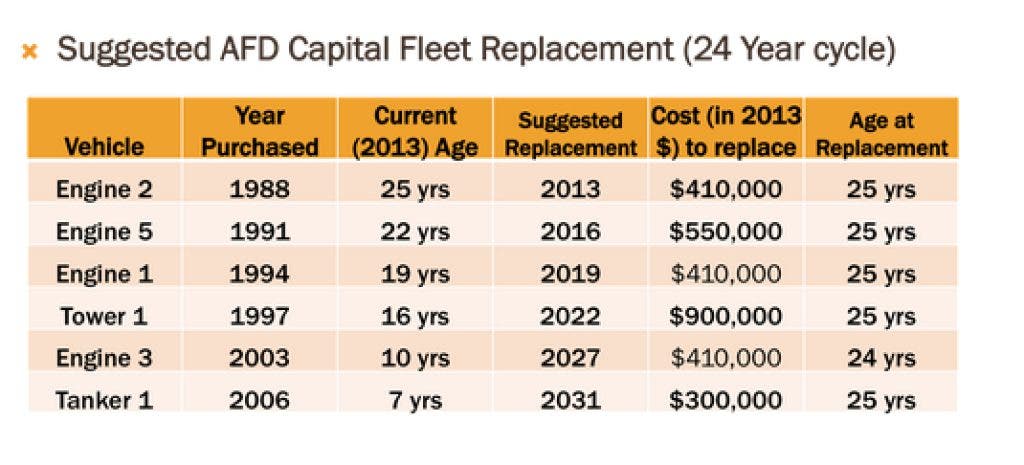
Vehicles: Bid-out the bigger repair work (frame/structure) of the vehicles to someone other than the dealer, which quoted $250,000 for repair on one engine. Develop a Strategic Plan to replace the capital equipment:
- Adjust vehicle age to a maximum of 24 years through scheduled purchases and programmed preventive maintenance.
- Current fleet size and makeup require a yearly contribution to a capital reserve fund for future purchases.
Because the town has not purchased any vehicle since 2006, the desired age of the fleet is skewed:
- Engine 2 is in critical condition due to tank-support frame rust.
- Engine 5 is in an earlier stage of the same rust condition as Engine 2.
- Tower 1 is due for refurbishing but has not been scheduled due to flat budgets.
[See Figure 5]
Incorporate periodic (six-year) preventive maintenance refurbishing service:
- One vehicle per year at 6-, 12-, and 18-year points (one quarter, one half, and three quarters of life span)
- Refurbish one vehicle to be funded as a line item in the budget every year.
[See attached Figure 6]
Addressing rust and deterioration during these service intervals will extend the life of the vehicles, permit new available technological updates to be incorporated (if the budgets allow), and preserve the residual value of each vehicle at time of replacement.
We also recommend adopting a capital fleet Replacement Cycle that gets 24 years out of each vehicle with periodic, planned purchases (see http://amherstnh.gov/town-budget/ for purchase cycles). This would require just under $3 million over 18 years, translating into a $165,555 per year warrant.
[See attached Figure 7]
Department of Public Works
Staffing: DPW should review the staffing needs across all four work seasons to maximize the deployment of DPW staff in accomplishing all required tasks. This should precede the hiring of new staff.
The department should develop a succession plan for the sole administrative assistant in anticipation of her future retirement. The goal would be to provide timely training for her replacement without disrupting operations.
Equipment: Assess all equipment and create a strategic replacement plan that will renew the fleet on a regular basis. Review and update the Capital Improvement Plan.
Facilities: We strongly recommend that the storage facility for DPW vehicles be rebuilt this year (FY2013) using existing materials and labor. We expect that the cost of additional materials will be modest. This will result in significantly increased equipment life and reduced prep time to put that equipment into use in the winter months.
Develop a plan for a wash/rinse station for town vehicles, which may also generate revenue from other towns. Perhaps a near-term solution could be the construction of a waste-water collection tank at the Fire Department’s wash station.
Other recommendations: Increase the Warrant Article this year, or as soon as possible, to $200,000 in order to further increase the annual budget for road repair. While this brings us closer to a realistic amount than in the past, DPW is still underfunded.
Recreation Department
Staffing: Two years ago, the department lost a ½-time position, shifting activities-registration and daily management to others, including the director. We recommend adding a part-time position ($18,000-$24,000) using funds from the revolving account, which will have no tax impact.
Equipment: The 1994 Kubota tractor needs over $5,000 worth of repairs, which is not a cost-effective use of funds. A new Kubota tractor should be leased (total = $30,000 over five years). To do so, the budget line item should be increased by $1,000 to $6,000 to cover the cost. Recreation and DPW should look for ways to coordinate year-round use.
Facilities: The town will lose access to Cemetery Field in 2014. An analysis should be done on how to assimilate programs into remaining fields and the impact on Amherst families. We recommend that Recreation work with other sources to identify potential replacement land. For each potential parcel, a cost/benefit analysis should be done to weigh the benefits, costs and financing alternatives.
The Baboosic Lake playground wall needs repair. An option is to relocate the playground to a place where it will get more use. The cost for doing so would be about $8,000, the same as repairing the wall. We recommend relocation, but in FY2015.
The Spalding Field retaining wall is unsafe, and should be replaced at a cost of $13,000 – funded through an increase in the Recreation budget.
Library
The library is a well-run, well-utilized town institution, and serves as the town’s de facto town center. While it doesn’t yet have a strategic plan, it regularly uses a wealth of metrics to remain responsive to use trends. Currently, it is focused on three long-term initiatives:
- Creating Young Readers: Early Literacy
- Satisfying Curiosity: Lifelong Learning
- Stimulating Imagination: Reading, Viewing and Listening for Pleasure
The library has seven full-time employees and five part-time (excluding pages), and, in our view, is well staffed. This year, to come in at a flat budget, the Library has elected to cut some programs and assets in favor of retaining all their personnel. We would like to see the Library retain their programs and assets. So, should further cuts be necessary in FY2015, we would recommend reducing full-time headcount – possibly converting them to part-time positions or eliminating positions entirely -- in order to retain or enhance programs and materials.
Facilities: The Library staff feels the total square footage of the building is fine but would like to reconfigure the working space to make it more efficient. We think the current configuration is adequate, but a cost estimate for reconfiguration should be part of the Library’s forthcoming strategic plan.
Broader recommendationsPlanning and Budgeting
The town should better integrate strategic and operational planning with budgeting -- planning to identify where the town should go, and budgeting to identify the ways and means to get there. Without both, the process is flawed. We recommend that the BoS take the lead in seeing that these plans are created and used as the ongoing bases for all decision making.
The Amherst Master Plan offers only aspirational direction and no specific goals, but could become a framework for building specific, measurable, achievable, and challenging strategic goals. The BoS should work with the Planning Board on this and also ensure that the Capital Improvement Plan is refreshed and used as an integral part of the process.
BoS should ensure that town departments create and align their respective strategic plans with the town’s strategic plan. Their annual operating plans and budgets should reflect how they expect to advance the broader strategic goals.
We also recommend that BoS take the lead in communicating with and educating the electorate about the strategic context for all BoS and departmental decisions, and why town government should be supported in its efforts to provide high-quality services.
Training and Equipment
Town employees – especially those who put their lives on the line and/or provide life-saving services – should receive the equipment and training required to help them succeed in their jobs. Hence, our support for budget increases in these areas.
Most departments need updated computers. The town should replenish and draw on the computer system capital reserve fund to provide adequate technology to departments.
Stronger Coordination/Integration
The town should investigate the cost/benefits of using centralized/integrated purchasing – not only across town departments, but in combined purchasing with the schools.
There is some duplication of effort and equipment between Amherst Recreation and the schools regarding maintenance of fields and administration of programs. We recommend exploratory discussions between the two to see if there any ways to more cost effectively manage and fund these efforts.
There has been some talk about the merits/drawbacks of combining Fire and EMS while retaining the volunteer/on-call nature and economic benefits of the current model. Some NH towns our size have successfully combined these groups. We recommend a best-practices review of Fire and EMS covering:
- Organizational options (FT, on call, hybrid);
- Personnel staffing levels and skill sets;
- Vehicles and equipment;
- Operational processes (numbers of people, trucks, etc. deployed);
- Space utilization; and
- Economic tradeoffs.
Exploring ways to reconcile space issues for Fire, EMS, Police and Communications should be part of this broader analysis.
ConclusionThe town of Amherst has continued to make selective investments throughout the recessionary period of the past six years. However, where these investments have been made has been uneven. W&M has worked to identify where inequities exist and has recommended actions to rebalance budgets where necessary so that all town departments are funded for success.
Indispensible to this ongoing process is a strategic roadmap for the town – shaped by leaders and citizens alike – that can serve as a touchstone for evaluating departmental plans, budgets and decisions. We hope to see these plans created, maintained, discussed, and used by everyone as the basis for sound decision making in the years ahead.
The Amherst Ways + Means Committee
Bob Brewster (chair), Mike Akillian, Jay Dinkel, Dick LeFebvre, Colleen Lynch, Maggie Paul, Russ Thomas, Paula Troie