Health & Fitness
Amherst Ways & Means Weighs in on Warrant Articles
Amherst Ways & Means Offers Their Views on the FY 2014 Warrant Articles
This year, the Amherst Ways & Means Committee (W&M) worked closely with department heads to review funding levels required to ensure that citizens receive the most cost effective services. W&M believes the FY2014 proposed warrant articles collectively reflect a sensible approach to doing that.
Making Prudent and Timely Investments
Every department head has been charged to provide the best services possible with the funds allocated by the taxpayers. One department is no more or less important than any other. Each has its own unique contribution to the overall well being of our town. While some are more popular than others, all are needed.
Operating consistently on a flat or default budget is not desirable, because it is more costly for the town in the long run; for example, it doesn’t provide for the proper maintenance of our infrastructure. The Public Works Department is a good example. Roads, bridges, and buildings all continue to age and require constant attention. The longer they are allowed to deteriorate, the more costly to repair.
Find out what's happening in Amherstfor free with the latest updates from Patch.
Even expensive items, such as a fire truck, have a life expectancy. A department head cannot budget as a line item funds for future purchases, because all funds not expended during the current budget cycle must be returned to the General Fund. This is why it is prudent to approve capital reserve funds each year.
Warrant Article Positions
W&M’s position on each of the town warrant articles is listed below. (Vote counts are listed in the following sequence: for, opposed, abstained.)
Find out what's happening in Amherstfor free with the latest updates from Patch.
Article 22: Operating Budget 7-0-0
All changes that W&M recommended to the BoS have been incorporated into the FY2014 budget and will help in the rebalancing the appropriate funding of departments. These changes will have a minimal tax impact on Amherst residents. The increase has been estimated to $0.23 per thousand, or approximately a $75.00 increase over last year's taxes for the average $325,000 home in Amherst. That equates to a $6.25 / month increase.
Some citizens have also looked at the town budget and asked about the Road Maintenance line item for the Department of Public Works (DPW), and they have compared that with the $15 million road bond that was approved a few years ago. Please keep in mind that the road bond was designed to repair or reconstruct certain sections of certain roads within the town. The remaining sections on the remaining roads will be maintained through the Road Maintenance line-item within the DPW budget. A few years ago, it was determined by an outside committee that, to “keep our good roads in good condition,” the town needed to spend approximately $1.2 million per year on road maintenance. With the addition of the voter approved $200,000 from last year’s Warrant Article, this amount in the FY2014 budget is closer to that goal, but it is still under $1.0 million.
Article 23: Town Hall Structural Repair 7-0-0
The need to repair the structural deficiencies of the town hall is real and present. This warrant is the second time the town has tried to gain approval by the voters to fix identified structural problems. Today, the problems are worse because of the delay in attending to them. We strongly urge that this article pass so as not to further jeopardize the integrity of the historic structure or personal safety.
Article 24: Appropriation of Previously Collected Land Use Change Tax Funds and Deposit To Town Hall Structural Repair Fund 7-0-0
We endorse the transfer and use of the $87,000 in this fund to help defray the repair costs to town hall.
Article 25: Police Union Contract – Single Year Contract 7-0-0
The Amherst Police Department bargaining unit made the town a very generous offer this year. In an effort to keep their costs down, they volunteered to give up their cost of living (COLA) adjustment, enabling the police budget to come in virtually flat even though it will result in a net-pay decrease for some of the officers as they assume a greater portion of their employment expenses.
The total cost of Article 25 is $0.01 per thousand or $3.25 per year for an average ($325,000) house. An added benefit of their forgoing a COLA was that it only made it fair that the BoS extend the same treatment to the rest of the town employees. This resulted in a significant savings for the taxpayers during tough economic times.
Article 26: Special Meeting 7-0-0
Article 27: Assessing Revaluation Capital Reserve Fund 7-0-0
W&M endorses the idea of using capital reserve funds to save incrementally for anticipated future expenses.
Article 28: Communication Center Capital Reserve Fund 7-0-0
Article 29: Computer System Capital Reserve Funds 7-0-0
Article 30: Forestview Cemetery Capital Reserve Fund 5-1-1
W&M supports this capital reserve article. One member would have preferred to have a cost estimate for the project against which to set an annual reserve.
Article 31: Replacement of Fire Engine 7-0-0
Amherst enjoys a significant cost benefit because of the volunteer nature of our Fire Department. Since part-time firefighters are only paid when on call, taxpayers only pay a fraction of what they would if we had a full time department. However, our fire trucks and rescue gear must be available full-time and always in workable condition.
The size and deployment of our fleet of fire fighting vehicles is not arbitrary. The requirements are specified in a document titled “Fire Suppression Rating Schedule”. (http://www.iso.com/Products/Public-Protection-Classification-Service/Fire-Suppression-Rating-Schedule-FSRS-manual-for-PPC-grading.html ). Among other things, the schedule states that a structure has to be within 1,000 feet of a fire hydrant or within five miles of a fire station (this is why Amherst has two fire stations and four engines). It also sets requirements for the amount of water that must be pumped at a site, and that amount is directly related to the number of pumps (fire engines) that we can deploy. Less pumps mean less water.
The ISO (Insurance Services Office www.iso.com ) rates the town’s ability to fight fires as prescribed in its manual. Insurance companies then use this rating to set premiums for residential and commercial fire insurance coverage. Simply put, a lower rating costs us all more for insurance.
The out-of-pocket cost to taxpayers for Article 31 will be $260,000 (with the remaining $150,000 coming from the capital reserve fund). This equates to $4.60 per month for the average house in Amherst. W&M recommends that the taxpayers save some money and buy the new truck instead of paying more for their insurance.
The manufacturer’s designed life for our fire trucks is 20 years. Because of the way we use them and the way that our volunteers take care of them, we have historically extended that life. Replacement, however, is inevitable. Sooner or later, the old equipment costs more to keep in service, loses all residual value, and suffers from the lack of technological upgrades (anti-skid brakes, traction control, etc). We should be providing quality equipment to the volunteers who protect us.
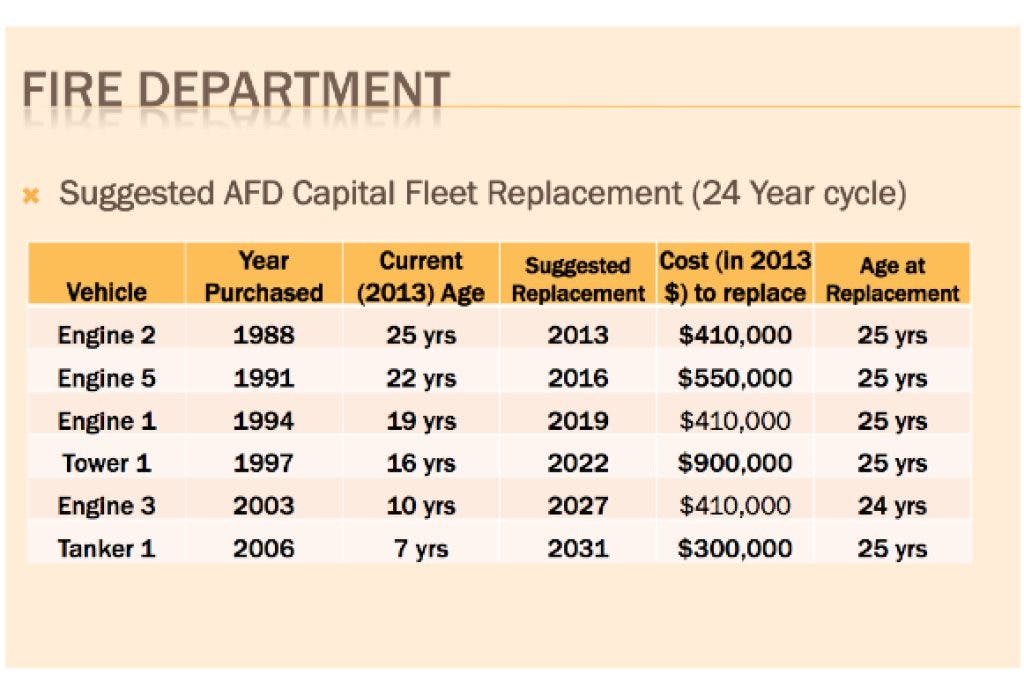
Since the total cost of our fleet is almost $3 million, the replacement process must be managed in a thoughtful manner. With a fleet of six capital vehicles with an average maximum age of 24 years, we should be purchasing a new vehicle every four years. Not purchasing a new vehicle for the past six years has skewed the desired age line of our fleet. W&M submitted a schedule to the BoS to correct that problem. (see http://amherstnh.gov/wp-content/uploads/2010/09/BoS-Presentation-Display.pdf slides 35-41).
(See Figure 1 for an excerpt from that presentation showing how we can get back on schedule.)
This strategic fleet management schedule requires a contribution of $165,500 per year to the Fire Apparatus Capital Reserve Fund. That works out to just $35 per year on the average $325,000 house. For less than $3.00 per month, Amherst can deploy a first rate fleet of fire fighting vehicles and avoid an increase in our fire insurance premiums. W&M supports the purchase of the fire truck listed in this warrant as part of implementing this sensible fleet management strategy.
Article 32: Fire Apparatus Capital Reserve Fund 7-0-0
W&M hopes that Article 31 passes, thus obviating the need for this article this year.
Article 33: Ambulance Capital Reserve Fund 7-0-0
Article 34: Public Health Mosquito Surveillance and Control Program 7-0-0
Article 35: Discontinue Capital Reserve Funds 7-0-0
Conclusion
Some may find fault with the budget as presented. However, during the deliberative session, no one proposed a single change to the dollar amounts requested. Another default budget, we believe, will put us further behind in our obligations and add to greater future expenses.
We recognize that some citizens may be displeased with some recent actions of the BoS, and may be inclined to vote NO on one or more article to voice their displeasure. W&M wants to emphasize that the budget citizens vote for on Election Day is their budget, not the selectmen’s budget. We believe this budget and the services it is slated to finance for all Amherst citizens in the coming year to be prudent and well crafted. We hope citizens support it.
The Amherst Ways & Means Committee
Bob Brewster (chair), Mike Akillian, Jay Dinkel, Dick LeFebvre, Colleen Lynch, Maggie Paul, Russ Thomas, Paula Troie