Community Corner
Gold Award Girl Scout Works To Save Bats From Extinction
Amanda Fulton of Amherst earned Girl Scouting's highest honor with her project to provide safe spaces for bats.

Press release from Girl Scouts:
Nov. 10, 2021
In less than 10 years, a fungus causing white-nose syndrome has killed more than 90 percent of three North American bat species, according to the U.S. Geological Survey. Saving and propagating the few that are left is so important to Gold Award Girl Scout Amanda Fulton that she gave more than 90 hours of her time to build and distribute bat boxes and educate the public on the issue.
Find out what's happening in Amherstfor free with the latest updates from Patch.
Fulton, 17, of Amherst, is a senior at Souhegan High School and a Girl Scout Ambassador who earned Girl Scouting’s highest honor, the Gold Award, for her work to save these crucial members of the food web.
“Bats are cute!” said Fulton, who’s had a lifelong fascination with the animals. “Bats in the western world are very misunderstood. They are really good for the environment. They pollinate plants. They don’t spread disease any more than any other animal.”
Find out what's happening in Amherstfor free with the latest updates from Patch.
Since the day she was a Brownie watching older Girl Scouts get their Gold Award, she has wanted to reach that highest honor herself, and said she always thought doing something for the environment would be her topic. Knowing how endangered bats are, she set out to help bats locally. Her project, “Helping Bats and Educating Communities,” encompassed two big efforts: building and hanging bat boxes and making presentations to local communities to educate people on the how to help bats revive.
Not only is white-nose syndrome killing bats, she said, so is habitat destruction, deforestation, climate change, and wind-powered energy.
“Having varied roosting habitats helps to slow the spread of white-nose syndrome,” she said, “as well as gives bats safe places to rest. I also made it clear on my website and infographic how and where people could donate to help the research into white-nose syndrome.”
You can see her website at https://amandafulton4.wixsite.com/website
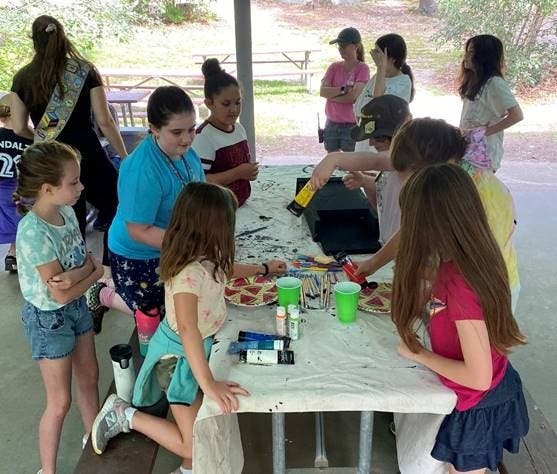
Ultimately, Fulton was able to present her work to more than 100 people in New Boston and Mont Vernon, including to Girl Scout day campers in Bedford who helped make bat boxes. She distributed brochures in Amherst, New Boston, and Mont Vernon, and did outreach online. She placed three bat boxes in New Boston and provided three more to the New Boston Forestry Commission to replace worn boxes or simply mount them on tree.
Her project advisor, Tom Miller of the New Boston Forestry Commission promised to keep an eye on the bat boxes. “Anything we can do for the declining bat population has got to help,” he said.
Fulton has been in Girl Scouts since she was 6 years old. She said she likes doing service projects and particularly enjoyed helping with the Nashua Children’s Home. Being high-achieving by nature, she wanted to keep going through the entire Girl Scout program, and encouraged other girls to go for the Gold Award.
“It’s easier than it looks on paper,” she said. “When you pick something you actually care about, it seems like it goes pretty fast. It’s gratifying when you reach the end and make a difference.”
At school, Fulton is a varsity cross-country skier, a New Hampshire Scholar with a distinction in arts, is in the National Honor Society and Spanish National Honor Society. She’s currently applying to colleges, planning to major in international or global affairs. Her dream job would be working at the United Nations or an international embassy.
This press release was produced by Girl Scouts. The views expressed here are the author's own.