Politics & Government
Berry: We Lost. It Sucks. Now What?
Outgoing Weare GOP state Rep: We need to build a larger coalition, not fight over which faction gets to control a smaller one.

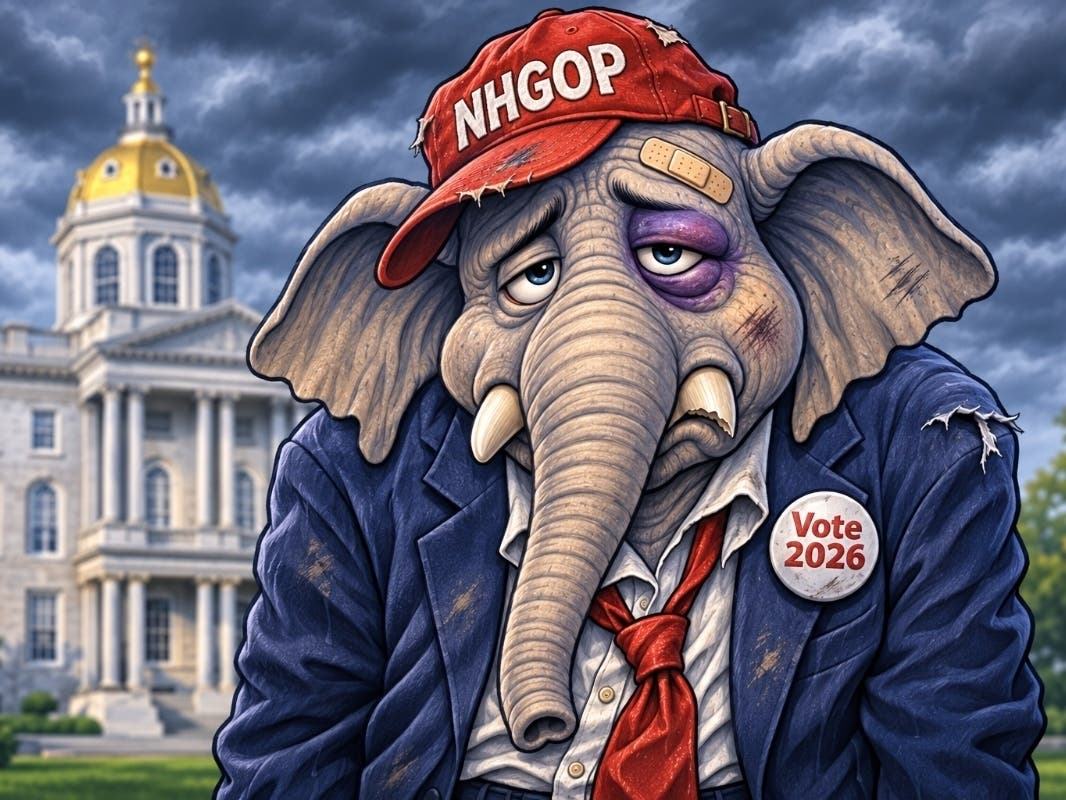
There is no way to sugarcoat what happened Tuesday night.
New Hampshire Republicans got our teeth kicked in. We lost seats, lost colleagues, and watched voters who agreed with us on major policy questions turn around and vote us out of office. I was one of them. After six years serving in the New Hampshire House, including the last two representing Weare and Goffstown, I lost my own reelection bid. It sucks. There is no other way to put it.
Find out what's happening in Bedfordfor free with the latest updates from Patch.
Losing is part of politics, and after six years in Concord, I certainly understand that voters have the final say. But losing this badly demands some serious reflection about where our party stands, how voters perceive us, and what we need to do differently. Republicans can either learn from Tuesday’s results or spend the next two years convincing ourselves that nothing needs to change. I have no interest in the latter.
I do not believe Tuesday was a repudiation of conservative policies. In fact, I think the results suggest quite the opposite.
Find out what's happening in Bedfordfor free with the latest updates from Patch.
Consider what happened in Goffstown, one of the two towns I represent. Two years ago, I won the town convincingly. This year, 63% of Goffstown voters supported the property tax cap I authored and fought to put on the ballot. Yet I lost my reelection bid in that same town by roughly 900 votes.
I spent two years fighting to give taxpayers more control over their property taxes, delivered the legislation that made it possible, and watched nearly two-thirds of my town support it. Then I got the axe anyway.
Why?
I believe the answer has less to do with the policies Republicans delivered and more to do with what the Republican Party has come to represent in voters’ minds. The results in Goffstown illustrate a problem that Republicans need to take seriously. Voters can agree with us on major issues, support the legislation we pass, and still decide they do not want us representing them. We cannot simply dismiss that contradiction because we happen to like our own policies.
For better or worse, the Republican brand has become inseparable from Donald Trump. I know that observation will upset some Republicans, but pretending otherwise will not make it any less true.
Trump fundamentally changed our party in 2016, and in many ways, that change was necessary. He brought millions of working-class voters into the Republican coalition who had spent generations voting for Democrats. He challenged a political establishment that had become increasingly disconnected from the people it claimed to represent.
That realignment was one of the most consequential political developments of my lifetime, and Republicans would be fools to abandon it.
But there is another side to that equation. While we gained working-class voters, we lost others. Some were traditional Republicans, some were independents, and some were people who agreed with us on taxes, spending, education and public safety but simply could not bring themselves to vote for candidates carrying the Republican label.
Tuesday demonstrated just how expensive that problem has become.
One of the few features of our much-maligned two-party system that actually works is its ability to force political realignment. Parties are not permanent coalitions of the same voters holding the same opinions forever. They evolve, expand, contract, and occasionally reinvent themselves in response to the electorate.
Republicans did exactly that in 2016. Democrats have done it throughout their history as well. Parties that refuse to adapt eventually find themselves on the losing end of elections, no matter how convinced they are their policies are correct.
Now it is our turn again.
The challenge facing Republicans is considerably more complicated than simply returning to the pre-Trump Republican Party. That party had its own problems, which is precisely why Trump was able to transform it in the first place. We cannot abandon the blue-collar voters who joined our coalition, nor should we want to. Working families who care about the cost of living, public safety, and whether their children have opportunities to succeed belong in the Republican Party.
But we also need to figure out how to bring back the voters we have driven away.
That means understanding that winning an argument on policy does not automatically translate into winning an election. It means recognizing that voters can agree with us on property taxes and still dislike what they believe our party represents. It means accepting that our national political brand has consequences for Republicans running for the New Hampshire House, even when those candidates have spent their time focused on local issues.
Most importantly, it means being willing to change something.
I am not suggesting we abandon our principles, moderate every position, or start chasing whatever happens to be popular this week. Quite the opposite. Republicans have a strong record to defend on taxes, education freedom, election integrity, and public safety. Those are issues worth fighting for, and I have no intention of backing away from them simply because I lost an election.
But principles and political strategy are not the same thing. If voters support our policies but refuse to elect us, insisting that we simply repeat ourselves louder is not a serious plan for regaining a majority.
There will undoubtedly be Republicans who read this and conclude that the answer is to double down on everything. There will be others who believe the solution is to purge the party of anything associated with Trump. I believe both approaches fundamentally misunderstand the problem.
We need to build a larger coalition, not fight over which faction gets to control a smaller one.
I am proud of what Republicans accomplished in Concord, and I am frustrated that so many good legislators who helped deliver those accomplishments will not be returning. I am disappointed that I will not be among those returning either. But voters owe us nothing, regardless of how hard we worked or how good we believe our record to be. Elections are not participation trophies, and the voters have rendered their verdict.
I lost. My party lost. It sucks. Now we have a choice. We can spend the next two years arguing about whose fault it was, or we can do the much harder work of figuring out how to earn back the trust of voters who agree with us but no longer want to vote for us. Losing an election does not mean I am done fighting for the things I believe in, but it does mean I have an obligation to learn something from it. I hope my fellow Republicans feel the same way.
As for me, after six years in Concord, I am looking forward to spending more time with my young family, who have sacrificed more than their fair share while I served in the House. With Thanksgiving just around the corner, that is something I am genuinely thankful for. The other thing I am thankful for is Gov. Kelly Ayotte’s veto pen, which I suspect is about to become the hardest-working pen in New Hampshire.
Ross Berry is the former GOP chairman of the New Hampshire House Election Law Committee. He wrote this for NHJournal.com.
This story was originally published by the NH Journal, an online news publication dedicated to providing fair, unbiased reporting on, and analysis of, political news of interest to New Hampshire. For more stories from the NH Journal, visit NHJournal.com.